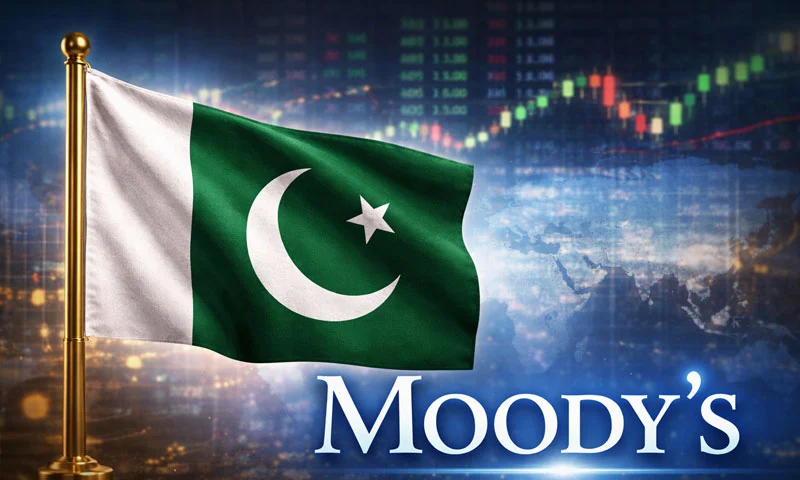
Global credit rating agency Moody’s Investors Service has revised its outlook on Pakistan’s banking sector from positive to stable, highlighting the country’s gradually recovering economy and more balanced fiscal and external positions. The move comes amid broader improvements in economic indicators but also underscores ongoing challenges facing Pakistan’s financial system.
In its February 2026 update, Moody’s said that the banking sector’s operating environment continues to recover, but the improvement is cautious and incremental rather than rapid. “We have changed our outlook on Pakistan’s banking system to stable from positive,” Moody’s said, signalling a less optimistic trajectory than before.
Moody’s forecasted real GDP growth of about 3.5 percent in 2026, an improvement from 3.1 percent in 2025, supported by ongoing structural reforms and easing macroeconomic pressures. Despite this, the agency noted that financial performance will likely remain stable but not robust, as banks still face stress from asset quality issues and profitability constraints.
Why the Change Matters
The shift from positive to stable outlook does not indicate a downgrade in rating, but it means that Moody’s now perceives less acceleration in economic momentum and greater uncertainty about rapid improvement. A positive outlook suggests that future upgrades are more likely, while a stable outlook implies that the current assessment is expected to remain steady over the next one to two years.
Moody’s highlighted the close link between banks and the government since Pakistani banks hold a large share of government securities, which are sensitive to the sovereign’s credit strength. Any stress in public finances could therefore directly affect the financial sector’s performance.
Economic Context
The revised outlook comes against a backdrop of gradual macroeconomic stabilization after years of crisis. Pakistan endured a severe economic downturn from 2021 to 2024, marked by high inflation, currency depreciation, and shrinking foreign exchange reserves. By mid-2025, inflation had slowed significantly from double-digit peaks, and GDP growth returned to positive territory thanks to a combination of monetary easing and structural reforms.
Despite these gains, persistent fiscal vulnerabilities and external pressures have restrained more optimistic projections. According to data from the State Bank of Pakistan, the country continued to record a current account deficit in late 2025 and early 2026, and foreign direct investment remained subdued.
What Experts Say
Economists say Moody’s shift reflects a cautious but realistic assessment of Pakistan’s economic trajectory. Komal Kenneth Shakeel, an economist and Head of Partnerships at Ignite, described the move by Moody’s not as a downgrade cycle but as “a signal that volatility has eased without a strong growth push behind it.” That, she added, means the banking sector is expected to perform steadily but not expand rapidly unless structural reforms gain momentum.
Financial analysts emphasise that a stable outlook still offers comfort compared with a negative outlook, which signals deterioration. Stable conditions can help maintain investor confidence, drawing some capital flows and encouraging banks to strengthen their balance sheets.
Importance for Pakistan’s Economy
Moody’s assessment is significant for Pakistan’s broader economy. The banking sector plays a central role in financing private investment, supporting business activity, and underpinning confidence in financial markets. A stable outlook may help contain borrowing costs and prevent sudden capital outflows, even if it does not immediately unlock cheaper credit or a surge in foreign investment.
In a global context where emerging markets compete for investor attention, maintaining a stable rating outlook can reduce the risk of sudden market volatility. Economists say that continued compliance with international financial programmes, including the International Monetary Fund (IMF) Extended Fund Facility, will be essential to bolster sentiment and potentially move the outlook back to positive or higher in the future.