The National Highway Authority has announced a fresh increase in toll tax on highways and major motorways across Pakistan, with revised rates coming into effect from April 5. The move marks the second hike this year and is expected to significantly increase travel costs for both private motorists and commercial transporters.
New Toll Rates Announced
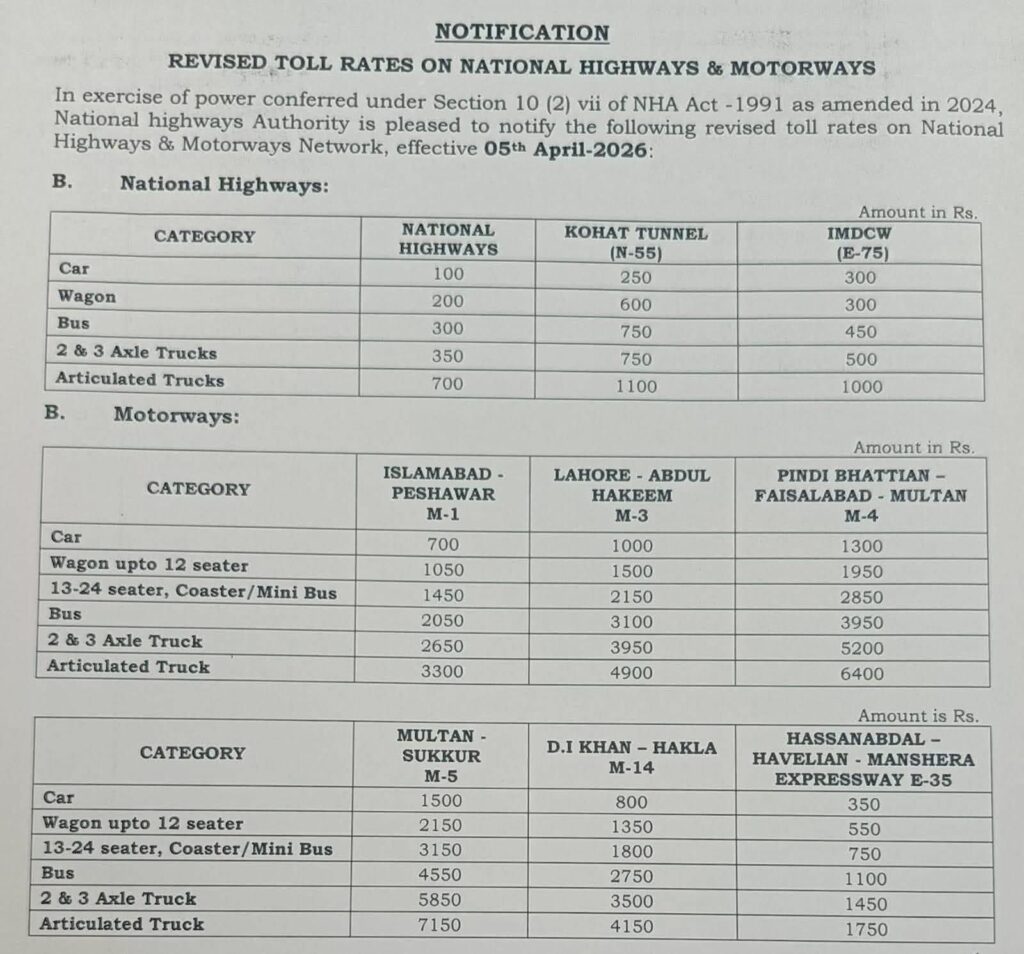
Under the revised notification, toll charges for cars on national highways have been set at Rs100, while the toll at the Kohat Tunnel has increased to Rs250.
Major increases have also been implemented on key motorways:
- Islamabad to Peshawar M-1 motorway toll for cars raised to Rs700
- Lahore to Abdul Hakeem M-3 motorway increased from Rs800 to Rs1,000
- Pindi Bhattian to Faisalabad to Multan M-4 motorway increased from Rs1,050 to Rs1,300
- Multan to Sukkur M-5 motorway raised from Rs1,200 to Rs1,500
- Dera Ismail Khan to Hakla M-14 motorway increased from Rs650 to Rs800
- Hassan Abdal to Havelian to Mansehra E-35 motorway increased from Rs300 to Rs350
For heavy vehicles, toll charges have also surged significantly, with some routes exceeding Rs7,000 for large trucks.
Second Hike This Year
This increase marks the second revision in toll taxes in 2026, reflecting a continuing trend of rising road usage charges.
Officials have linked these periodic increases to the cost of maintaining and expanding Pakistan’s highway and motorway network, which requires substantial funding due to rising construction and operational expenses.
Read More: Fuel Crisis Deepens in Pakistan: Petrol, Diesel Hike Expected as LPG Prices Jump 34%
Immediate Impact on Commuters
The toll hike will directly affect daily commuters and long-distance travelers.
For a car traveling between Lahore and Multan on the M-4 motorway, the toll has increased by Rs250 per trip. Frequent travelers could see monthly travel costs rise by thousands of rupees.
Intercity commuters, particularly those who travel for work or business, will feel the impact immediately as travel becomes more expensive.
Transport Costs Likely to Rise
The biggest impact is expected in the transport sector.
Bus operators, goods transporters and logistics companies are likely to pass on the increased toll costs to passengers and customers.
This could lead to:
- Higher bus fares on intercity routes
- Increased freight charges
- Higher delivery costs for businesses
Transporters have historically adjusted fares quickly after such increases, meaning passengers could see higher ticket prices within days.
Read More: Fuel Prices Surge, Expenses Rise: How to Save Money in Tough Times
Ripple Effect on Prices of Goods
The toll hike, combined with already rising fuel prices, could further push inflation upward.
Goods transported via highways, including food, construction materials and industrial supplies, will become more expensive to move.
As a result:
- Prices of vegetables and fruits transported from rural areas may rise
- Essential goods could see incremental price increases
- Supply chains may become more costly and less efficient
This creates a compounded effect where both fuel and toll increases contribute to higher living costs.
Pressure on Businesses and Economy
Businesses that rely heavily on road transport, including logistics firms, retailers and manufacturers, will face increased operational costs.
Small and medium enterprises may struggle to absorb these costs, forcing them to either increase prices or reduce margins.
Economists warn that repeated increases in transport-related costs can slow economic activity and reduce competitiveness.
Infrastructure Funding vs Public Burden
While the NHA maintains that toll increases are necessary to sustain infrastructure development and maintenance, critics argue that the growing financial burden on the public is becoming unsustainable.
The authority has emphasised that improved road quality and expansion projects require consistent funding, but commuters are increasingly questioning the frequency of price hikes.
A Growing Cost of Mobility
With fuel prices already at record highs and now toll taxes increasing again, the overall cost of mobility in Pakistan is rising sharply.
For ordinary citizens, this means more expensive travel, higher cost of goods and reduced affordability.
The combined effect of fuel and toll increases is expected to remain a key economic concern in the coming months.