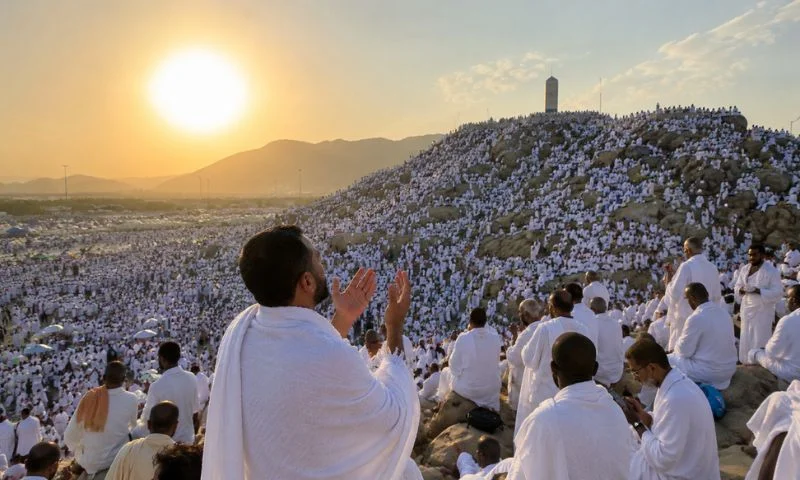
More than 1.5 million Muslim pilgrims gathered on the Plain of Arafat on Tuesday for the climax of Hajj 2026, enduring soaring desert temperatures as they prayed, recited Quranic verses, and sought forgiveness on Islam’s holiest day of pilgrimage.
From before sunrise, streams of white-robed pilgrims moved toward Mount Arafat, also known as Jabal al-Rahmah or the Mount of Mercy, where Prophet Muhammad (Peace Be Upon Him) delivered his final sermon more than 1,400 years ago.
The Day of Arafah, observed on the ninth day of Dhu Al-Hijjah, represents the spiritual peak of Hajj and is considered the most important stage of the annual pilgrimage.
Saudi authorities said pilgrims remained within the marked boundaries of Arafat from sunrise until sunset, engaging in Talbiyah, supplications, remembrance, and recitation of the Quran in an atmosphere of devotion and tranquility.
“At dawn on the ninth day of Dhu Al-Hijjah, pilgrims gather at the Plain of Arafat, where they remain from sunrise until sunset, engaging in Talbiyah, remembrance, and supplication,” the Saudi Press Agency reported.
At noon, scholars delivered the annual Arafah sermon before pilgrims performed combined and shortened Dhuhr and Asr prayers in accordance with the Sunnah of Prophet Muhammad (Peace Be Upon Him).
Extreme Heat Challenges Pilgrims
The pilgrimage unfolded under punishing temperatures that approached 40 degrees Celsius at Arafat and climbed as high as 44 degrees in nearby Mecca earlier in the week.
Saudi officials repeatedly urged pilgrims to remain hydrated, avoid prolonged exposure to direct sunlight, and use shaded pathways and cooling stations installed across the holy sites.
The Kingdom has expanded heat mitigation measures following last year’s deadly heatwave during Hajj. Authorities introduced additional misting fans, water distribution points, mobile cooling units, and shaded rest areas this season.
Despite the regional instability created by the ongoing US and Israeli conflict with Iran, pilgrims from around the world continued arriving in Saudi Arabia to fulfill one of Islam’s five pillars.
Iran’s official IRNA news agency said more than 30,000 Iranian pilgrims participated this year, significantly lower than the 86,000 initially expected.
The agency attributed the decline to the “wartime situation” in the Middle East.
Pilgrims Prepare for Muzdalifah Journey
As sunset approached, pilgrims prepared to leave Arafat and head toward Muzdalifah, where they would perform combined Maghrib and Isha prayers before spending the night in worship and collecting pebbles for the symbolic stoning ritual in Mina.
Throughout the day, helicopters monitored crowd movement from above while thousands of security personnel, medical workers, and volunteers coordinated one of the world’s largest annual religious gatherings.
Saudi Arabia has invested heavily in crowd management systems, transport infrastructure, and healthcare facilities in recent years as part of wider efforts to improve pilgrim safety and operational efficiency.
As the sun began to set over Arafat’s rocky hills, pilgrims raised their hands in prayer in a deeply emotional scene repeated every year by Muslims seeking spiritual renewal and forgiveness.