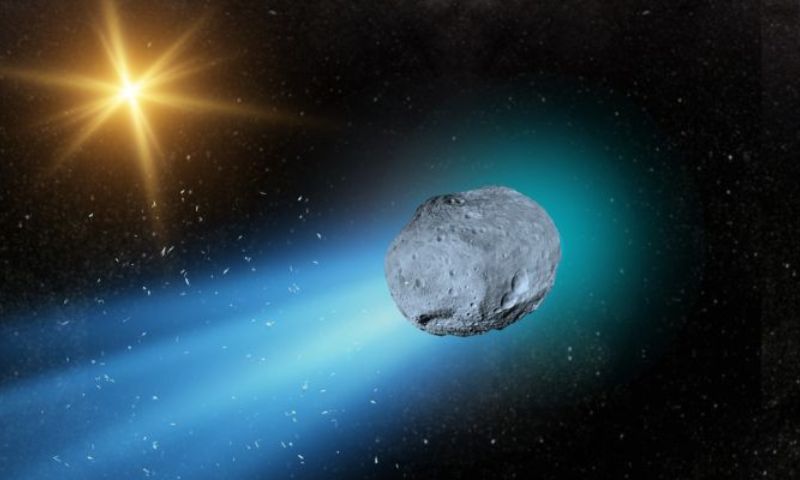
Astronomers around the world are buzzing after new research suggested that Comet 3I/ATLAS may be far older than our Sun, possibly dating back nearly 14 billion years. If confirmed, that would make it one of the oldest known objects ever observed passing through our solar system and a rare visitor from interstellar space.
Comet 3I/ATLAS was first detected by the ATLAS sky survey, a system designed to spot near-Earth objects early. What quickly set this comet apart was its unusual trajectory. Scientists noticed that it did not follow a path typical of objects born within our solar system. Instead, its steep angle and extreme speed strongly suggest it originated outside the Sun’s gravitational family, making it only the third confirmed interstellar object observed after ʻOumuamua and 2I/Borisov.
Recent modeling has gone a step further. Some researchers now believe the comet may have formed before the Sun itself, in the early days of the Milky Way. That bold claim has drawn attention—and caution. Experts stress that the “14-billion-year” estimate refers to the age of the material inside the comet, not the moment it became a solid object. In simple terms, parts of Comet 3I/ATLAS may contain ancient cosmic matter created soon after the universe began.
The idea sparked public curiosity, including speculation about alien signals. However, scientists working with NASA have firmly ruled that out. Data from deep-space monitoring and NASA’s Europa Clipper instruments detected no artificial signals, confirming the comet is a natural object. Researchers say this clarity is important, as misinformation often spreads quickly around interstellar discoveries.
Beyond headlines, Comet 3I/ATLAS offers real scientific value. Studying such objects helps astronomers understand how planets and stars formed across the galaxy. Interstellar comets act like time capsules, preserving chemistry from distant star systems that may no longer exist. Each one provides clues about how common certain elements are beyond our own neighborhood.
Scientists caution that more observations are needed before making firm claims about its age. Still, Comet 3I/ATLAS stands as a reminder of how small and how connected our solar system is within the vast universe. Every rare visitor like this pushes humanity a step closer to understanding where we came from and how the cosmos evolved.