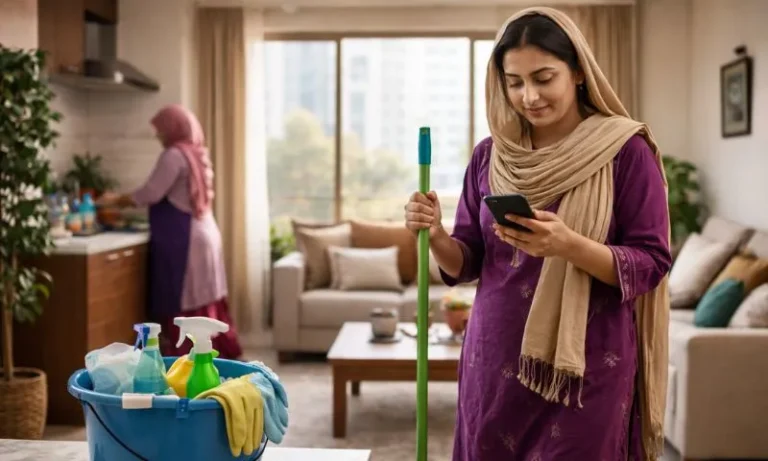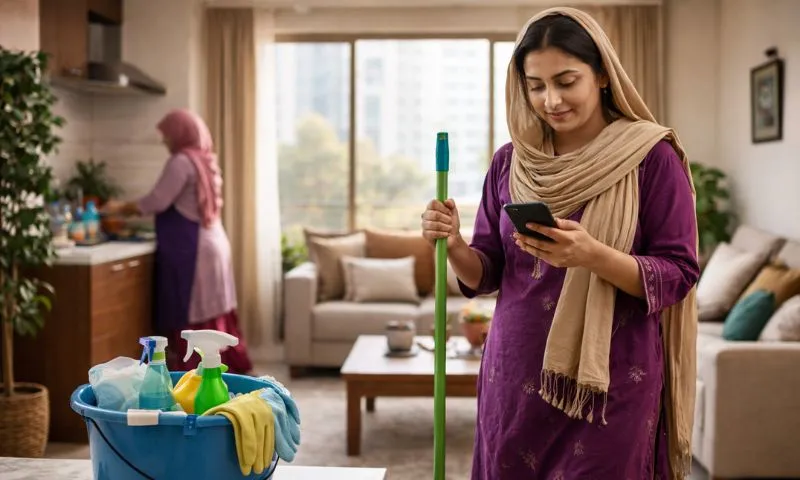
On a humid afternoon in Gulshan-e-Iqbal, 32-year-old Shazia Bibi moves quickly through a two-bedroom apartment. Within an hour, the kitchen is spotless, floors are mopped and the house is back in order.
Her next job is already waiting on her phone.
Shazia is part of a growing number of domestic workers in Pakistan joining app-based home service platforms that promise quick bookings and steady income. These digital services are beginning to reshape a sector long dominated by informal arrangements, where workers are hired through personal contacts and paid in cash.
With millions of domestic workers across Pakistan, most of them women, the shift toward digital platforms is opening new doors but also introducing new challenges.
Opportunity meets algorithmic control
For workers like Shazia, the move has brought higher and more predictable earnings compared to traditional house jobs.
“I used to work in two houses and earn around 15,000 rupees,” she says. “Now I can make up to 25,000 if I get enough bookings.”
But the new system comes with strict rules.
Every job is tracked, timed and rated. A delay of even a few minutes can affect future bookings. Customer reviews play a crucial role in determining how often a worker is assigned jobs.
“If someone gives a low rating, your work can stop coming,” Shazia says. “So after every job, we request them to give five stars.”
Labour rights advocates in Pakistan warn that while platforms appear to formalise work, they also shift control from employers to algorithms.
“These systems create invisible pressure,” says a Karachi-based labour researcher. “Workers are constantly being monitored and judged by ratings rather than treated as employees with rights.”
Convenience for users, cost for workers
For urban households, especially younger families, app-based services offer flexibility and convenience. Cleaners, electricians and beauticians can be booked within minutes, often for short tasks.
But for workers, the experience can be physically and mentally demanding.
Delays caused by traffic, security checks at apartment complexes or overlapping bookings can lead to penalties or reduced earnings. Workers say they often rush between jobs to avoid fines.
“There are days when I don’t even sit down,” Shazia says. “If I take a break, I lose the next booking.”
Basic facilities are another concern. Many workers avoid drinking water during shifts because they are unsure whether they will be allowed to use a client’s washroom.
Between jobs, they wait in public spaces such as bus stops or staircases, with limited access to rest areas.
Experts say the situation mirrors the early days of ride-hailing and delivery platforms in Pakistan, where workers were drawn in by flexible income but later faced income uncertainty and rising pressure.
“There is a pattern with these platforms,” the researcher says. “At first, earnings look attractive. Over time, incentives change and workers bear more risk.”
A changing relationship inside homes
The rise of digital platforms is also changing long-standing relationships between households and domestic workers.
In traditional arrangements, workers often developed familiarity with families over years. With app-based services, that connection is replaced by short-term, transactional interactions.
Some households remain cautious.
“I don’t know who is coming into my house,” says Sana Ahmed, a Karachi resident. “With our regular help, there is trust. With an app, it feels different.”
As Pakistan’s urban economy evolves, app-based domestic services are likely to expand. For now, they offer both opportunity and uncertainty.
Back in Gulshan, Shazia checks her phone as another booking appears.
“The work is hard,” she says. “But for now, it helps me run my home. So I keep going.”