Pakistan’s top space science body, the Space and Upper Atmosphere Research Commission (SUPARCO), has shared its astronomical outlook for the upcoming Ramadan 1447 AH, offering a forecast on when the holy month is likely to begin in the country. SUPARCO’s prediction plays an important role in informing moon-sighting authorities and the general public about possible timelines for starting the fast.
According to SUPARCO’s astronomical data, the new moon (conjunction) for Ramadan is expected to occur on Tuesday, February 17, 2026, marking the beginning of the crucial phase that leads to the holy month. Astronomers use scientific models to determine the moon’s age, angular separation from the sun, and its altitude above the horizon after sunset. These parameters help estimate whether the crescent moon can be sighted with the naked eye the following evening.
Local meteorological forecasts also support the likelihood of crescent visibility on Wednesday, February 18, which corresponds to the 29th day of Shaban 1447 AH. In Karachi and other major regions of Pakistan, the Pakistan Meteorological Department (PMD) notes that the moon’s age and position around sunset on February 18 are favourable for sighting, provided weather conditions remain clear or partly cloudy.
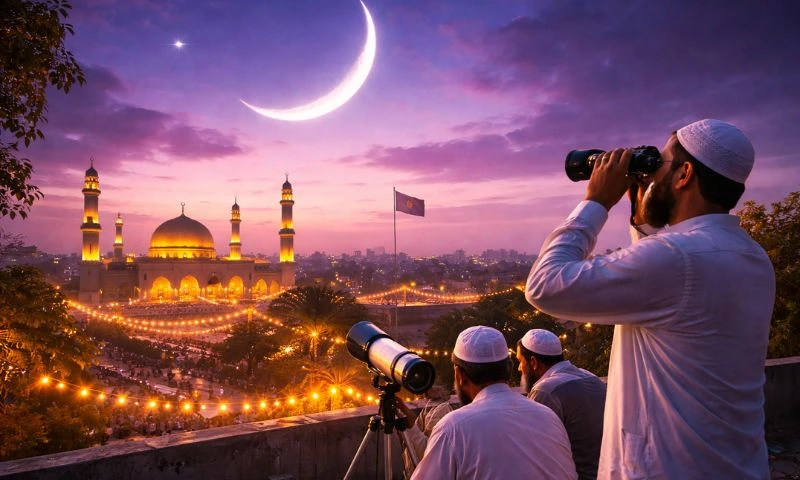
If the crescent is confirmed on the evening of February 18, the first day of fasting will likely be observed on Thursday, February 19, 2026, in line with traditional practice in South Asia. Moon-sighting committees across the country will convene to share and verify sightings in coordination with scientific inputs.
However, SUPARCO and other experts emphasise that astronomical forecasts are not final decisions. The Central Ruet-e-Hilal Committee, Pakistan’s official authority for moon sighting, will conduct meetings, review verified testimonies, and make the final announcement on the start of Ramadan. A key session of the committee is scheduled to take place in Peshawar on February 18, when clerics, meteorologists, and SUPARCO representatives will assess claims and declare the official beginning of the holy month.
Ramadan holds deep religious significance for Pakistan’s majority Muslim population. It is observed with fasting from dawn to sunset, increased prayer, charitable giving, and nightly Taraweeh prayers in mosques. The month often encourages community solidarity, reflection, and enhanced spiritual devotion.
The practice of relying on both celestial calculations and verified moon sightings reflects a blend of scientific methods and centuries-old religious traditions. Across the Islamic world, different countries may observe slight variations in start dates based on local sightings or astronomical determinations.
As Pakistan prepares for the sacred month, citizens are encouraged to follow official updates from the Ruet-e-Hilal Committee and local mosques to mark the start of Ramadan nationwide.