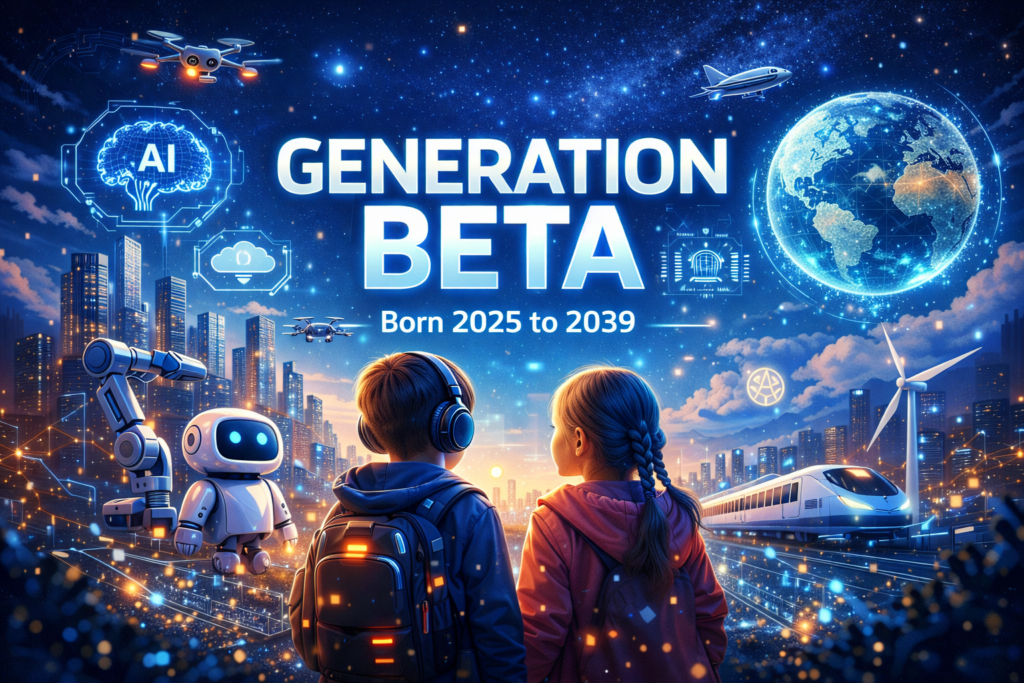
As the calendar turned to 2026, social media feeds and online forums filled with claims that a brand-new generation had arrived, Generation Beta. According to widely shared posts, all children born from 2025 to 2039 will now fall under this label. While some dismissed the idea as an internet trend, experts say the concept of Generation Beta is rooted in established demographic research, not online speculation.
Who Is Generation Beta?
Generation Beta refers to people born between 2025 and 2039, following Generation Alpha (born roughly between 2010 and 2024). The term has been introduced and popularised by demographic researchers, most notably Mark McCrindle, whose work on generational analysis is frequently cited by academics, policymakers, and global media outlets.
It is important to note that no international authority officially defines generations. Instead, generational labels are analytical tools used by sociologists, economists, and researchers to describe groups of people shaped by similar historical, technological, and social conditions.
Why the Name ‘Generation Beta’?
The name follows a Greek-alphabet naming system that began with Generation Alpha. After Alpha, the next logical designation is Beta.
Researchers argue that Greek-letter naming reflects a broader shift: the first generations to be born entirely in the 21st century, without lived memory of the pre-digital world. The term “Beta” does not suggest inferiority or social traits but simply indicates sequence.
Experts stress that generational names are descriptive, not predictive. They help frame discussion but do not define individual personality, intelligence, or ability.
What Will Define Generation Beta?
Although Generation Beta is only just being born, researchers outline several factors likely to shape their upbringing:
1. Life in an AI-First World
Generation Beta will be the first cohort born into a world where artificial intelligence is embedded in daily life – from education and healthcare to transportation and entertainment. Unlike Generation Z, which witnessed the rise of smartphones and social media, Generation Beta will grow up with AI assistants, automation, and predictive technologies as the norm.
2. Seamless Digital-Physical Integration
For Generation Beta, the boundary between online and offline life is expected to be increasingly blurred. Smart homes, connected cities, and digital learning environments will be standard, not novel.
3. A World Defined by Global Challenges
Climate change, demographic shifts, and technological disruption will form the backdrop of their childhood. Researchers suggest this may influence how Generation Beta approaches problem-solving, collaboration, and adaptability in adulthood.
How Generation Beta Differs from Generation Z
While both generations are considered digitally native, their formative environments are fundamentally different.
Generation Z (born roughly between the late 1990s and early 2010s) grew up during:
The rise of social media
Rapid smartphone adoption
Political and social movements amplified through online platforms
Generation Beta, by contrast, will grow up in:
A world already shaped by AI and automation
Education systems enhanced by adaptive technology
Smart infrastructure embedded in everyday life
Where Generation Z adapted to digital transformation, Generation Beta will inherit it fully formed.
Generation Beta is expected to make up a significant portion of the global population by mid-century, potentially influencing future economies, workplaces, and political systems. While it is too early to define their values or behaviour, researchers agree on one point: their world will be profoundly different from that of previous generations.
As history shows, each generation is shaped less by its label and more by the realities it faces. For Generation Beta, those realities will include unprecedented technological integration, global interdependence, and rapid change.