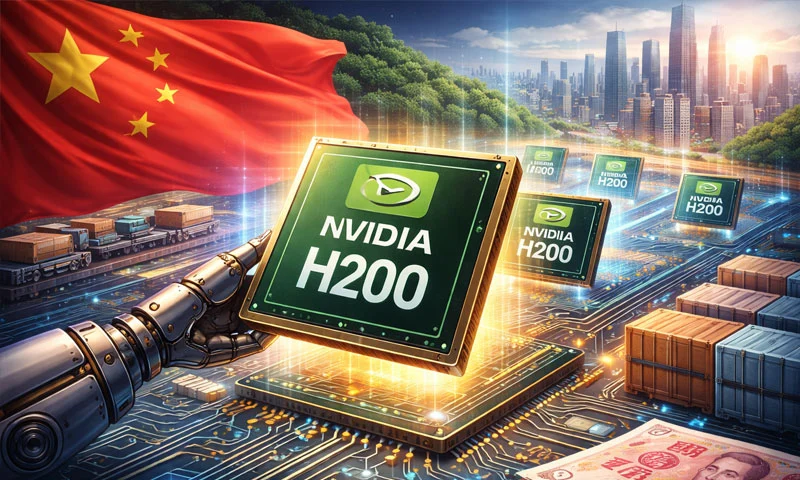
China has taken a significant step in the global technology race by approving the first batch of Nvidia’s H200 artificial intelligence (AI) chips for import, according to multiple sources familiar with the matter. The approvals were granted during a visit to China by Nvidia CEO Jensen Huang, marking a notable shift in Beijing’s stance toward cutting-edge U.S. tech products.
The H200, Nvidia’s second most powerful AI processor, delivers roughly six times the performance of the earlier H20 model — previously the most advanced AI chip allowed into China. This high computing power makes the H200 critical for large-scale AI workloads, including machine learning research, deep learning models and data centre operations.
Chinese tech giants are expected to be the first beneficiaries of the nod. ByteDance, Alibaba and Tencent have reportedly received approvals for several hundred thousand H200 units, with additional companies now waiting for subsequent rounds of green lights.
The approval comes after the U.S. government formally authorised exports of H200 chips to China earlier in January 2026. That decision reversed a long-standing ban on advanced AI chips, allowing Nvidia to seek sales in the lucrative Chinese market under certain conditions, including national security reviews and usage limitations.
Until now, Chinese customs had blocked H200 shipments despite the U.S. export clearance, creating uncertainty for Nvidia and its supply chain. Chinese firms had already ordered more than two million H200 chips, far exceeding the company’s inventory, highlighting the scale of demand.
Experts see the move as part of a broader balancing act by Beijing. On one hand, China wants to access top-tier AI hardware to support research and development and compete with global peers like OpenAI. On the other, the government remains committed to nurturing its own semiconductor industry, which has been growing quickly but still lags behind U.S. designs in many categories.
Despite the clear demand, some observers note that import approvals come with conditions. Beijing is reportedly discussing rules that could require companies to purchase a proportion of domestically made chips alongside foreign imports, a move intended to protect local manufacturers.
The approvals also occur amid political pushback in the United States. Some U.S. lawmakers have voiced concerns that exporting advanced AI technology could help China narrow the technology gap, with proposals under consideration to give Congress more oversight over AI chip exports.
For now, China’s decision to allow the import of Nvidia’s H200 AI chips reflects a nuanced strategy — one that seeks to satisfy immense internal demand for AI capabilities while preserving momentum toward semiconductor self-sufficiency.