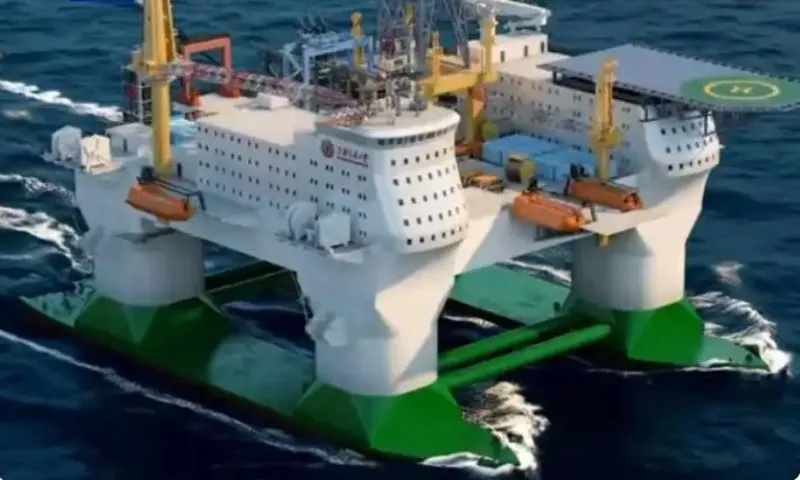
China has officially launched the world’s first ultra-large floating artificial island designed for deep-sea scientific research, marking a major step forward in marine technology and ocean exploration.
The project, unveiled in Shanghai, is a national-level science and technology infrastructure initiative aimed at advancing research in marine science, resources, and engineering. The facility is described as an “open-sea floating island” capable of operating in all weather conditions.
A Unique Research Platform
The floating platform is designed to function as a comprehensive research hub, combining multiple systems to support deep-sea exploration. It consists of three key components: a main offshore platform, ship-based laboratories, and land-based support facilities.
At the core of the project is an innovative semi-submersible twin-hull structure. This design allows the platform to remain stable in rough ocean conditions while supporting large-scale testing of marine equipment weighing hundreds of tons.
According to reports, the facility will enable scientists to conduct experiments at ocean depths of up to 10,000 meters, opening new possibilities for studying extreme underwater environments.
Advancing Marine Science and Industry
The floating island is expected to play a crucial role in accelerating research across several fields, including marine ecosystems, deep-sea mining, and offshore oil and gas exploration.
Experts say the platform will help scientists better understand the seasonal evolution of marine ecosystems and explore the origins and development of life in deep-sea environments.
It will also serve as a testing ground for advanced marine equipment and technologies, supporting the commercial development of ocean resources.
In addition, the facility is expected to improve forecasting of extreme weather events such as typhoons, contributing to better disaster prevention and mitigation efforts.
Timeline and Institutional Support
The project is being led by Shanghai Jiao Tong University, which has also established a dedicated institute for deep-sea science and engineering to oversee research activities.
Construction of the floating research facility is expected to be completed by 2030, with phased development allowing for gradual expansion of capabilities.
Officials have described the initiative as a major milestone in China’s efforts to strengthen its position in global marine research and technology.
Global Significance
The launch of the floating artificial island comes at a time when countries are increasingly investing in ocean exploration and marine resources.
Oceans cover more than 70 percent of the Earth’s surface, yet a large portion remains unexplored. Advances in deep-sea technology are seen as critical for unlocking new resources and addressing global challenges such as climate change and biodiversity loss.
China’s new platform is expected to contribute significantly to international scientific knowledge while also enhancing the country’s capabilities in marine innovation.
Looking Ahead
As the project progresses, the floating island is set to become a key hub for cutting-edge research and collaboration in ocean science.
Its ability to operate continuously in open-sea conditions positions it as a groundbreaking development in the field of marine research infrastructure.
With completion targeted for 2030, the facility is expected to redefine how scientists explore and utilize the deep ocean.