A new study in animal cognition is rewriting what we thought dogs could learn. Scientists now show that some exceptionally clever dogs can learn new words by simply listening to conversations between their humans, even when they aren’t being directly addressed. This goes beyond commands like “sit” or “stay” and into the realm of vocabulary learning once thought unique to human toddlers.
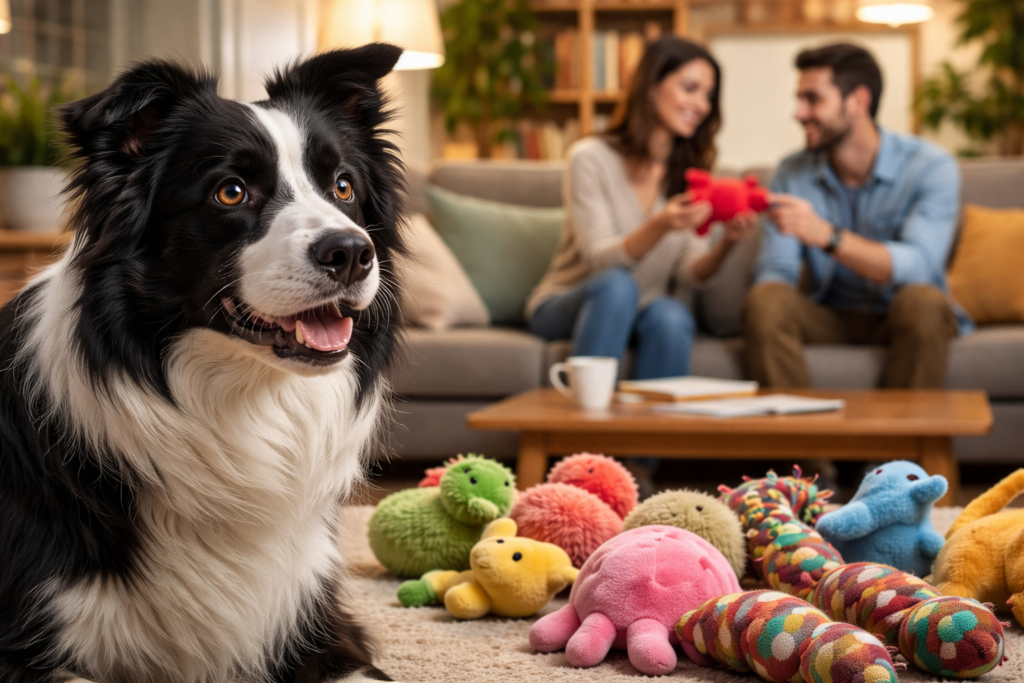
Researchers from Eötvös Loránd University in Budapest and the University of Veterinary Medicine in Vienna designed a series of experiments with 10 rare Gifted Word Learner (GWL) dogs to test how they picked up object names. These gifted pups belong to the tiny fraction of dogs known to retain hundreds of toy names such as the famous border collie Chaser, who could retrieve 1,022 toys by name in earlier research.
In one experiment, the dogs heard owners discuss two new toys without addressing the dogs directly. After a few short sessions spread across days, the pups were tested with a roomful of toys and asked to fetch the correct one by name. Seven out of 10 dogs correctly retrieved the right toys more often than chance, showing they had learned new words simply by overhearing their humans. This success was comparable to when owners directly introduced the toys.
The researchers pushed the learning even further. In another test, they introduced a new toy to the dogs, then placed it out of view before naming it during a conversation. Remarkably, several of the dogs still matched the toy to its name later. “Our findings show that the socio-cognitive processes enabling word learning from overheard speech are not uniquely human,” lead scientist Dr. Shany Dror explained, noting the similarities with how 18-month-old human toddlers learn language.
This ability doesn’t appear in all dogs. GWL dogs are extremely rare, and scientists believe their skills reflect a combination of genetics, early learning, and rich human interaction. Their capacity to extract meaning from speech requires attention to human gaze, vocal cues and context—much like human infants do.
Experts see this research as a window into both canine cognition and the roots of language learning itself. It shows that dogs not only read our emotional cues, as earlier studies highlighted, but can also pick up on specific labels for objects without direct instruction.
This breakthrough reveals just how sophisticated some canine minds can be and hints at future ways we might improve communication with our oldest animal companions.