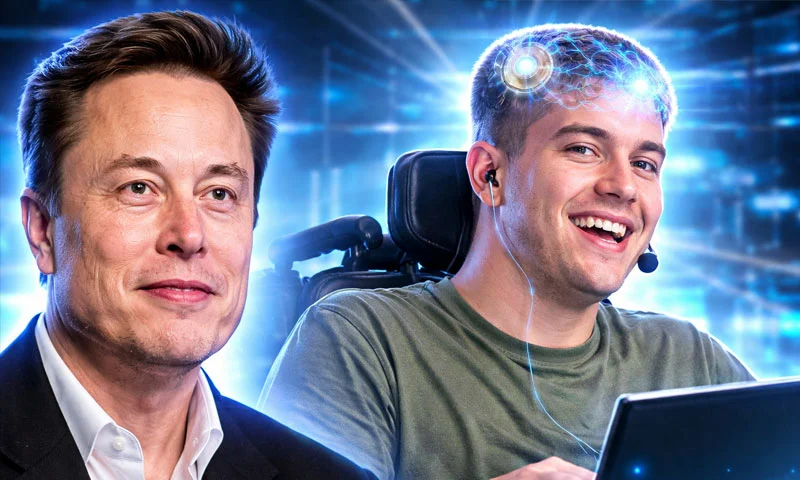
Noland Arbaugh, the first human patient to receive Elon Musk’s Neuralink brain implant, has shared a major update after completing 100 days with the device.
Arbaugh, who is paralyzed from the shoulders down, said the implant has already had a significant impact on his life. Reflecting on his experience, he said, “100 days in and I already can’t imagine life without it.”
His statement highlights the early success of Neuralink’s human trial and its potential to transform lives.
Regaining Control Through Technology
The Neuralink brain chip allows Arbaugh to control a computer using only his thoughts. He can move a cursor, type messages, and play games without using his hands.
The implant works by interpreting brain signals and converting them into digital commands. This enables people with paralysis to interact with technology in new ways.
Arbaugh has demonstrated these abilities publicly, showing how he can play chess and navigate a computer screen using the implant.
Challenges and Improvements
Despite the progress, Arbaugh has also faced some challenges during the trial. At one stage, the device experienced issues when some of the implant’s threads retracted from the brain. This affected signal quality and reduced performance.
However, Neuralink engineers were able to address the issue by adjusting the software, restoring much of the functionality. The company continues to monitor the implant closely and make improvements as part of the trial process.
What is Neuralink
Neuralink is a neurotechnology company founded by Elon Musk. It aims to develop brain-computer interfaces that can help people with neurological conditions.
The company’s long-term goal is to enable direct communication between the human brain and computers. Early applications focus on helping patients with paralysis regain independence and improve quality of life.
A Breakthrough for Medical Science
Experts say brain-computer interfaces could revolutionize treatment for conditions such as spinal cord injuries and neurodegenerative diseases. While still in early stages, Neuralink’s human trial marks a major milestone in the field of neuroscience.
Arbaugh’s experience provides valuable insights into how the technology performs in real-world conditions.
Neuralink plans to expand its trials and include more patients in the coming years. Regulatory approvals and long-term safety studies will play a key role in determining how widely the technology can be used.
For now, Arbaugh’s journey offers hope for millions of people living with paralysis and other severe conditions.