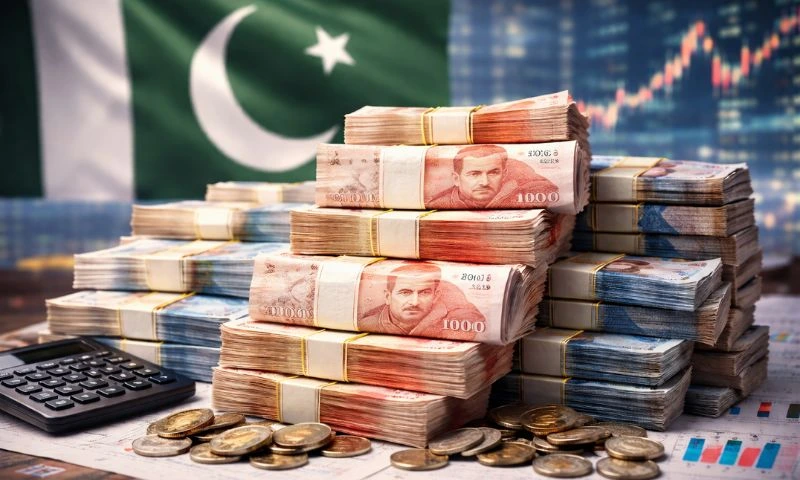
Pakistan’s debt burden has continued its upward climb, with every Pakistani now owing Rs333,041, according to the latest Fiscal Policy Statement for 2024–25 presented to Parliament. This represents a 13% increase from Rs294,098 per person in the previous year and highlights the growing fiscal pressure on the economy.
The debt per person figure is calculated by dividing total public debt by Pakistan’s estimated population of 241.5 million. Between June 2024 and June 2025, total public debt rose from Rs71.2 trillion to Rs80.5 trillion, driven largely by higher interest payments and exchange rate movements, the Finance Ministry said.
Public debt as a share of the nation’s economic output also increased. The debt-to-GDP ratio moved from 67.6% in June 2024 to 70.7% in June 2025, exceeding the statutory limit set under the Fiscal Responsibility and Debt Limitation Act (FRDL). Under this law, the federal fiscal deficit should not exceed 3.5% of GDP, but in 2024–25 it reached 6.2%, almost double the permitted level.
Economists say rising debt levels reflect structural challenges in Pakistan’s economy. External factors such as a weakening rupee and high interest rates have increased the cost of servicing debt, while domestic fiscal management has struggled to keep deficits within legal limits. According to the State Bank of Pakistan’s data, gross public debt has steadily risen over the past decade, from around Rs36 trillion in 2020 to more than Rs80 trillion by 2025.
A 2025 report from the Economic Policy & Business Development (EPBD) think tank also highlighted that Pakistan’s debt burden has jumped from around Rs90,047 per person in 2014 to more than Rs318,000, reflecting sustained growth in borrowing over the past decade.
Analysts warn that the high debt load could limit Pakistan’s ability to invest in development and social services. A significant portion of government revenue goes to interest payments, crowding out spending on education, health and infrastructure. Higher debt costs also make the economy vulnerable to global shocks and exchange rate volatility.
Despite these challenges, the Fiscal Policy Statement noted that revenue collection remained close to budget targets, while non-tax revenues exceeded expectations thanks to stronger central bank profits and petroleum levy collections. The overall fiscal deficit, including provincial accounts, was contained at 5.4% of GDP, slightly below the original target, the ministry said.
Experts suggest that meaningful fiscal reforms are needed to stabilise Pakistan’s debt trajectory. This includes broadening the tax base, rationalising expenditures, and enhancing debt management strategies to ensure sustainability. Without such measures, the rising per-person debt could continue to burden future generations.