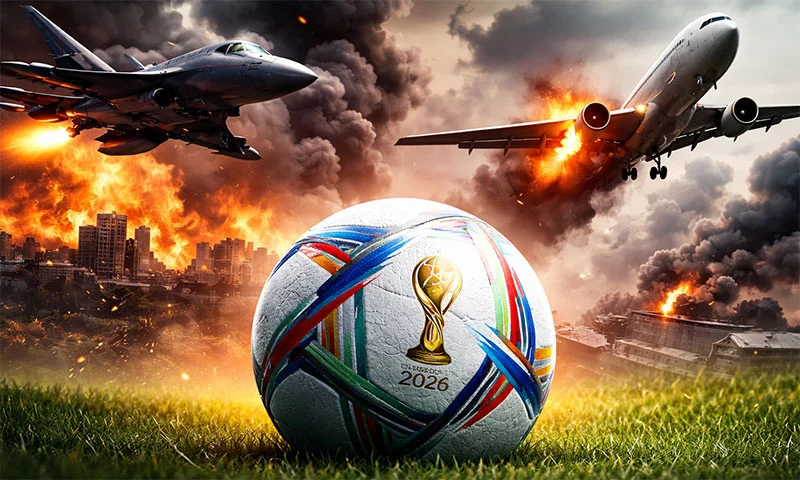
The escalating conflict between the United States, Israel, and Iran has begun to disrupt international sports events by creating major travel uncertainty for teams and athletes. Officials and analysts worry about safe passage into and out of key competitions, including the 2026 FIFA World Cup and Winter Paralympics.
The conflict has led to airspace closures and canceled flights across the Middle East, leaving athletes and international teams unsure about travel routes and event schedules. The World Cup, set to begin in June, is now being overshadowed by geopolitical tensions that could affect team participation and logistics.
World Cup Participation in Doubt
Iran’s involvement in the 2026 FIFA World Cup is currently in question. The nation qualified for the tournament in North America but Iran’s president of football federation, Mehdi Taj, said uncertainty surrounds the team’s ability to play after recent strikes and escalation in conflict. “What is certain is that after this attack, we cannot be expected to look forward to the World Cup with hope,” he told local media.
The Iranian national team was scheduled to play group matches in California and Washington state, but growing geopolitical tensions and safety concerns have cast doubt on their participation.
FIFA has so far made no official decision on Iran’s status in the tournament and has stressed it will continue monitoring the situation.
Winter Paralympics and Other Sporting Events Affected
Travel complications are also spilling into other international competitions. The International Paralympic Committee (IPC) said travel uncertainty could affect participants heading to the Milano Cortina 2026 Winter Paralympic Games in Italy. Many teams are already in Europe for training, which helps alleviate travel pressure, but concerns remain for others en route.
Beyond FIFA and the Paralympics, events such as flag football in Saudi Arabia featuring Tom Brady and other international exhibitions could face location changes or postponements amid safety concerns.
Air Travel Chaos Disrupts Sports Logistics
The conflict has closed airspace in much of the Middle East, including in countries such as Iran, UAE, Qatar, Kuwait, Bahrain, and Iraq, forcing flight cancellations or reroutes that affect athletes and support staff traveling worldwide.
Tennis players based in Dubai, for instance, faced delays and travel delays when trying to reach tournaments in the United States, as flights to Indian Wells were rerouted or rescheduled.
The disruptions ripple through several major aviation hubs globally, complicating travel plans for teams bound for tournaments across Europe, Asia, and North America.
Broader Impact on Global Sports Industry
Sports leagues and associations are monitoring the situation closely. Organizers are weighing contingency plans to accommodate shifts in travel and player movements. Many major sports events have no precedent for dealing with a geopolitical conflict on this scale so close to their start dates.
In basketball, football, and motorsports, key international fixtures may be rescheduled, relocated, or converted to neutral venues depending on how the conflict evolves and how air travel corridors reopen.
Fan and Host City Implications
If Iran were to withdraw from the World Cup, it could trigger adjustments to tournament logistics. FIFA’s rules permit replacement of a team in such cases, and associations like Iraq or the United Arab Emirates have been mentioned as possible alternates.
Host cities such as Seattle and Inglewood are bracing for the potential absence of Iran’s supporters, which could affect crowd dynamics and local preparations.