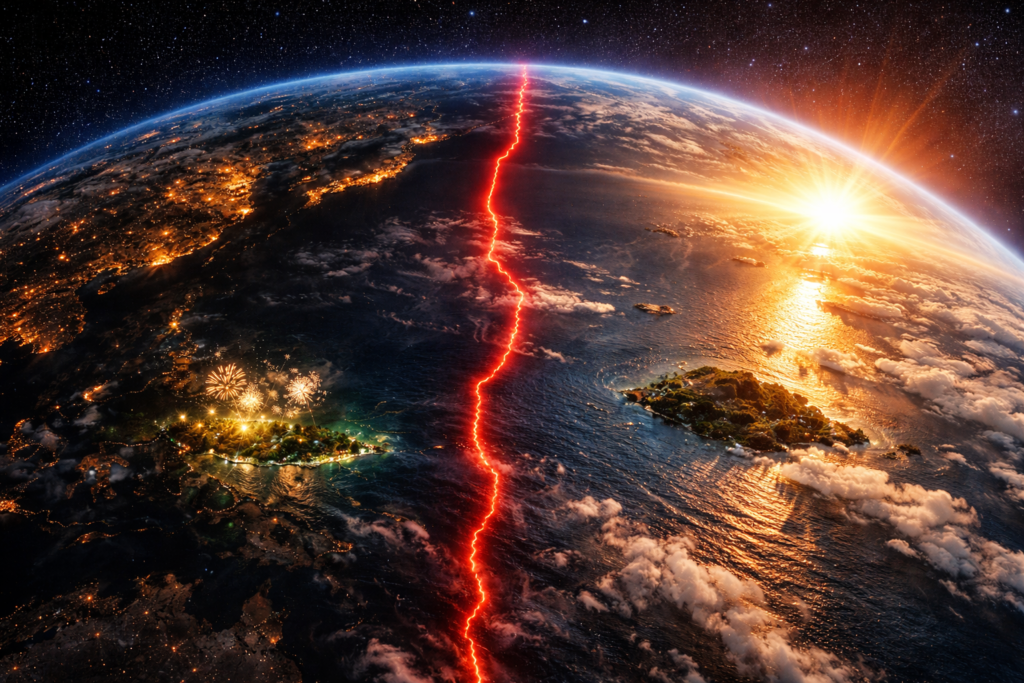
As fireworks light up skies around the world and countdown clocks hit zero, the arrival of a new year is not as simultaneous as it feels. In fact, due to the way Earth is divided by time zones, it takes 25 full hours for the New Year to sweep across all inhabited parts of the planet.
At the heart of this staggered celebration is the International Date Line — the imaginary boundary that marks where each new day begins and ends. While it generally follows the 180th meridian in the Pacific Ocean, the line doesn’t run straight. That’s because, as explained by the National Oceanic and Atmospheric Administration, the date line has no legal international status. Countries are free to decide which calendar day they observe — and some have used that freedom to their advantage.
The First Place to Ring in the New Year
The honor of welcoming 2026 first belongs to Kiritimati (Christmas Island), part of the island nation of Kiribati. Although the island lies almost directly south of Hawaii, it celebrates the New Year a full day earlier.
This wasn’t always the case. Before 1995, the International Date Line actually split Kiribati, meaning different islands were living on different calendar days. That changed when the country’s president shifted the date line eastward to wrap around the nation, unifying its time zones. The decision unexpectedly placed Kiribati at the very front of the global calendar — a move that also ensured it became the first country to welcome the year 2000.
As a result, Kiribati entered 2026 when it was still 5 a.m. on December 31 in the US Eastern Time Zone.
Soon after, Samoa and Tonga followed, with Auckland in New Zealand becoming one of the first major cities to celebrate the New Year with large public events.
The Last to Say Goodbye to 2025
On the opposite end of the timeline are Niue and American Samoa. Located just southwest of Kiribati, these islands are the final inhabited places on Earth to enter the New Year.
By the time American Samoa welcomes 2026, much of the world has already been living in the new year for nearly a full day. In US Eastern Time, the moment arrives at 6 a.m. on January 1 — closing the 25-hour global New Year journey.