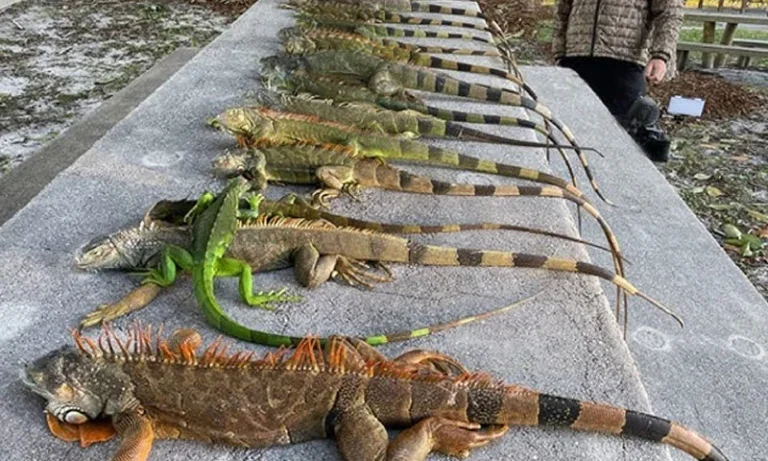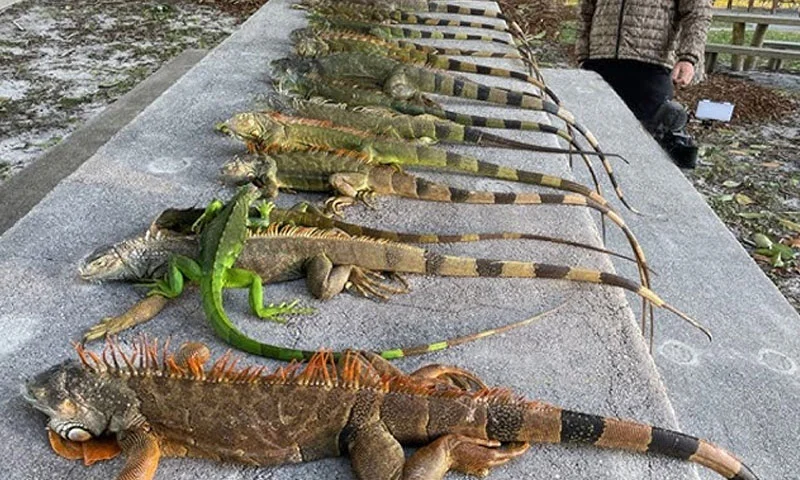
Florida is witnessing an unusual winter phenomenon: green iguanas are literally falling from trees as temperatures plunge in a rare cold snap sweeping the southeastern United States. The cold-blooded reptiles become temporarily immobilised during frigid conditions — leaving them unable to grip branches and causing them to tumble to the ground in large numbers.
This strange spectacle unfolded as an Arctic-style cold front pushed temperatures into the 40s Fahrenheit (around 4–7°C) and below across South Florida. Iguanas rely entirely on warmth from their environment to regulate their body heat. When the mercury drops rapidly, their internal processes slow, and they enter a torpor-like state — similar to temporary hibernation. In this state, iguanas can’t climb or hold onto tree branches, leading to the now-viral scenes of reptiles falling out of the canopy in residential neighbourhoods from Miami to Palm Beach.
What Causes Iguanas to Fall From Trees?
Experts explain that iguanas are ectotherms — animals whose body temperature depends on the surrounding air — meaning they do not generate their own heat like mammals and birds. When exposed to cold stress, their metabolism, heart rate and muscle coordination slow dramatically, leaving them limp and unable to hold onto perches. Natalie Claunch, a wildlife biologist, noted that temperatures below about 50°F (10°C) can make iguanas lose muscle control and drop from trees.
Although this phenomenon looks alarming, it doesn’t always mean the animals are dead. Some iguanas remain cold-stunned and may recover once temperatures rise. However, prolonged exposure to freezing weather can weaken immune systems and increase the risk of infection and injury.
State Response and Public Effort
In response to the unusual situation, the Florida Fish and Wildlife Conservation Commission (FWC) issued a temporary executive order allowing residents to collect cold-stunned iguanas without a permit and bring them to designated drop-off sites. Under normal laws, capturing or possessing iguanas — a non-native species — is illegal and carries fines or penalties.
During this event, residents have collected thousands of iguanas at FWC locations across the state. At designated collection points from Lakeland to Marathon, more than 2,000 cold-stunned iguanas were reported turned in over a two-day period. The plan is to humanely euthanize or transfer suitable live animals to licensed handlers, part of a broader strategy to reduce the invasive species’ impact on Florida’s ecosystems.
Southwest Florida residents, such as Marlin Smith of Bonita Springs, joined wildlife officers in collecting the stunned reptiles, noting that invasive species management benefits overall ecological health. (“It’s nice to engage the public… because there’s only so many FWC officers,” Smith said.)
Invasive Species and Ecological Impact
Green iguanas are not native to Florida but were introduced decades ago through escaped pets and subsequent breeding. Over time, they became established along the Gulf Coast and South Florida, where their burrowing can damage infrastructure and disrupt native species and habitats. Because of their large population and ecological threat, wildlife officials view the cold snap as a rare opportunity to manage the invasive reptiles more effectively, even though such events are unlikely to control the overall population significantly.