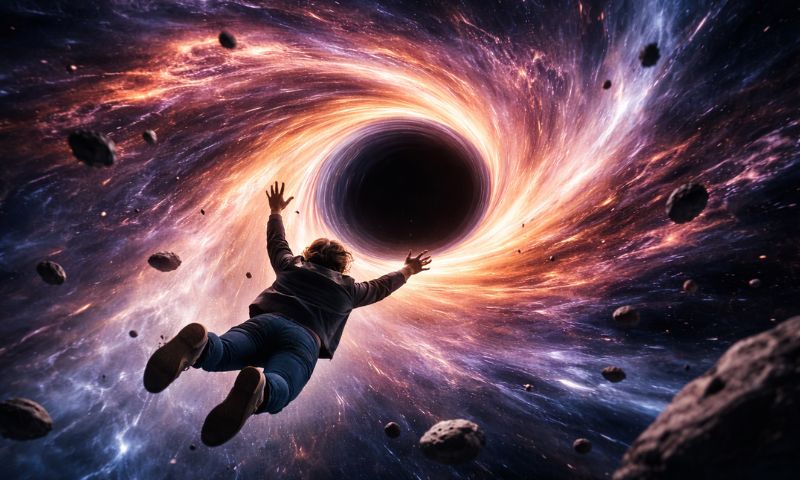
On a clear night, it feels harmless to look up and wonder: what if you fell into a black hole? Hollywood often turns it into a portal. Physics tells a stranger and darker story.
Start with the basics. A black hole is a region where gravity grows so intense that “nothing, not even light, can escape” once it crosses the event horizon—the boundary scientists call the “point of no return.”
If you fell toward a black hole, you would not instantly vanish. First, you would notice your view distort. Light from stars and hot gas would bend into warped rings and arcs. NASA simulations show how an accretion disk and “photon rings” can multiply and smear as spacetime twists closer to the horizon.
Then comes the body horror—tidal forces. Gravity pulls harder on the part of you closer to the black hole than the part farther away. NASA explains that this difference increases as you approach the event horizon, stretching you into a long, thin shape called spaghettification. As NASA puts it: “Infalling objects stretch out like noodles, a process astrophysicists call spaghettification.”
But the ending depends on the black hole’s size.
A stellar-mass black hole has a small event horizon and brutal tidal forces. You likely get torn apart before reaching the horizon.
A supermassive black hole can be “gentler” at the horizon because its radius is huge. NASA’s visualization uses a Milky Way–style black hole with 4.3 million times the Sun’s mass, and it notes a key rule of thumb: “If you have the choice, you want to fall into a supermassive black hole,” because smaller ones can rip you apart sooner.
We know these giants are real, not just theory. The Event Horizon Telescope’s first black hole image targeted M87*, whose mass is about 6.5 billion Suns, seen as a glowing ring around a dark center. The same global effort later imaged Sagittarius A* at the center of our Milky Way—more than 26,000 light-years away and roughly 4 million Suns in mass.
Now for the strangest part: time. Near a black hole, gravity warps spacetime so strongly that time runs differently. NASA describes time dilation near black holes: clocks closer to the black hole tick more slowly than clocks far away. In NASA’s simulation, the falling camera reaches the event horizon in about three hours of its own time, yet a distant observer would see it slow and appear to freeze just shy of crossing.
Inside the horizon, physics turns uncertain. NASA explains that once you cross, you and the spacetime you ride in rush inward toward a singularity, “where the laws of physics as we know them cease to operate.”
Even black holes don’t last forever at least in theory. Stephen Hawking proposed in 1974 that black holes can slowly lose energy through Hawking radiation, gradually evaporating over immense timescales.
So, what happens if you fall into a black hole? You would see the universe bend into impossible shapes. Gravity would stretch you. Time would behave like a trick. And beyond the horizon, nature keeps its deepest secrets at least for now.