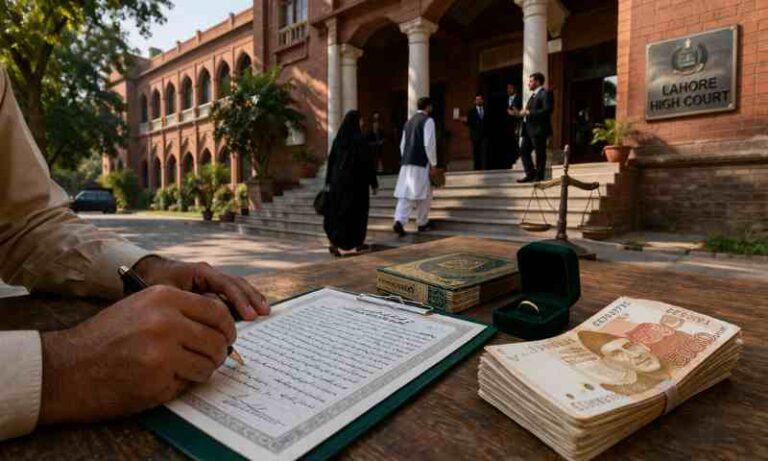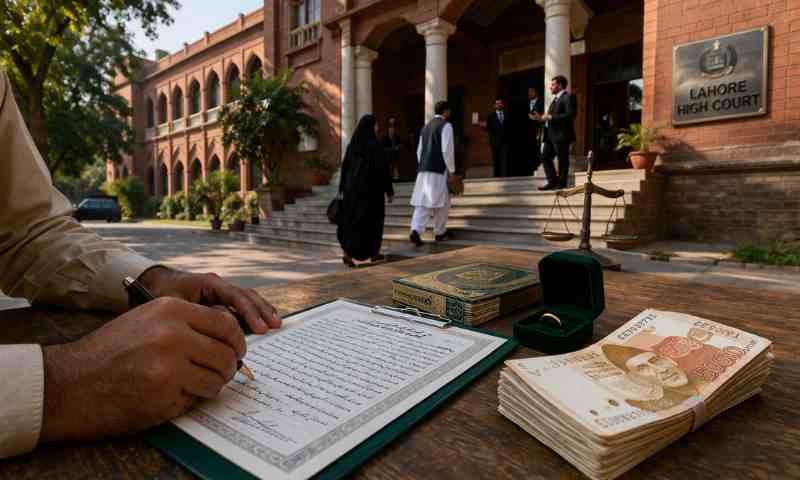
In a significant ruling reinforcing women’s financial rights, the Lahore High Court has declared that a husband is legally bound to pay dower immediately upon demand if no specific time for payment is mentioned in the marriage contract.
Key Ruling by Lahore High Court
The judgment clarified that when a Nikahnama does not clearly define whether dower is prompt or deferred, or fails to specify the timing of payment, the obligation becomes immediately enforceable once the wife demands it.
The court emphasised that dower, also known as haq mehr, is a mandatory legal right of the wife and cannot be delayed arbitrarily by the husband.
Legal experts say this ruling strengthens the enforceability of marriage contracts and removes ambiguity that often leads to prolonged disputes.
Background of the Case
The case reached the high court after lower courts issued conflicting interpretations regarding the timing of dower payment. The dispute centered on whether the husband could delay payment when the contract lacked clear terms.
The Lahore High Court set aside earlier interpretations and clarified that in the absence of a specified timeline, dower should be treated as payable on demand.
The judgment aligns with established principles in Islamic and Pakistani family law, which recognise dower as a financial safeguard for women.
Legal Significance and Women’s Rights
The court highlighted that dower is not merely a symbolic amount but a binding financial obligation. It serves as protection for women, especially in cases of marital disputes or separation.
Legal observers note that many cases in Pakistan involve delayed or unpaid dower due to vague contract wording. This ruling is expected to set a strong precedent for future cases and improve enforcement.
In earlier judgments, courts have also stressed that “the payment of dower recorded in a marriage contract is a binding legal obligation.”
The latest decision further strengthens this principle by removing uncertainty over payment timing.
Broader Legal Context
Under Islamic law and Pakistan’s legal framework, dower can be classified as prompt or deferred. However, if the nature or timing is not specified, courts increasingly interpret it in favour of immediate payment to protect the wife’s rights.
The ruling also comes amid a series of decisions by Pakistani courts aimed at safeguarding women in marital disputes, including cases where husbands were directed to pay full dower immediately after contracting additional marriages without permission.
Experts believe such judgments are part of a broader judicial trend to ensure accountability and fairness in family law.
Impact on Society
The decision is likely to have far-reaching implications for marriage contracts across Pakistan. Lawyers suggest that couples may now pay closer attention to clearly defining dower terms in Nikahnamas to avoid disputes.
For women, the ruling offers stronger legal backing to claim their financial rights without unnecessary delays.
As courts continue to clarify family law provisions, this judgment reinforces the importance of transparency and fairness in marital agreements.