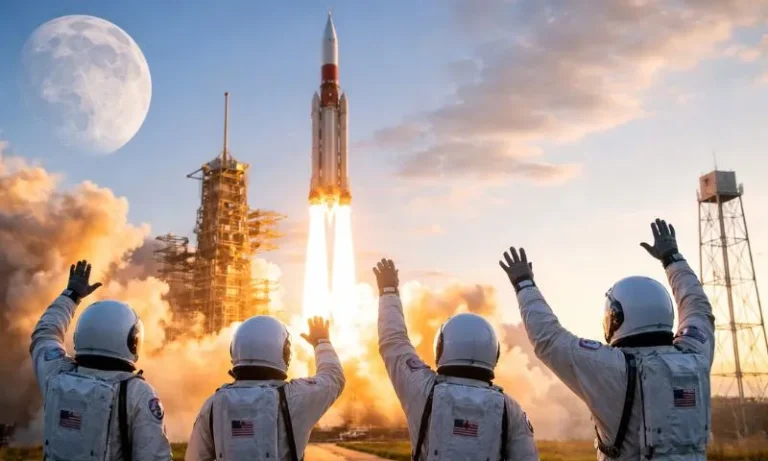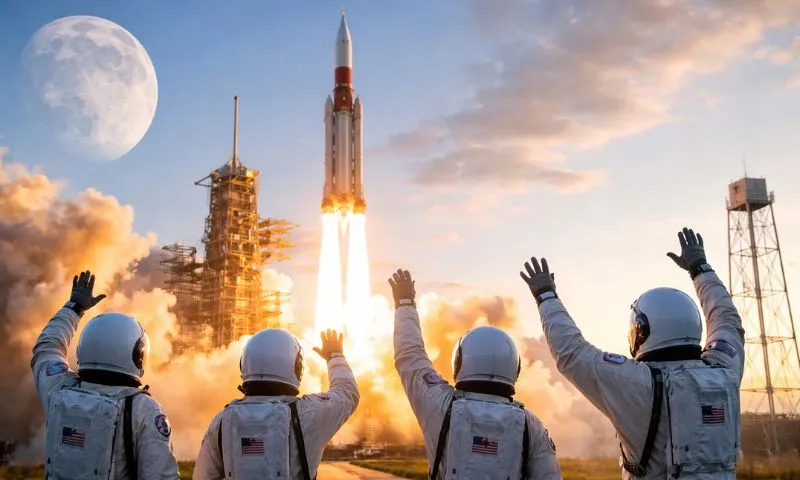
The NASA has successfully launched four astronauts on a historic mission to the Moon, marking the first crewed lunar journey since the Apollo era more than half a century ago.
The mission, part of NASA’s Artemis programme, represents a major step toward returning humans to the Moon and eventually sending astronauts to Mars.
Historic Launch After Decades
The Artemis II mission lifted off from the Kennedy Space Center in the United States, carrying a four-member crew aboard the Orion spacecraft.
This is the first time humans have travelled toward the Moon since 1972, when the last Apollo mission concluded.
The astronauts include Reid Wiseman, Victor Glover, Christina Koch and Canadian astronaut Jeremy Hansen.
The mission is expected to last around 10 days and will take the crew on a journey of more than 250,000 miles, farther than any humans have travelled in decades.
A Test Mission Before Future Moon Landing
Unlike earlier Apollo missions, Artemis II will not land on the Moon. Instead, it will perform a lunar flyby to test systems needed for future exploration.
The astronauts will orbit the Moon and return to Earth, helping NASA assess critical technologies such as life support systems, navigation and deep space communication.
This mission is a key step toward Artemis III, which aims to land astronauts on the Moon later this decade.
A Diverse and Historic Crew
The Artemis II crew reflects a new era of space exploration. Christina Koch is set to become the first woman to travel around the Moon, while Victor Glover will be the first Black astronaut on a lunar mission. Canadian astronaut Jeremy Hansen will be the first non American to join such a journey.
Commander Reid Wiseman expressed the excitement of the mission shortly after launch, saying, “We have a beautiful moonrise, we’re headed right at it.”
Global Significance and Future Goals
NASA officials say the mission is part of a long term plan to establish a sustained human presence on the Moon and use it as a base for future missions to Mars.
The Artemis programme has already involved partnerships with international space agencies and private companies, reflecting a broader global effort to expand human exploration beyond Earth.
Experts say the mission also has geopolitical significance, as countries including China are advancing their own lunar ambitions.
A New Chapter in Space Exploration
The launch has been widely hailed as a milestone moment, reviving human exploration of deep space after decades of focus on low Earth orbit missions.
With Artemis II now underway, attention will shift to the next phase of the programme, which aims to land astronauts on the Moon’s south pole and build a long term lunar presence.