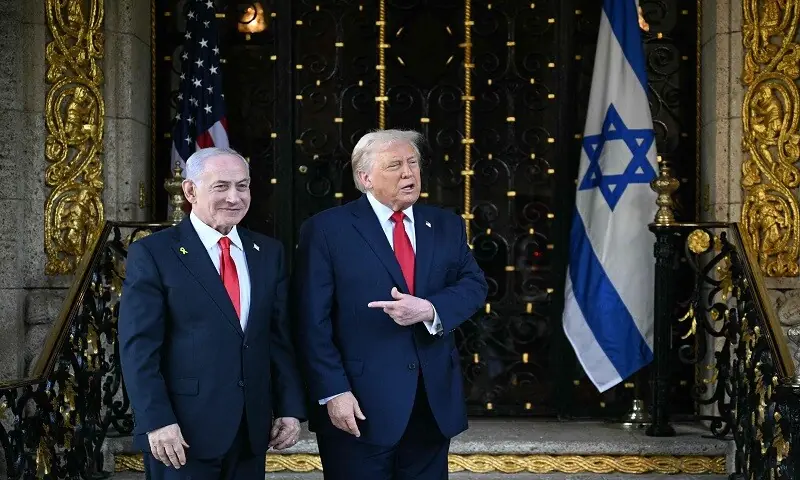
Israeli Prime Minister Benjamin Netanyahu arrived in Florida on Monday for high-stakes talks with US President Donald Trump, as Washington presses for progress on the fragile Gaza ceasefire while Israel seeks to refocus attention on Iran.
The meeting, held at Trump’s Mar-a-Lago residence, comes amid growing concern within the White House that both Israel and Hamas are delaying the second phase of the Gaza truce agreed last year. US officials believe the next stage is critical to preventing a renewed escalation in the war-ravaged enclave.
According to sources familiar with the talks, Trump intends to push Netanyahu to move forward with phase two of the agreement, which includes Israel’s military withdrawal from Gaza, the establishment of a temporary technocratic Palestinian authority, and the deployment of an international stabilization force.
Netanyahu, however, is expected to use the meeting to emphasize what he describes as the growing threat from Iran. Israeli officials say he will urge Washington to maintain pressure on Tehran and consider further action against its missile and nuclear capabilities.
Ahead of his meeting with Trump, Netanyahu held separate discussions with US Secretary of State Marco Rubio and Defense Secretary Pete Hegseth. His office said the talks focused on Gaza’s future security framework and regional threats.
Israeli government spokesperson Shosh Bedrosian said Netanyahu would insist that Gaza must be fully demilitarized and that Hamas be stripped of its weapons — a demand the group has repeatedly rejected.
Hamas’s armed wing, the Ezzedine al-Qassam Brigades, reiterated on Monday that it would not surrender its arms while Israeli occupation continues. In a video statement, the group also confirmed the death of its longtime spokesperson, Abu Obeida, months after Israel said he was killed in an airstrike.
The Gaza ceasefire, brokered with international mediation, is considered one of the major foreign-policy achievements of Trump’s return to the White House. The first phase led to the release of nearly all Israeli hostages taken during Hamas’s October 7, 2023 attack, while Israel scaled back major military operations.
Despite this, mutual accusations of ceasefire violations persist. Israeli strikes have continued in parts of Gaza, while negotiations on governance and security arrangements have stalled.
Reports suggest Trump hopes to announce a Gaza transitional plan as early as January, potentially unveiling it at the World Economic Forum in Davos. However, US officials are said to be increasingly frustrated with Netanyahu’s reluctance to commit publicly to the roadmap.
Analysts say tensions are also rising over Iran. While Israel argues Tehran is rebuilding its missile capabilities, some US experts believe the issue is being amplified to justify renewed confrontation. Iran has dismissed reports of imminent conflict as psychological warfare and warned that any new attack would trigger severe retaliation.
As diplomacy intensifies, the outcome of the Trump-Netanyahu talks could prove decisive for both Gaza’s future and the broader stability of the Middle East.