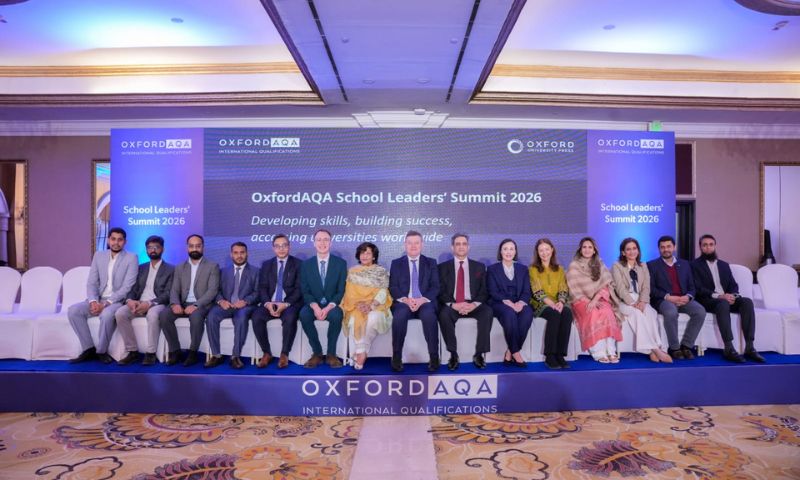
OxfordAQA, a partnership between Oxford University Press and AQA, convened the OxfordAQA School Leaders’ Summit 2026 in Karachi, bringing together more than 100 senior education leaders, policymakers, school heads, and practitioners from across Pakistan.
Held under the global theme “Develop skills, build success, access universities worldwide,” the Summit focused on how education systems must evolve to equip learners with future-ready skills while protecting academic integrity in an increasingly digital and AI-driven learning environment.
Discussions centered on the global shift toward competence-based education, ethical assessment practices, and international progression pathways. Speakers emphasized that skills such as critical thinking, adaptability, and the real-world application of knowledge are becoming as important as subject content in preparing students for higher education, employment, and responsible citizenship.
Opening the Summit, Arshad Saeed Husain, Managing Director of Oxford University Press Pakistan, highlighted the need to rethink traditional learning outcomes:
“Future-ready education goes beyond content delivery. It demands a shift towards competencies, critical thinking, and application; skills that empower learners to thrive in a rapidly changing world.”
Reflecting on OxfordAQA’s expanding engagement in Pakistan, Andrew Coombe, Managing Director of OxfordAQA, said:
“It has been a pleasure to return to Pakistan once again. I am excited about the opportunities OxfordAQA brings to students here, equipping them with the skills and knowledge essential for success in a rapidly changing world.”
He added that the School Leaders’ Summit reflects OxfordAQA’s commitment to re-centering education around skills that support higher education, employment, and global citizenship, while ensuring fairness and integrity as technology reshapes learning and assessment.
Jennifer Duggan, Head of Qualifications at OxfordAQA, underscored the value of collaboration with local educators:
“Working alongside Pakistan’s educational leaders has been a privilege. Their vision and dedication align perfectly with OxfordAQA’s mission to empower learners with the future-ready skills our world needs.”
A keynote address by Dr. Alexandra Tomescu, Generative AI Specialist at Oxford University Press, explored “Balancing Innovation and Integrity: How AI Is Changing the Educational Landscape.” She stressed the ethical use of AI in classrooms and assessments:
“I am excited about the transformative role AI can play in Pakistan’s international schools. It is critical that this technology is used ethically and responsibly, supporting teachers and students while safeguarding trust and integrity in learning.”
She also noted that despite rapid technological advances, critical thinking, creativity, and human ingenuity remain essential.
The Summit also examined skills-based assessment and global university access through insights from Shahnaz Wazir Ali, educationist and social sector development policy specialist, and Matt MacGregor, Professional Development Lead at OxfordAQA. Reflecting on his experience, MacGregor said:
“I am deeply grateful for how warmly OxfordAQA has been welcomed in Pakistan. Encountering the passion, sincerity, and openness of educators here has been inspiring. Their commitment to excellence and eagerness to embrace new ideas create a powerful environment for collaboration.”
Representing OxfordAQA’s work in Pakistan, Salma Adil noted:
“OxfordAQA supports Pakistani schools in delivering internationally benchmarked qualifications while remaining locally relevant. The strong focus on skills, fairness, and progression resonates deeply with educators across the country.”
The Summit concluded with a panel discussion on “Empowering Students with Future-Focused Skills,” followed by an overview of the Oxford International Programme. Continuing sessions in Lahore and Islamabad will further strengthen OxfordAQA’s engagement with Pakistan’s education community and advance skills-based learning nationwide.