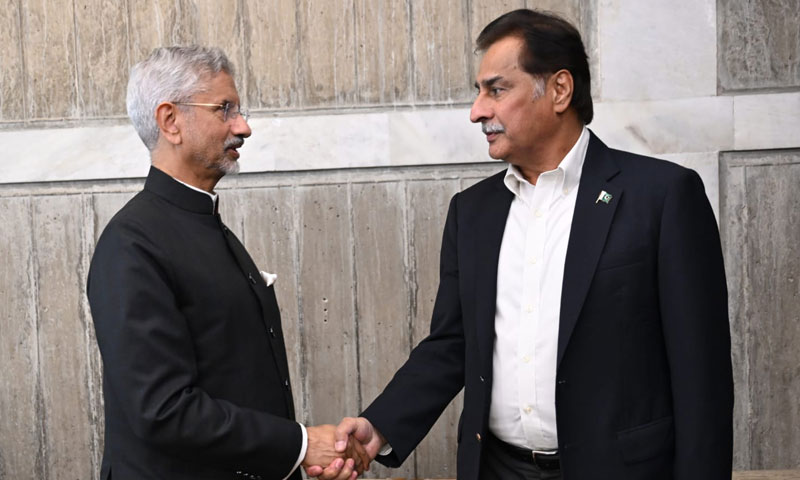
Pakistan’s National Assembly Speaker Sardar Ayaz Sadiq and India’s External Affairs Minister Subrahmanyam Jaishankar shared a brief yet significant diplomatic moment in Dhaka on December 31, 2025, while paying their respects at the funeral of Bangladesh’s former prime minister Begum Khaleda Zia. Their warm greeting and handshake on the sidelines of the state funeral offered a rare positive note in a period marked by regional tensions and shifting alliances in South Asia.
Zia, a towering political figure and the first woman to lead Bangladesh, died at the age of 80 after a prolonged illness, prompting three days of national mourning and a state funeral beside her husband, former President Ziaur Rahman. Thousands gathered in Dhaka’s Manik Mia Avenue and outside the national parliament to pay their final respects. Dignitaries from more than 30 countries, including high-level representatives from India, Pakistan, Sri Lanka, Nepal, Bhutan, and the Maldives, attended the ceremonies under heavy security.
Sadiq travelled to Dhaka to represent Pakistan with condolences from the government and people of Pakistan. He extended sympathy to Zia’s family particularly her son, Tarique Rahman, who now leads the Bangladesh Nationalist Party (BNP) and conveyed messages of support from Pakistani leadership.
Jaishankar arrived separately to deliver a personal condolence letter from Indian Prime Minister Narendra Modi to Tarique Rahman, underscoring New Delhi’s respect for Zia’s role in Bangladesh’s political history and the importance of India–Bangladesh ties. His gesture highlighted the event’s diplomatic weight, as leaders of neighboring countries came together in a shared moment of grief.
The handshake between the Indian and Pakistani officials drew attention because it marked one of the first public exchanges between top representatives of the two countries since clashes earlier in the year had heightened tensions. Several analysts noted that while the meeting was largely symbolic, it carried deep meaning for South Asian diplomacy, suggesting that respect and common human moments can still bridge divides even when formal relations are strained.
Zia’s legacy itself was complex: she led Bangladesh through multiple terms and navigated fierce political rivalries, but also represented democratic struggle and resilience. Her state funeral not only honored her life but also became a rare gathering point for diplomatic engagement among nations whose relations are often tested by history and contemporary conflicts.