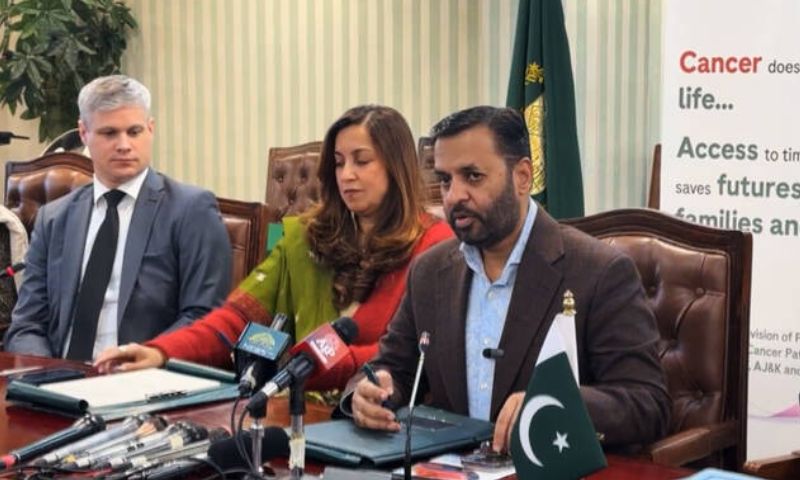
Pakistan took a major step toward reducing the heavy burden of cancer treatment costs by signing a landmark agreement with Roche Pakistan on January 9, 2026, in Islamabad. The agreement was signed at a formal ceremony between the Ministry of National Health Services, Regulations and Coordination and Roche Pakistan. Senior government officials, including Federal Health Minister Syed Mustafa Kamal, and Roche Pakistan’s Managing Director Hafsa Shamsie, led the event.
Under this new partnership, free cancer medicines will be provided to eligible patients from Islamabad, Azad Jammu & Kashmir, and Gilgit-Baltistan. The initiative begins at the Pakistan Institute of Medical Sciences (PIMS) and is set to run for five years, with the scope for future expansion based on its success.
The cost of cancer care in Pakistan is often staggering. According to officials, treatment expenses can reach up to PKR 9.8 million (about $34,500) per patient over five years. For many families, this cost is simply unattainable. The Roche agreement aims to ease that burden by covering 70% of the treatment cost, while the government will contribute 30%, making medicines effectively free for those in need.
Health Minister Mustafa Kamal described the partnership as a “landmark step” toward reducing the affordability gap in cancer care and a strong example of effective public-private collaboration. He highlighted that the medicines will be available to patients free of cost, ensuring access for those without financial means.
The agreement focuses first on medicines for three major cancer types: breast cancer, lung cancer, and liver cancer — diseases that contribute significantly to Pakistan’s cancer burden. In recent years, the country has reported more than 185,000 new cancer cases and over 125,000 cancer-related deaths annually. Breast cancer alone accounts for a large share of these cases, making this initiative a critical support for patients and families facing life-threatening illness.
Roche Pakistan’s long-term work in the country already includes programs to improve access to cancer care for low-income patients. Its earlier UNMOL Patient Support Program has helped thousands of patients access oncology medicines at reduced or no cost and played a role in expanding patient support services nationwide.
Officials from both sides expressed hope that this model of collaboration will strengthen national healthcare and pave the way for more similar partnerships. With cancer incidence rising globally and in Pakistan, this agreement aims to ensure that financial barriers do not prevent access to essential, life-saving medicines.