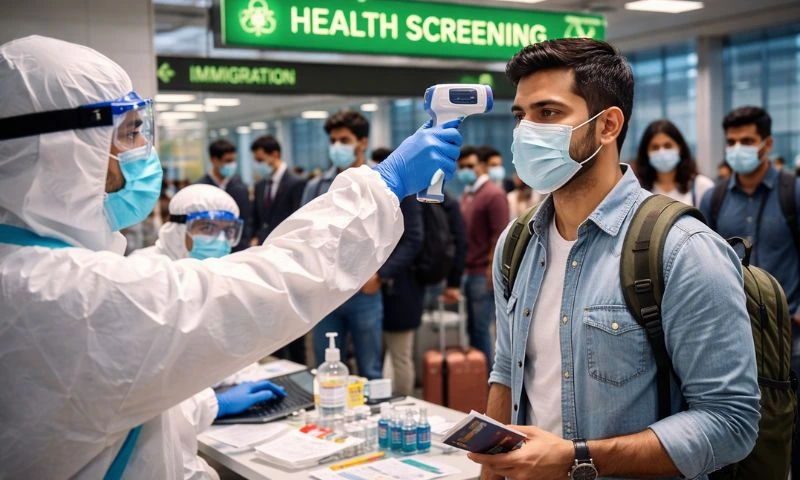
Pakistan has ordered strict and enhanced health screening of all travellers at international borders, airports, seaports and land crossings to guard against the Nipah virus threat, authorities announced this week. The move aims to prevent cross-border transmission after recent confirmed cases in West Bengal, India.
The Border Health Services-Pakistan (BHS-P) under the Ministry of National Health Services issued a comprehensive advisory directing 100% health screening for arriving travellers, including passengers, crew members, drivers and support staff. Travel and transit histories from the past 21 days must be verified for everyone entering the country, regardless of nationality or status.
The enhanced screenings will involve thermal checks and clinical assessments to detect early symptoms such as fever, headache, respiratory distress and neurological signs like confusion or altered consciousness. Anyone showing signs consistent with Nipah virus infection will be isolated immediately and restricted from onward travel, and then referred to designated isolation facilities or tertiary care hospitals.
Officials emphasised that every traveller must be granted health clearance by BHS-P before entering Pakistan. False declarations of travel origins or concealment of travel history will be treated seriously and reported for further action.
Nipah virus, carried naturally by fruit bats and sometimes pigs, is classified by the World Health Organization (WHO) as a priority pathogen due to its high fatality rate — ranging from 40% to 75% — and potential for human-to-human spread through close contact. There is currently no approved vaccine or specific cure.
Health authorities have also urged provincial labs to strengthen capabilities for safe sample handling and transport, and rapid response teams are to be placed on standby for contact tracing and cluster investigations if a suspected infection emerges.
While no human cases have been reported in Pakistan so far, the National Institute of Health (NIH) issued alerts to healthcare providers and authorities, warning that outbreaks in neighbouring regions could pose risks. Reuters reported that India has confirmed Nipah virus cases in West Bengal, prompting increased screening across the region.
Experts have stressed vigilance but also cautioned against panic. Prof Dr Javaid Usman, a microbiologist, noted that the virus spreads through droppings from fruit bats and pig contacts, meaning any introduction to Pakistan would likely occur via carriers rather than community transmission.
Infectious disease expert Dr Rana Safdar explained that Nipah outbreaks have occurred sporadically in South and Southeast Asia. “The risk of spread to surrounding countries thus far remains moderate to low, but surveillance and preparedness must stay strong,” he told Dawn.
Public health authorities are urging returning travellers who develop symptoms within 21 days of exposure to self-isolate, seek medical care early and share their travel history with providers.