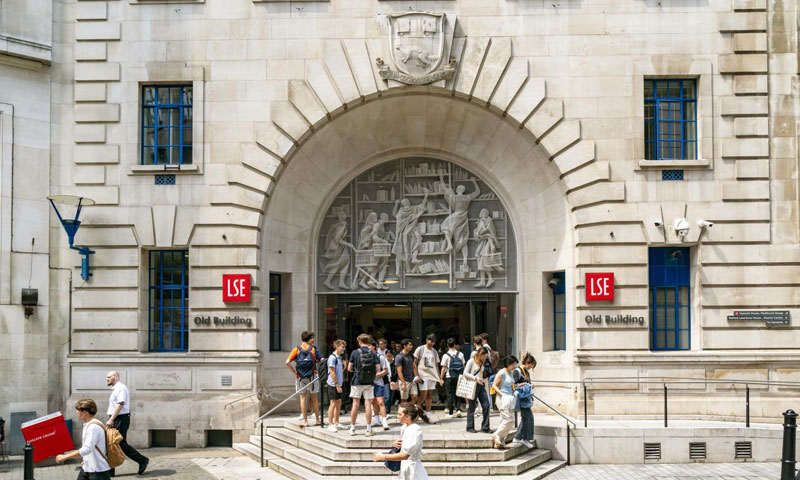
A Pakistani student has launched legal proceedings against London School of Economics and Political Science, alleging that a flawed marking process during her undergraduate degree cost her a crucial academic opportunity and caused lasting personal and professional harm.
Rehab Asad Shaikh, originally from Khairpur Gambat in Sindh, is seeking compensation and formal acknowledgment from LSE after her undergraduate dissertation was initially awarded a low mark under exceptional circumstances — a decision that later proved to be significantly wrong.
Shaikh moved to the UK in 2020 after graduating from Karachi Grammar School. She completed her undergraduate studies in policy-related disciplines at LSE in 2023. Her ambition at the time was to pursue an MPhil at University of Cambridge. However, her plans were disrupted when her final dissertation received a mark of 57, narrowly missing the threshold required for competitive MPhil admissions.
The marking took place during the nationwide UK Marking and Assessment Boycott in 2023. As a result, Shaikh’s dissertation was assessed by a single examiner, rather than the standard double-marking process designed to ensure quality control and fairness.
Believing the process had placed her at a disadvantage compared to her peers, Shaikh pursued every available channel for redress. She filed academic appeals, submitted formal complaints, and eventually escalated her case to the Office of the Independent Adjudicator, the body that oversees student complaints against UK universities.
After more than two years, LSE agreed to re-mark her dissertation. The result was dramatic: her score rose from 57 to 72, a rare 15-point increase.
Despite this correction, LSE concluded that no fault had occurred and that Shaikh had suffered no material disadvantage. The university rejected claims of harm, describing the stress, delays, and lost opportunities she experienced as “self-reported” and “not compelling.”
Shaikh strongly disputes that assessment. She told that the original mark directly affected her academic choices, forcing her to abandon her Cambridge plans and instead pursue a master’s degree at University of Oxford, where she later completed a programme in Modern South Asian Studies.
Following the re-mark, her transcript briefly indicated she had been awarded a departmental academic prize, only for the recognition to be withdrawn hours later and then reinstated after further correspondence. Shaikh says the episode illustrates how institutions can minimise the emotional impact of their actions.
Now employed in a senior role within a UK government ministry, Shaikh believes her career trajectory might have been different had the original error not occurred.
“My case is not just about a mark,” she said. “It’s about accountability, transparency, and whether universities take student welfare seriously when things go wrong.”
She added that since speaking publicly, other students have come forward with similar experiences involving long delays, opaque procedures, and limited empathy once students leave an institution.
“A 15-point mark change is extraordinary,” she said. “A two-and-a-half-year wait is damaging. The real question is whether the system is equipped to respond fairly — and humanely — when students challenge outcomes.”