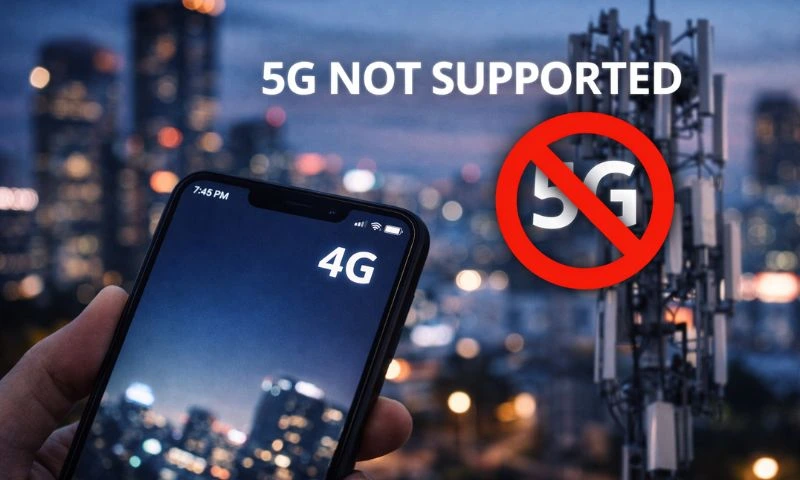
Pakistan’s long-awaited 5G rollout has begun, but many users are facing an unexpected limitation. Despite having 5G-capable smartphones, a large number of users with iPhones, Google Pixel devices, and some Samsung models are currently unable to access the new network.
According to reports, the issue is not related to hardware limitations but rather software restrictions and lack of official carrier approvals.
Why 5G Is Not Working on Premium Phones
The primary reason behind this limitation lies in how global smartphone manufacturers control 5G access. Apple, Google, and Samsung require telecom operators to receive official certification before enabling 5G on their devices.
In the case of Apple, 5G is activated through carrier bundles. Without approval, the option remains disabled on iPhones. As explained, “5G will not work on an iPhone until the carrier pushes the required carrier bundle.”
Similarly, Google restricts 5G access on Pixel devices through firmware-level controls. If a telecom operator is not officially supported in a region, the device will remain locked to 4G networks.
Samsung follows a different approach using a Country Specific Code system. Devices connected to uncertified networks, especially imported models, may not enable 5G functionality.
Certification Delays Behind the Issue
The root of the problem appears to be timing. Pakistan’s 5G rollout has moved quickly, but telecom operators such as Jazz, Zong, and Ufone have not yet completed certification processes with global manufacturers.
Industry sources indicate that these approvals are essential for enabling 5G compatibility on premium devices. Without them, even the most advanced smartphones cannot access local 5G networks.
One telecom operator has already acknowledged the limitation, confirming that 5G is currently not supported on iPhones and that efforts are underway to expand compatibility.
Some Brands Already Working
Interestingly, not all smartphones are affected. Brands like Xiaomi, Oppo, and Vivo are reportedly less restrictive and allow easier access to 5G networks without extensive certification requirements.
This has created a situation where mid-range devices from certain manufacturers may support 5G, while premium flagship phones remain limited to 4G for now.
User Frustration Grows
The issue has sparked frustration among users, especially those who invested in expensive flagship devices expecting full 5G functionality.
Many users are questioning why commercial 5G services were launched before ensuring compatibility with major global brands. For now, most affected users will continue relying on 4G despite the availability of 5G infrastructure.
What Happens Next
Telecom operators are actively working with manufacturers to resolve the issue. Once approvals are granted and updates are rolled out, affected devices are expected to gain access to 5G networks.
However, no official timeline has been provided, leaving uncertainty around when full compatibility will be achieved.
Pakistan’s 5G journey has officially begun, but this early limitation highlights a key reality. Next-generation connectivity depends not only on network infrastructure but also on global ecosystem alignment between telecom operators and device manufacturers.