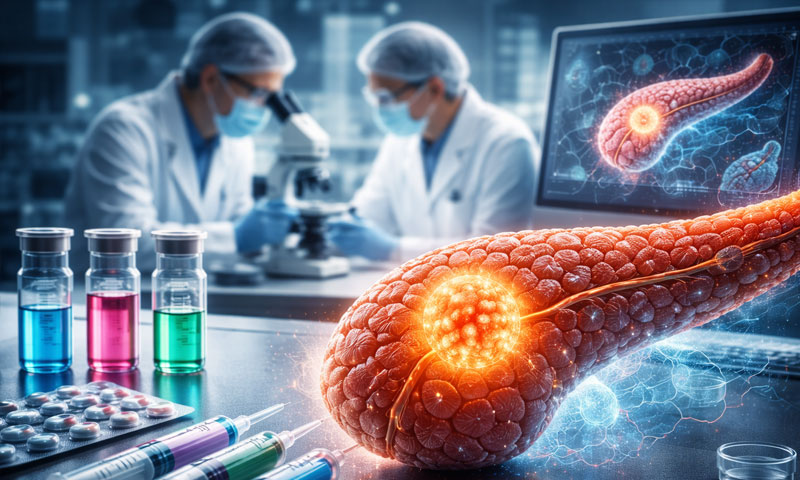
Scientists in Spain have taken a major step forward in the fight against pancreatic cancer, one of the deadliest forms of the disease. Researchers led by Dr. Mariano Barbacid, a prominent Spanish molecular biochemist, have developed a triple-drug combination therapy that completely erased pancreatic tumors in mice — an achievement that could pave the way for future human treatments.
Pancreatic cancer is notoriously aggressive, with most patients diagnosed at a late stage and fewer than 10% surviving five years after diagnosis. This poor prognosis is due in part to the cancer’s resistance to traditional therapies and its complex biology.
The new study, conducted at the Spanish National Cancer Research Centre (CNIO) in Madrid, used a combination of three drugs that together target key pathways in tumor growth. In laboratory mice with the most common and lethal type of pancreatic cancer — pancreatic ductal adenocarcinoma (PDAC) — the therapy not only eliminated tumors but also prevented them from returning over extended observation periods.
What makes this development particularly remarkable is that the triple therapy appears to work without significant toxicity. In the mouse models, animals remained tumor-free for months after treatment and showed few side effects. The research was published in the Proceedings of the National Academy of Sciences (PNAS), emphasizing its scientific significance.
Dr. Barbacid is not new to cancer research. He is widely recognised for his earlier work isolating the first human oncogene — a gene that can transform normal cells into cancer cells — which laid the foundation for understanding malignant growth at a molecular level.
Experts caution that success in animal models does not guarantee a cure for humans yet, but the results are undeniably promising. Translating these findings into clinical trials will require careful safety evaluation, regulatory approvals and likely several years of additional research. Still, the progress marks a critical milestone in pancreatic cancer science.
Pancreatic cancer research is advancing on multiple fronts. Other groups worldwide are exploring innovative treatments such as immunotherapy combinations, targeted gene inhibitors, and new diagnostic tools for early detection — all aimed at overcoming the disease’s biological defenses.
For example, novel immunotherapy strategies are showing promise in preclinical models by encouraging tumor regression, and new blood tests may help detect pancreatic cancer at an earlier, more treatable stage.
The CNIO breakthrough adds a powerful new candidate to the growing list of experimental therapies. If future research confirms these results in human clinical trials, it could one day transform treatment for a cancer type that today offers patients very limited options.