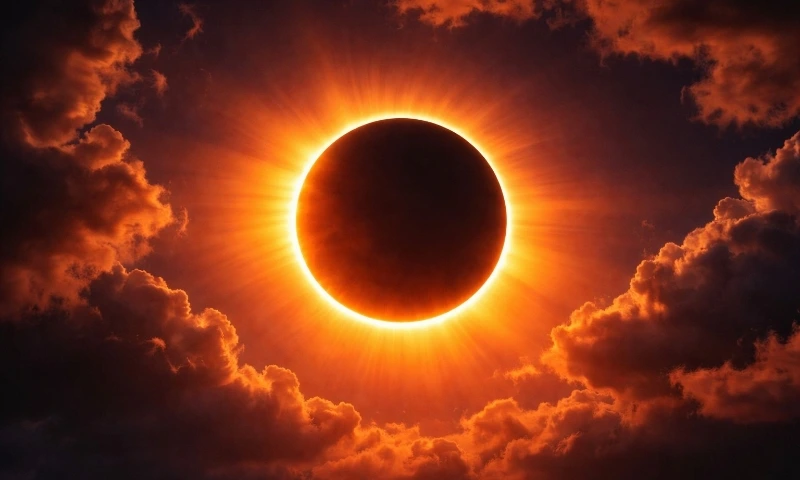
Sky watchers around the world are preparing for a spectacular astronomical event as the first solar eclipse of 2026 is scheduled for February 17. This event will be an annular solar eclipse, often referred to as a ring of fire eclipse, when the Moon moves directly between the Earth and the Sun but does not completely block it.
An annular eclipse occurs when the Moon is near its farthest point from Earth in its orbit. Because it appears slightly smaller in the sky, it cannot fully cover the Sun’s disk. Instead, a bright ring of sunlight remains visible around the Moon, creating the dramatic ring of fire effect. At the peak of this eclipse, nearly 96 percent of the Sun’s surface will be covered.
The full ring effect will only be visible in limited parts of the world. The path of annularity is expected to pass mainly across remote regions of Antarctica. Observers in parts of southern Africa, the southern tip of South America, and nearby oceanic areas will witness a partial solar eclipse, where only part of the Sun appears obscured.
Unfortunately, Pakistan and most of Asia will not be able to see this eclipse directly, as they lie outside the visibility path. However, astronomy enthusiasts can follow live streams and virtual coverage provided by observatories and space agencies. These broadcasts allow viewers to experience the celestial event safely and in real time.
Solar eclipses are not just visually impressive. They also provide valuable opportunities for science education and public engagement. Educators often use these events to explain how the Sun, Moon and Earth align, as well as how orbital mechanics shape what we see in the sky. Experts always remind the public that looking directly at the Sun without proper protection can cause serious eye damage. Anyone observing a solar eclipse must use ISO certified eclipse glasses or indirect viewing methods.
This February eclipse marks the beginning of an active eclipse season in 2026. A total lunar eclipse is scheduled for early March, offering another dramatic display in the night sky for viewers in certain regions.
Although the ring of fire will not be visible from Pakistan, excitement around the world continues to build. For astronomy lovers, February 17 promises a reminder of how dynamic and beautiful our solar system can be.