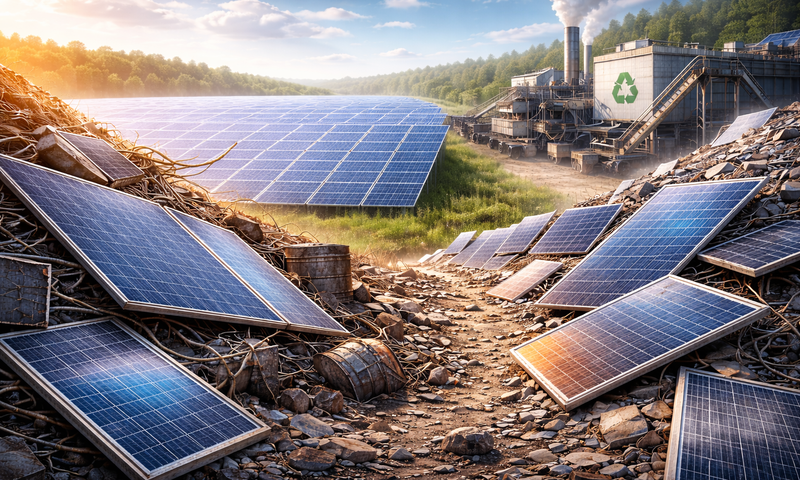
The global shift toward solar energy is accelerating at an unprecedented pace — and Pakistan is no exception. Rising electricity prices, frequent power outages, and falling solar panel costs have pushed households, businesses and industries across the country to embrace rooftop and utility-scale solar power. For millions, solar energy has delivered cheaper, uninterrupted electricity and relief from the national grid.
However, experts warn that behind this clean-energy success story lies a slow-building environmental challenge: solar panels do not last forever.
Solar panels are not lifetime assets
Most solar panels have an operational lifespan of 25 to 30 years. After that, their efficiency drops sharply, making them uneconomical to use. While today’s installations are still relatively new, the first wave of large-scale solar panels installed globally is already approaching retirement.
International energy and environmental agencies caution that once these panels reach end-of-life, they become complex electronic waste — bulky, difficult to recycle, and potentially hazardous if dumped improperly.
According to global energy assessments, millions of tonnes of solar panel waste are expected to accumulate worldwide over the next two decades. Countries that adopted solar early, including parts of Europe, the United States and East Asia, are already beginning to face disposal and recycling challenges.
Why solar panel waste is difficult to manage
Solar panels are made from glass, aluminium frames, silicon cells, plastics, and trace amounts of toxic materials such as lead and cadmium. While much of the material is recyclable, the process is neither simple nor cheap.
Unlike conventional scrap, solar panels require specialised facilities to safely separate and process their components. Without proper recycling systems, panels risk ending up in landfills, where broken glass and toxic substances can contaminate soil and groundwater.
Environmental analysts warn that if unmanaged, today’s green solution could become tomorrow’s e-waste crisis.
Pakistan’s growing risk
Pakistan’s solar market has expanded rapidly in recent years, with imported panels flooding the market and rooftop systems multiplying across urban and rural areas. Yet, there is currently no comprehensive national policy to handle solar panel waste once these systems reach the end of their life.
Experts say Pakistan risks repeating the mistakes seen with plastic waste and electronic scrap, where lack of planning led to environmental and health hazards. Given the scale of current installations, the country could face thousands of tonnes of retired panels in the coming decades.
The global response: recycling and regulation
Some countries have already started addressing the issue. In parts of the European Union, solar panels are legally classified as electronic waste, making manufacturers responsible for collection and recycling. Dedicated recycling plants can now recover up to 90 percent of panel materials, including glass and aluminium, and reuse silicon for new panels.
Researchers are also developing next-generation panels that are easier to recycle and use fewer toxic components. Others are exploring circular economy models, where old panels are refurbished, repurposed, or broken down into raw materials for reuse.
In Germany, one of Europe’s largest solar markets, solar panels have been covered under the WEEE framework since 2014. Panel producers must register with a national waste authority and participate in approved recycling schemes. Germany now operates specialised facilities that can recover:
Glass and aluminium frames
Silicon from solar cells
Other reusable materials
Recycling rates for solar panels in Germany can exceed 85–90 percent by weight, according to industry and regulatory data.
What can be done in Pakistan
Energy and environmental experts argue that Pakistan still has time to act — but only if planning begins now. Key recommendations include:
Introducing solar waste regulations alongside renewable energy policies
Encouraging producer responsibility, making importers and manufacturers part of recycling solutions
Investing in local solar recycling facilities
Promoting research into panel reuse and second-life applications
Raising public awareness that solar panels are not permanent assets
A choice before the crisis
Solar energy remains a vital tool in reducing carbon emissions and easing Pakistan’s energy crisis. But specialists stress that sustainability does not end at installation.
Without foresight, the panels powering homes today could become an environmental burden tomorrow. With proper policy, technology, and regulation, however, solar waste can be transformed into a managed resource rather than a looming crisis.