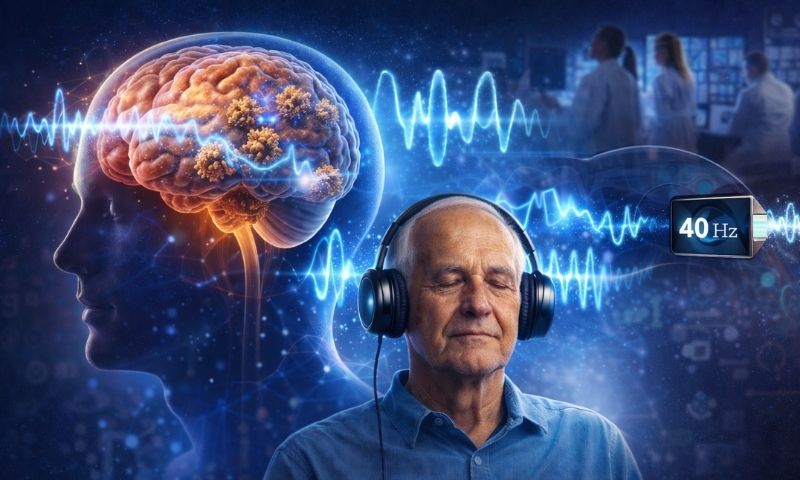
Researchers are exploring a surprising new frontier in Alzheimer’s disease treatment: sound therapy. Recent scientific studies suggest that specific sound frequencies especially 40 Hz could help the brain clear toxic proteins and slow cognitive decline, offering hope for a future non-invasive therapy for the devastating neurodegenerative condition that affects millions worldwide.
Alzheimer’s disease causes memory loss, confusion, and impaired thinking. These symptoms are linked to the buildup of abnormal proteins like beta-amyloid plaques and tau tangles in the brain, which damage neurons and disrupt brain function. Current treatments can ease symptoms, but there is still no cure that stops the disease’s progression.
A recent study that has gained attention from scientists and the public examined 40 Hz sound stimulation in non-human primates. In this research, elderly rhesus monkeys listened to a low-frequency 40 Hz sound for one hour each day for a week. Scientists found that levels of beta-amyloid in the cerebrospinal fluid increased, indicating that the brain was clearing toxic proteins more effectively. This effect didn’t disappear quickly — it persisted weeks after the sound stimulation ended.
Experts believe this type of therapy might work by resynchronizing brain activity and enhancing the brain’s waste-clearing system. In healthy brains, synchronized electrical rhythms help regulate processes like cleaning out harmful proteins. But in Alzheimer’s, these rhythms become disrupted. Sound stimulation at specific frequencies at least partially restores these rhythms, helping the brain flush out beta-amyloid plaques.
The underlying mechanism of this effect has been studied in rodents and humans as well. Research shows that 40 Hz sensory stimulation whether light or sound can reduce amyloid burden and improve measures related to cognition in animal models. Early small human trials also suggest that daily 40 Hz sensory stimulation may slow cognitive decline and reduce biomarkers linked to Alzheimer’s progression.
This approach, sometimes referred to as gamma frequency sensory stimulation, is being tested in larger clinical trials. Devices delivering coordinated light and sound at 40 Hz are under evaluation to determine if long-term use can help patients in the real world. A phase III clinical trial is underway to assess the effectiveness of such interventions in a broader group of Alzheimer’s patients.
Separately, traditional music therapy and familiar audio have long been used to improve mood, social interaction and emotional well-being in people with dementia, though not specifically as a disease-modifying treatment.
While researchers caution that sound therapy is not yet a proven cure, the accumulating evidence suggests it could become a valuable part of future Alzheimer’s treatment strategies — one that is non-invasive, affordable, and safe.