For decades, the idea of a friendly robot butler handling boring household chores lived firmly in science fiction. In 2026, that vision is beginning to take physical shape. Thanks to rapid advances in artificial intelligence and robotics, the first generation of truly multi-purpose domestic robots is preparing to enter homes slowly, carefully, and with human help still firmly in the loop.
In Silicon Valley, start-ups are racing to train robots to fold laundry, load dishwashers, water plants and clean kitchens. The promise is bold. The reality, for now, is more cautious.
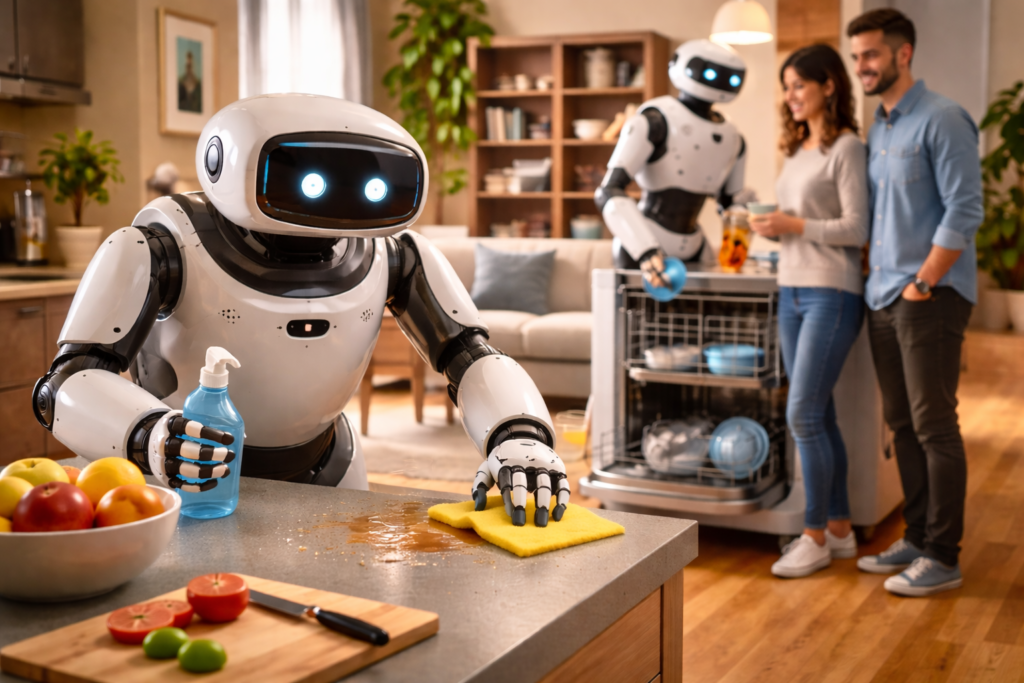
At Tangible AI, a young start-up, its robot Eggie can hang up jackets, strip beds and wipe spills. Standing around 4.5 feet tall, Eggie moves on wheels and performs tasks with bulky robotic arms. The actions are impressive but slow. Crucially, Eggie is remotely controlled by a human operator, a fact largely absent from promotional videos.
Bipasha Sen, founder of Tangible AI, remains confident.
“Today people have two aspirations — a car and a house. In the future they’ll have three aspirations — a car and house and a robot,” she says.
A similar story plays out at 1X, a robotics firm backed by Nvidia. Its humanoid robot NEO can water plants, fetch drinks and tidy dishes, although it struggles with cupboard handles. Norwegian CEO Bernt Børnich admits the system relies on both autonomy and human intervention.
“We have a lot of data so a lot of the stuff in my home can get automated but periodically someone kind of steps in and helps,” he says.
NEO is expected to cost around $20,000 or $500 per month, limiting early adoption to wealthy customers who are comfortable with remote human oversight.
Elsewhere, Weave Robotics has taken a narrower approach. Its stationary robot Isaac is already operating autonomously in San Francisco laundromats, folding T-shirts in about 90 seconds.
“Deployment is the strategy,” says co-founder Evan Wineland.
At Sunday AI, engineers demonstrated Memo, a robot capable of clearing tables and making coffee without human control — although it did break a wine glass during testing. Co-founder Tony Zhao explained how wearable gloves help gather real-world training data from hundreds of homes.
Meanwhile, Physical Intelligence is focusing on robot “brains” rather than bodies. Backed by investors including Jeff Bezos and OpenAI, the company aims to create AI that can power any physical robot.
“We want to be able to breathe intelligence into any sort of physical embodiment,” says co-founder Chelsea Finn.
Despite massive investment and growing competition from China, experts remain cautious. The International Federation of Robotics estimates it could take 20 years before domestic robots become truly useful and widely accepted.
For now, robot housekeepers are no longer fantasy but they are not yet independent helpers either.