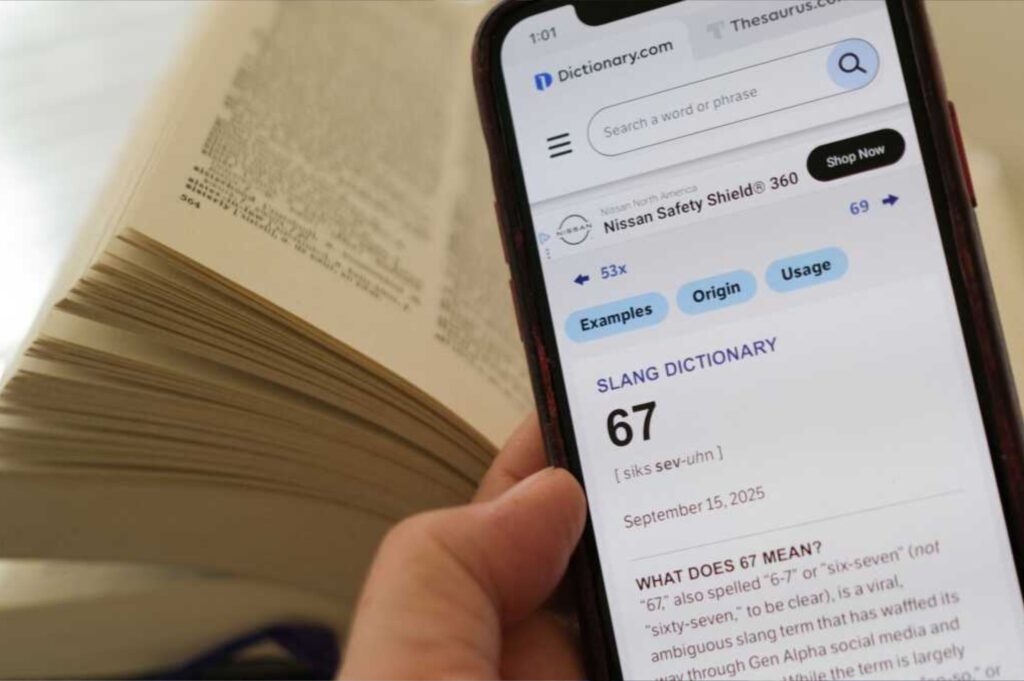
Each year, dictionaries and linguists highlight a word or phrase that captures the spirit of the time — and for 2025, that title belongs to a simple, seemingly innocuous number: “67.” What started as an obscure slang term on youth social platforms evolved into a cultural phenomenon that linguists now say reflects how young people think, feel, and communicate today.
Originally circulating on platforms like TikTok, Instagram, and X, “67” became shorthand among teenagers and Gen Z users for a vibe that’s hard to pin down with a single word. It’s not just about the literal number; it embodies a kind of ambiguous mood, often used to signal a feeling that’s “sort of right, sort of off,” or to caption moments that feel odd, existential, or ironically imperfect. This flexible use helped the term spread quickly beyond niche communities into mainstream social feeds, meme culture, and everyday texting.
Linguists studying digital communication noticed that “67” was being deployed in ways similar to past internet-born terms: as an emotional shorthand, a mood label, and a playful in-joke that invites shared understanding without explicit definition. The term’s rise was so notable that major dictionaries began tracking its usage frequency throughout 2025. By analyzing billions of public social posts, lexicographers observed surges whenever viral videos or cultural moments leaned into the “67 mood” from awkward family gatherings to surreal celebrity moments.
Critics and commentators have had fun speculating about why “67” resonated so widely. Some see it as a reaction to an era marked by mixed signals and fast-changing trends: a number that encapsulates everything and nothing at the same time. Others likened it to previous words of the year that captured collective emotion during periods of uncertainty and transition. Teen culture, in particular, embraced “67” precisely because it’s open-ended — a Rorschach test of feeling, shaped by context, tone, and personal interpretation.
Educators and language experts note that this isn’t the first time numbers have crossed into linguistic territory. Think of how “404” became synonymous with error and absence long before smartphones dominated communication. But few numerical memes have achieved the lexical staying power of “67” in defining a full year’s digital expression.
While some may dismiss “67” as just another fleeting internet fad, its journey from obscurity to official recognition suggests something deeper about how language evolves online. It’s a reminder that modern vocabulary isn’t just written in dictionaries. It’s lived, shared, and remade every day through the social platforms where people connect.