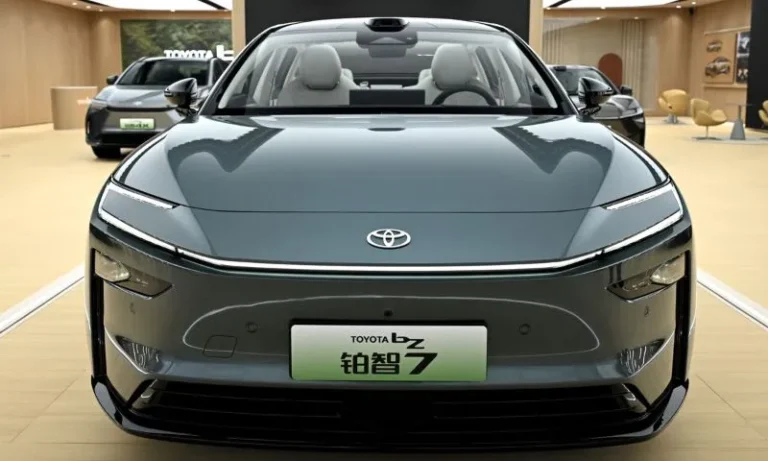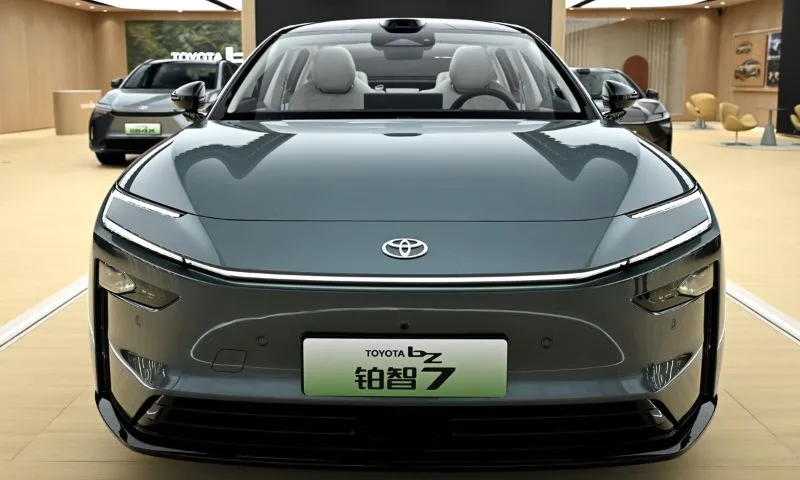
Japanese automaker Toyota has officially launched its new luxury electric sedan, the Toyota bZ7, in China, marking a significant step in its expanding electric vehicle strategy.
The vehicle has already made a powerful market entry, securing more than 3,000 bookings within just one hour of launch, reflecting strong consumer demand in the world’s largest EV market.
Affordable luxury positioning shakes up EV segment
The Toyota bZ7 has been introduced as an “affordable luxury” electric sedan, with a starting price of 147,800 yuan, approximately 21,500 dollars.
The model is available in five variants, with the top-end version priced at 199,800 yuan, or roughly 29,000 dollars. This pricing places it in direct competition with electric vehicles from brands such as BYD and Tesla, both of which dominate China’s EV landscape.
Industry analysts note that Toyota’s competitive pricing strategy is aimed at regaining market share in China, where local manufacturers have taken a strong lead in electric mobility.
Advanced technology and smart ecosystem integration
The bZ7 comes equipped with cutting-edge technology designed to enhance user experience and connectivity.
It features Huawei HarmonyOS 5.0, making it one of Toyota’s most technologically advanced vehicles to date. The system allows seamless integration with Xiaomi’s smart ecosystem, enabling users to control home devices directly from the car.
In addition, the car includes Momenta’s R6 advanced driver assistance system, supported by a roof-mounted LiDAR, allowing autonomous driving capabilities in both urban and highway environments.
Performance and battery efficiency
The Toyota bZ7 is powered by a front-wheel-drive electric motor producing 118 kW of power and 250 Nm of torque.
The sedan accelerates from 0 to 100 kilometers per hour in 8.7 seconds, offering a balance between performance and efficiency.
Two battery configurations are available:
- 71 kWh battery offering up to 600 km range
- 88 kWh battery offering up to 700 km range
The vehicle also supports fast charging, allowing it to charge from 10 percent to 80 percent in approximately 28 to 30 minutes, depending on the variant.
Premium interior and comfort features
Toyota has focused heavily on comfort and luxury in the bZ7’s interior design.
The vehicle features zero-gravity front seats with heating, ventilation, and massage functions. It also includes a 15.6-inch infotainment display and a 27-inch head-up display, offering a high-tech driving experience.
These features position the bZ7 as a strong competitor in the premium EV segment while maintaining affordability.
Part of Toyota’s China-focused EV strategy
The launch of the bZ7 reflects Toyota’s broader strategy to develop China-specific electric vehicles to compete with local manufacturers.
The company has been working closely with Chinese partners such as GAC to introduce technologically advanced and cost-effective EVs tailored for the domestic market.
China remains the largest and most competitive EV market globally, with intense price competition and rapid technological innovation.
Potential impact on Pakistan market
While the Toyota bZ7 is currently limited to China, its launch raises questions about its potential arrival in Pakistan.
Experts suggest that if introduced locally, the bZ7 could attract buyers looking for a luxury yet relatively affordable electric vehicle. However, challenges such as limited charging infrastructure, high import duties, and evolving EV policies may affect its adoption.
Pakistan’s EV market is gradually growing, with increasing interest in hybrid and electric vehicles, but infrastructure development remains a key hurdle.
Global EV race intensifies
Toyota’s move comes amid increasing competition in the global EV market, particularly in China, where companies like BYD and Tesla continue to dominate.
The bZ7 represents Toyota’s effort to close the technology gap and offer competitive alternatives with advanced software integration and longer driving ranges.