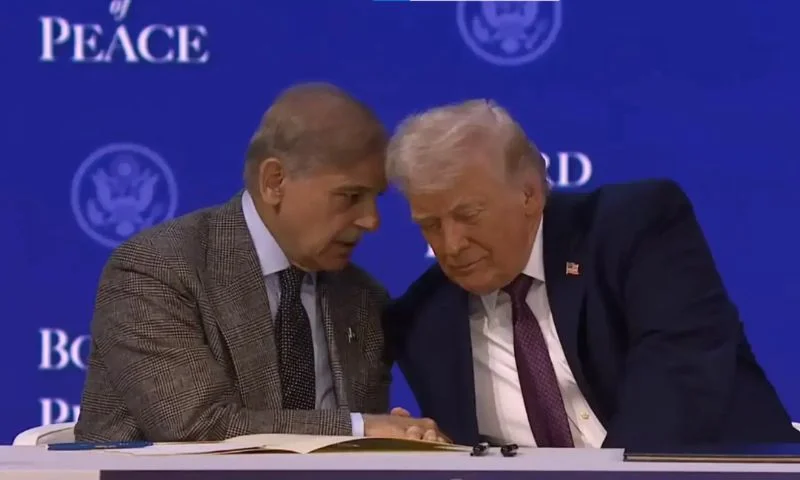
At the inaugural meeting of the Board of Peace in Washington, D.C., U.S. President Donald Trump publicly praised Pakistan’s Prime Minister Shehbaz Sharif and Chief of Defence Forces (CDF) Field Marshal Asim Munir, underscoring Pakistan’s role in regional peace efforts and the ongoing diplomatic engagement between Islamabad and Washington. The high-profile summit focused on Gaza reconstruction, peacekeeping plans and broader global stability challenges.
Strong Words from Trump at the Summit
In his address at the U.S. Institute of Peace, President Trump singled out Pakistan’s leadership, saying: “I like this man [PM Shehbaz] of Pakistan”, and referring to Field Marshal Munir as a “tough, good fighter, a serious fighter.” Trump’s remarks were widely reported by media attending the meeting, with world leaders gathered to discuss the future of Gaza and international cooperation.
The Board of Peace was launched by Trump to mobilise global support for Gaza’s reconstruction and lasting ceasefire after years of conflict. Earlier at the meeting, Trump announced that more than $7 billion had been pledged by contributing countries for humanitarian relief and rebuilding efforts, alongside a $10 billion U.S. contribution. The funds are earmarked to restore infrastructure, provide essential services and support long-term development once a ceasefire holds.
Read More: Trump Leads First Board of Peace Meeting: The Global Peace Plan Faces Criticism
Pakistan’s Role and Diplomatic Balancing
Prime Minister Shehbaz Sharif attended the summit representing Pakistan, highlighting Islamabad’s willingness to engage on peace initiatives while maintaining a careful stance on troop deployment. Reuters reported that Pakistan wants clarity that any involvement by its forces would be strictly peacekeeping and not include combat or disarmament of Hamas.
Shehbaz’s presence and Trump’s praise came amid broader U.S.–Pakistan cooperation on issues from economic ties to regional stability. Pakistan has previously worked with Washington to mediate tensions in South Asia, including assisting in ending a brief conflict with India in 2025. Trump has acknowledged this cooperation and thanked Pakistan’s leadership for helping prevent further escalation.
Pakistan’s military leadership has also been a key partner in these engagements. Field Marshal Asim Munir’s role as CDF has placed him at the centre of Islamabad’s security conversations with international partners. Trump’s reference to Munir as a “serious fighter” reflects Washington’s recognition of Pakistan’s military capabilities and its influence in regional security dialogues.
Read More: Gaza After the War: Trump Assembles US-Led Board, Appoints Blair and Military Chief
Board of Peace: Ambitions and Controversies
Despite strong financial pledges and diplomatic support, the Board of Peace has drawn criticism from some Western nations and international observers who argue that it could undermine the United Nations’ role in conflict resolution. Some countries have not joined the board, citing concerns about its mandate and potential political implications.
Trump’s initiative also aims to form an International Stabilisation Force to help secure post-conflict zones like Gaza, with commitments from several nations to contribute personnel. Indonesia, for example, agreed to a deputy command role in the force during discussions at the meeting.
Looking Ahead
The inaugural Board of Peace meeting showcased Pakistan’s growing engagement in international diplomacy, particularly on issues linked to peace and humanitarian aid. Trump’s public praise for Shehbaz Sharif and Munir suggests strong bilateral relations between Pakistan and the United States even as Pakistan navigates its domestic and regional priorities in global forums.