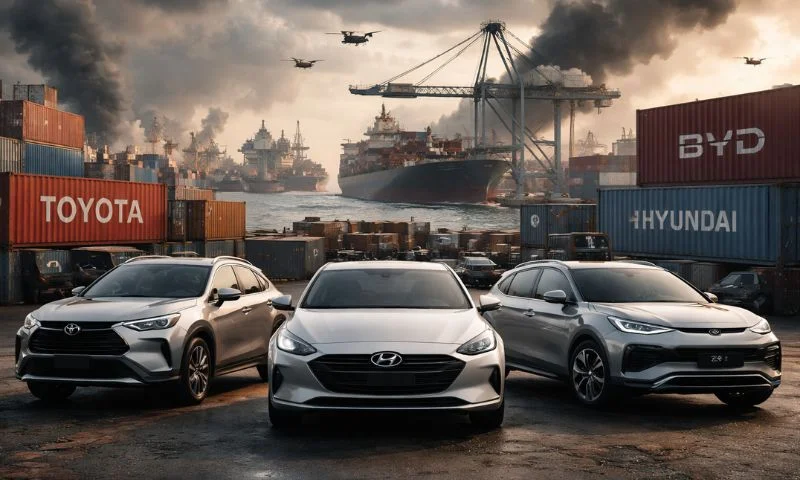
Growing geopolitical tensions and conflicts are beginning to ripple across the global automotive industry. Major carmakers such as Toyota, Hyundai and several Chinese electric vehicle manufacturers are expected to face the biggest impact as disruptions in energy prices, shipping routes and supply chains intensify.
The modern auto industry relies heavily on a complex international supply chain. Parts, batteries, semiconductors and rare earth minerals often travel across several countries before a car reaches consumers. When wars or geopolitical conflicts emerge, shipping costs increase, energy prices rise and logistics networks become unstable. Analysts say these factors directly affect vehicle production costs and demand worldwide.
Why Toyota and Hyundai Could Be Vulnerable
Japanese and South Korean carmakers have built global supply networks and rely heavily on exports to key markets. This makes companies like Toyota and Hyundai particularly vulnerable to disruptions in trade routes and shipping channels.
If energy prices continue to climb and shipping risks increase, export-driven automakers may face declining sales and higher operational costs. According to industry observers, these companies depend on stable international trade and efficient maritime logistics. Any prolonged disruption could squeeze margins and slow deliveries to major markets such as North America, Europe and Asia.
Recent trade tensions have already shown how sensitive the auto sector is to tariffs and political decisions. In 2025, the United States imposed a 25 percent tariff on imported automobiles and parts, increasing costs for foreign manufacturers and creating uncertainty across the global industry.
Read More: Toyota Set to Unwind $19 Billion in Shares in Historic Move
Chinese EV Giants Face a Different Kind of Risk
Chinese electric vehicle companies such as BYD, Geely and others have emerged as global leaders in EV manufacturing. China now produces more vehicles than any other country and dominates the supply chain for key EV battery materials like lithium, nickel and rare earth elements.
This dominance gives Chinese manufacturers a strong position in the EV market. However, geopolitical tensions also put them at risk. Western governments have started imposing tariffs on Chinese EV imports to protect domestic automakers. For example, the European Union has proposed additional duties of up to 38 percent on electric vehicles produced in China.
At the same time, global conflicts can disrupt access to raw materials and increase transportation costs. The EV industry depends heavily on batteries and critical minerals. If trade restrictions or supply bottlenecks emerge, Chinese EV makers could face production challenges despite their current dominance.
Read More: Electric Rides & Hybrid Power: Pakistan’s 2026 Car Lineup Preview
Supply Chain Disruptions Could Shake the Entire Industry
The global automotive supply chain is extremely interconnected. Tariffs, shipping disruptions and shortages of rare earth materials can quickly affect manufacturers across multiple continents.
Experts warn that trade wars and geopolitical conflicts could push automakers to rethink their production strategies. Some companies may move manufacturing to lower tariff regions or diversify supply chains to reduce dependency on a single country.
Such changes could reshape the global auto industry in the coming decade. Manufacturers will likely invest more in regional production hubs and resilient supply chains to avoid future disruptions.
The Road Ahead for the Global Auto Industry
Despite the uncertainty, demand for vehicles, especially electric cars, continues to grow worldwide. Global EV sales have increased dramatically over the past decade as governments push for cleaner transportation and consumers shift toward electric mobility.
However, the intersection of geopolitics, trade policies and supply chain risks means the road ahead will not be smooth. Automakers such as Toyota, Hyundai and major Chinese EV companies must navigate a complex global landscape where political decisions can shape the future of mobility.