

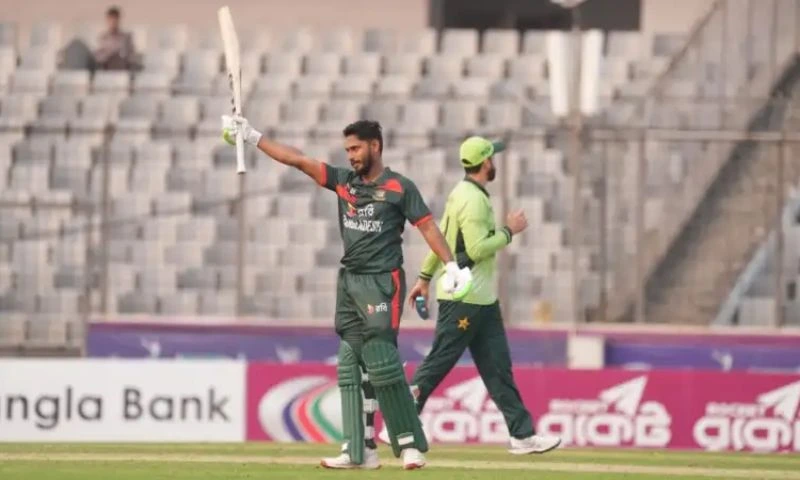
Bangladesh secured a thrilling 11-run victory over Pakistan in the third ODI at the Sher-e-Bangla National Stadium in Mirpur, sealing the three-match series 2-1 after a dramatic contest that went down to the final over. The match turned into a gripping battle between two outstanding individual performances. Bangladesh opener Tanzid Hasan struck a brilliant 107, while Pakistan’s Salman Ali Agha answered with a fighting 106, but Bangladesh ultimately held their nerve to defend a target of 291. Bangladesh finished their innings at 290 for 5 in 50 overs, while Pakistan were bowled out for 279 in their chase, falling short despite a late surge. Tanzid Hasan leads Bangladesh batting effort Bangladesh’s innings was built around Tanzid Hasan’s composed century, which came from 107 balls and laid the foundation for a competitive total on a pitch that offered uneven bounce and some turn. He shared a crucial 105-run opening partnership with Saif Hassan, giving Bangladesh early momentum. Middle-order contributions then kept the scoreboard ticking. Litton Das scored 41, while Towhid Hridoy remained unbeaten on 48 to help Bangladesh reach a challenging total. Pakistan’s bowling attack was led by Haris Rauf, who picked up three wickets, while Shaheen Shah Afridi and Abrar Ahmed chipped in with one wicket each. Pakistan collapse early in run chase Chasing 291, Pakistan got off to a shaky start after Bangladesh’s pace attack struck early. Taskin Ahmed removed key top-order batters including Sahibzada Farhan and Mohammad Rizwan during the powerplay, putting Pakistan under immediate pressure. Pakistan slipped to 67 for 4, leaving the middle order with a difficult task on a tricky Mirpur pitch. However, Salman Ali Agha launched a determined counterattack. The all-rounder scored 106 from 98 balls, anchoring the chase and keeping Pakistan in the contest even as wickets continued to fall around him. Saad Masood and Shaheen Shah Afridi added valuable runs in the later stages, but Bangladesh bowlers kept tightening the screws. Last-over drama seals Bangladesh victory The match produced a tense finish as Pakistan needed 14 runs from the final over with one wicket remaining. Bangladesh spinner Rishad Hossain bowled the decisive over. A dropped catch briefly gave Pakistan hope, but the hosts regained control. In the final delivery, Shaheen Afridi attempted a desperate big shot but missed, allowing Bangladesh to secure the win and the series. Fast bowler Taskin Ahmed finished with 4 wickets for 49 runs, playing a crucial role in Bangladesh’s victory and Pakistan’s collapse. Bangladesh claim historic ODI series win The result marked Bangladesh’s second consecutive bilateral ODI series win over Pakistan after more than a decade, highlighting the team’s growing confidence in home conditions. The Mirpur encounter also turned into one of the most entertaining ODIs of the year, featuring a tense chase, standout centuries and a dramatic final over finish.
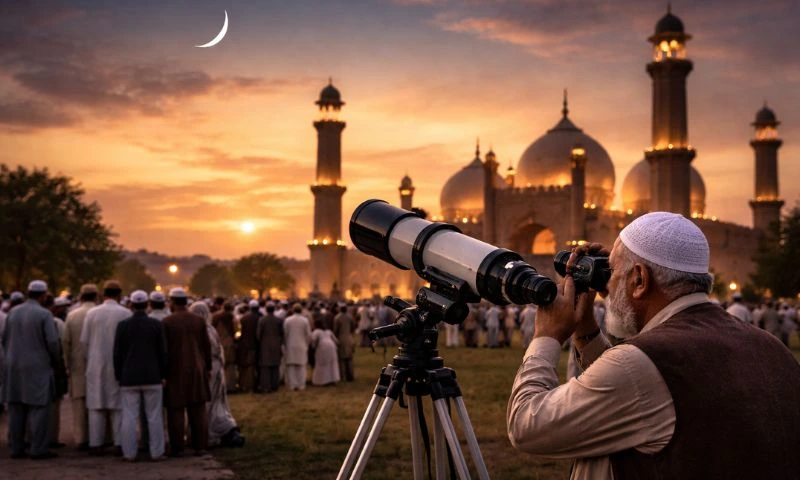
Pakistan Prepares for Eid as Public Holidays Announced
The federal government of Pakistan has officially announced public holidays for Eid ul Fitr 2026, allowing citizens across the country to celebrate the end of Ramadan with family and loved ones. According to a notification issued by the Cabinet Division, Prime Minister Shehbaz Sharif has approved Friday, March 20, and Saturday, March 21, 2026, as public holidays for the occasion of Eid ul Fitr. The holidays will apply to government offices and institutions observing both five-day and six-day working weeks. The announcement enables public and private sector employees to prepare for one of the most important Islamic festivals, which marks the end of the holy month of fasting. Eid expected on March 21 Experts believe Eid ul Fitr is likely to be observed on March 21, 2026, assuming Ramadan completes the full 30 days. The Pakistan Space and Upper Atmosphere Research Commission (SUPARCO) has released astronomical calculations regarding the appearance of the Shawwal moon. According to SUPARCO, “The new moon of Shawwal 1447 AH is expected to be born on March 19, 2026, at 06:23 PST.” The agency further explained that by sunset on March 19 the moon would be approximately 12 hours and 41 minutes old, with an estimated 28-minute gap between sunset and moonset along Pakistan’s coastal regions. However, the final confirmation of Eid will depend on the official moon sighting announcement. Ruet-e-Hilal Committee to make final decision Despite the astronomical predictions, the Central Ruet-e-Hilal Committee will make the official announcement after evaluating moon sightings across the country. The committee traditionally meets on the evening of the 29th day of Ramadan to receive testimony from various regions regarding the sighting of the Shawwal crescent. If the moon is sighted on March 19, Eid will fall on March 20. If not, Ramadan will complete 30 days and Eid will be celebrated on March 21. Moon sighting remains an important religious and cultural tradition in Pakistan, where the announcement is closely followed by millions of citizens. Travel preparations begin across the country With the Eid holidays approaching, preparations for travel and celebrations have already started nationwide. Public transport services are experiencing increasing demand as people plan trips to their hometowns. To facilitate travellers during the festive season, Pakistan Railways has announced the operation of four special Eid trains on major routes across the country. According to railway officials, the special trains will operate between cities including Lahore, Karachi, Quetta, Rawalpindi and Peshawar, helping accommodate the surge in passenger traffic during the holiday period. Authorities say the additional train services aim to ensure safe, timely and convenient travel for passengers heading home for Eid celebrations. Eid preparations underway Eid ul Fitr marks the end of Ramadan, the month of fasting observed by Muslims worldwide. The festival is celebrated with congregational prayers, charity, family gatherings and festive meals. Markets across Pakistan usually witness a sharp rise in shopping activity during the final days of Ramadan, with people purchasing clothes, gifts and food items in preparation for the holiday. The government’s announcement of Eid holidays helps businesses, travellers and families plan their schedules ahead of the celebrations.
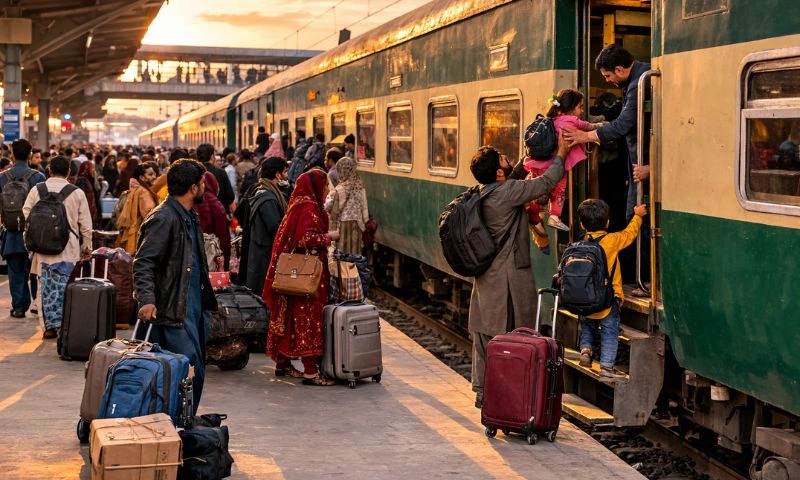
Pakistan Railways Announces Special Trains for Eidul Fitr 2026
Pakistan Railways has announced a special train schedule to facilitate passengers travelling across the country during Eidul Fitr 2026, when thousands of people return to their hometowns to celebrate the festival with their families. According to railway authorities, several Eid special trains will operate on major routes before and after the holiday to accommodate the expected surge in passenger traffic. The move aims to reduce travel pressure on regular services and provide additional seats during one of the busiest travel periods of the year. Every year, Pakistan Railways launches special train operations during Eid holidays because railway stations experience heavy crowds as people travel from major cities such as Karachi, Lahore and Islamabad to smaller towns and villages. Special trains to run on major routes Under the announced plan, four Eid special trains will run between major cities across Pakistan. The first special train is scheduled to depart from Lahore to Karachi on March 16, travelling through major stations including Okara, Sahiwal and Khanewal. The second special train will leave Quetta for Rawalpindi on March 17, passing through Sukkur, Rahim Yar Khan, Khanewal and Lahore. The third train will operate from Karachi to Peshawar on March 17, helping passengers from Sindh travel to Khyber Pakhtunkhwa and northern areas. The fourth special train will depart from Karachi to Lahore on March 18, providing another option for travellers heading to Punjab. Railway officials say the initiative is designed to improve travel convenience during the holiday season and reduce overcrowding on regular trains. A railway spokesperson said the special services would help facilitate passengers who want to reach their homes in time for Eid celebrations. Growing demand for Eid travel Passenger demand typically rises sharply in the days leading up to Eidul Fitr, particularly on long-distance routes connecting Karachi, Lahore, Peshawar and Quetta. Transport authorities say trains remain one of the most affordable travel options for millions of Pakistanis during the festive season. To handle the increase in passenger numbers, Pakistan Railways usually adds additional coaches to regular trains and launches special services on high-demand routes. Special trains often include economy class, AC standard and AC business coaches so that passengers with different budgets can travel comfortably. Importance of railway services during Eid Rail travel plays a crucial role during major religious holidays in Pakistan. For many families, it remains the most practical way to travel long distances, especially when road transport and flights become more expensive or fully booked. Officials say the Eid special train operations will help ensure smoother travel across the country and allow people to celebrate the festival with their loved ones. Pakistan Railways has advised passengers to book tickets early because seats on Eid special trains usually sell out quickly.

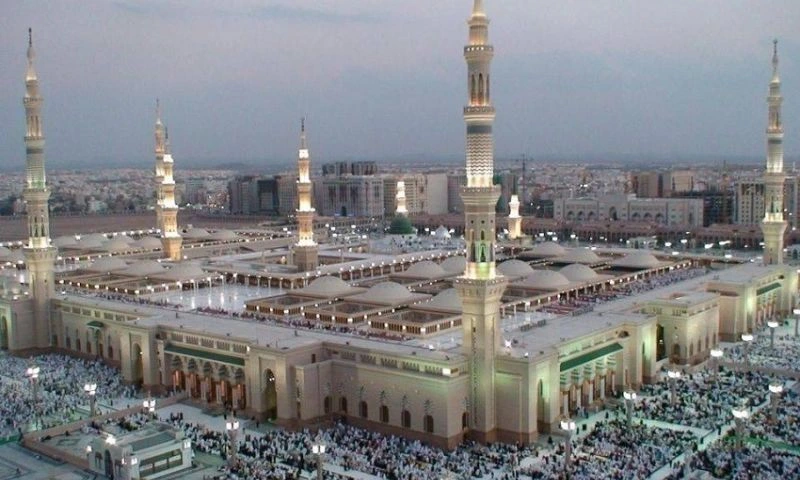
Grand Mosque Launches Heart Attack Treatment Zone for Pilgrims
Saudi health authorities have introduced a dedicated emergency treatment facility for heart attack patients at the Grand Mosque in Makkah. The initiative aims to provide rapid medical intervention for pilgrims and visitors experiencing cardiac emergencies while performing religious rituals. The Makkah Health Cluster has established what is known as the “Safe Heart Zone” inside the Grand Mosque complex. The project is being operated under the supervision of King Abdullah Medical City, one of the Kingdom’s leading specialized hospitals. Officials say the facility is designed to strengthen the response to cardiac emergencies and ensure that patients receive immediate medical care during critical moments. Faster response to cardiac emergencies The main goal of the Safe Heart Zone is to reduce treatment delays for heart attack patients. Quick intervention is essential in cardiac cases, and the initiative seeks to significantly shorten the time between diagnosis and treatment. Health officials noted that the project is particularly important during Ramadan and the annual Hajj pilgrimage, when millions of worshippers gather in Makkah. The initiative is expected to improve survival rates by ensuring that patients receive specialized treatment as quickly as possible. According to officials, the project seeks to improve outcomes for heart attack patients by reducing treatment time and ensuring faster intervention. Advanced medical facilities and equipment The Safe Heart Zone is equipped with modern medical technology and staffed by trained specialists capable of handling severe cardiac emergencies. The facility includes 10 cardiac intensive care beds and is supported by a team of 30 qualified healthcare professionals, including cardiologists, nurses and emergency medical staff. One of the most advanced features of the initiative is the use of a mobile catheterization laboratory at Al-Haram Hospital. This allows doctors to perform urgent interventional cardiology procedures without transferring patients to distant hospitals. The center is also equipped with advanced life-support technologies. These include ECMO devices (Extracorporeal Membrane Oxygenation), which help patients whose heart or lungs are failing. The facility also provides cardiac stents and specialized medications needed during emergency procedures. Integration with Saudi Arabia’s healthcare strategy Saudi authorities say the project forms part of broader efforts to improve healthcare services for pilgrims visiting the holy sites. The Safe Heart Zone supports the goals of the Health Sector Transformation Program, a major initiative under Saudi Vision 2030 that aims to modernize healthcare systems across the Kingdom. The initiative also strengthens coordination between hospitals, emergency services and regional healthcare networks to ensure that patients receive proper care even after initial treatment. Improving safety for millions of pilgrims Each year, millions of Muslims travel to Makkah for Umrah and Hajj, creating significant challenges for healthcare providers. Large crowds and physically demanding rituals increase the risk of medical emergencies such as heart attacks. By establishing specialized treatment zones close to the Grand Mosque, Saudi health authorities aim to ensure that pilgrims receive life-saving care within minutes. Officials believe the Safe Heart Zone will play a crucial role in protecting visitors and improving the overall safety of one of the world’s largest religious gatherings.

Iran-US Conflict Could Trigger Major Insurance Claims
Insurance companies that provide coverage for ships, aircraft and political violence risks are preparing for potential losses as the conflict between Iran and the United States escalates across the Middle East. A recent analysis by Moody’s Ratings indicates that while risks are increasing, the global insurance industry is likely to absorb the financial impact unless the conflict becomes prolonged. According to the report, insurers that specialize in marine, aviation and political violence coverage face a greater chance of large claims because military activity has disrupted transportation routes and raised security concerns across the region. “Specialty insurers and reinsurers… face increased likelihood of severe events leading to outsized claims as a result of the Iran conflict,” Moody’s said. The agency also noted that insurers are benefiting from higher prices for certain types of coverage as companies rush to protect assets in the region. Shipping routes face the greatest risk Marine insurers are expected to face the largest exposure because the conflict has severely disrupted shipping through the Strait of Hormuz, one of the most important maritime routes for global energy trade. The waterway normally handles a large share of the world’s oil shipments. However, the conflict has sharply reduced traffic in the region. Moody’s cited data showing that only about five vessels per day passed through the strait during the first eight days of March, compared with a pre-conflict average of roughly 100 daily transits. Insurers have responded quickly to the increased risk. On March 5, several marine insurance providers issued notices canceling or repricing hull and cargo war-risk policies that protect vessels against damage caused by acts of war. One of the biggest concerns for insurers is the possibility that ships could become trapped if the conflict blocks shipping lanes for an extended period. “War risk policies generally include ‘blocking and trapping’ provisions that allow a total loss claim after a prolonged period of detention,” Moody’s explained. Historical examples such as the Iran-Iraq war and the Russia-Ukraine conflict show that such situations can trigger complex claims and legal disputes. Aviation insurers also on alert The aviation insurance sector faces a different but equally serious risk profile. Airspace closures and missile activity across the region have increased the possibility of aircraft being damaged while parked at airports. Insurers are closely monitoring developments as tensions continue. “Airspace closures and missile activity have increased the risk of damage to aircraft on the ground,” Moody’s said. However, analysts say the current situation differs from the insurance crisis that followed the Russia-Ukraine conflict. In that case, nearly 400 aircraft worth more than $10 billion were stranded in Russia, leading to one of the largest aviation insurance disputes in history. Demand surges for political violence insurance Businesses operating in the Gulf region are increasingly purchasing political violence and terrorism insurance, often referred to as PVT cover. These policies protect companies against damage caused by missile strikes, sabotage, terrorism and attacks on infrastructure. Demand has risen sharply as geopolitical tensions increase. “Demand for this cover has been rising in response to the conflict, at significantly increased prices,” Moody’s said. However, claims disputes may arise because many policies exclude acts of war while covering terrorism or civil unrest. Moody’s warned that the distinction between these categories is often contested. “The distinction between war, terrorism and civil commotion is frequently contested,” the report noted. Global insurers expected to withstand the shock Despite the heightened risks, Moody’s believes that large global insurers and reinsurers are likely to manage the financial impact. Their ability to absorb potential losses comes from diversified global portfolios, strict limits on exposure and extensive reinsurance protection that spreads risk across the industry. Analysts say the insurance sector will continue to monitor developments closely as the geopolitical situation evolves. If the conflict escalates further or continues for an extended period, losses could rise significantly across several segments of the global insurance market.
