

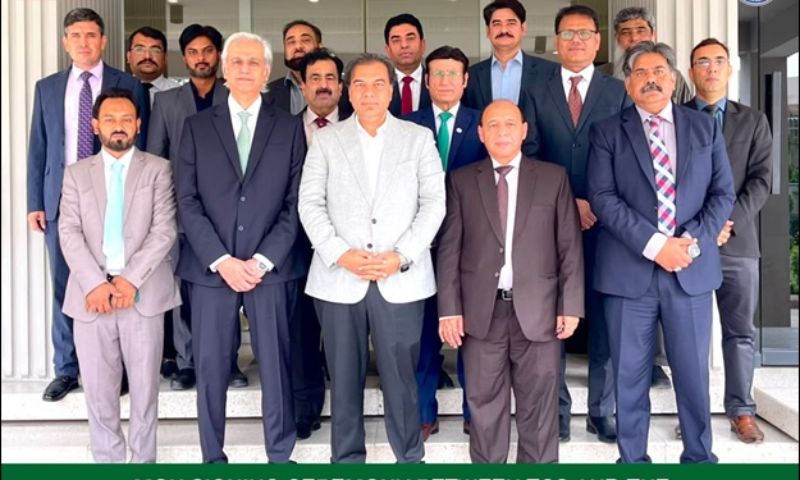
In a major move to improve public service delivery, Pakistan’s leading logistics company TCS has partnered with the Directorate General of Immigration and Passports (DGIP) to launch “Passport Aapki Dehleez Par,” a nationwide home delivery service that will allow citizens to receive their passports at their preferred address. The initiative officially launched during a meeting at the Directorate General of Immigration and Passports headquarters in Islamabad. The service forms part of the government’s broader digital transformation strategy to make passport services faster, safer and more convenient for citizens. Under the new arrangement, applicants will no longer need to make an additional visit to passport offices simply to collect their completed passports. Instead, TCS will deliver the documents directly to applicants through its nationwide logistics network. The launch follows a series of recent reforms introduced by DGIP, including 24 hour passport processing facilities, expansion of fast track passport services, wider availability of e Passports and a nationwide cashless passport fee payment system. TCS and DGIP promise secure and reliable passport delivery Speaking at the launch ceremony, TCS Chief Executive Officer Hassan Raza Leghari highlighted the importance of secure handling of travel documents. “TCS is proud to partner with the Directorate General of Immigration & Passports in delivering an essential public service directly to citizens’ doorsteps. Passports are highly confidential and important documents, and leveraging our nationwide logistics network and service excellence, we are committed to ensuring every passport reaches its recipient safely, securely, and on time.” Officials from both organisations also discussed future collaboration to modernise passport operations, improve efficiency and strengthen the overall customer experience. Director General Immigration and Passports Muhammad Ali Randhawa said the initiative would reduce unnecessary visits to passport offices while improving convenience for applicants. Read More: New Passport App and Home Delivery Coming Soon for Pakistanis “The launch of the Passport at Your Doorstep service reflects our commitment to making passport services more accessible, convenient, and efficient for citizens. By delivering passports directly to applicants’ homes, we are reducing unnecessary visits to passport offices while ensuring a secure and seamless collection process.” DGIP officials said robust verification procedures and secure delivery mechanisms will protect confidential travel documents throughout the delivery process. Part of Pakistan’s wider digital transformation drive The home delivery service represents another milestone in the government’s efforts to modernise public services through technology and improved logistics. In recent months, DGIP has introduced several citizen focused reforms, including faster passport printing, expanded online services and improved complaint management systems. Authorities say these initiatives have significantly reduced processing delays and improved service quality across the country. TCS brings decades of experience in courier, logistics and secure document handling to the partnership. The company operates one of Pakistan’s largest delivery networks and serves millions of customers across the country. According to information shared by TCS and DGIP, the “Passport Aapki Dehleez Par” service is expected to begin nationwide from July 10. Officials believe the initiative will make passport collection more convenient while improving security, accessibility and reliability for applicants. The launch reflects Pakistan’s growing focus on digital governance and citizen centred public services, with authorities aiming to simplify essential government procedures without compromising security.

Cape Verde Push Argentina to the Limit as Messi Steals Spotlight
Lionel Messi continued his remarkable World Cup form on Friday with another decisive performance. He scored as Argentina defeated Cape Verde 3-2 after extra time in a tightly contested knockout match. The Argentina captain struck in the 29th minute. That goal marked his 20th World Cup goal. He now leads France’s Kylian Mbappé by two goals in the all time World Cup scoring chart. Messi also extended his record run to eight consecutive World Cup matches with at least one goal. The streak highlights his consistency across multiple tournaments and high pressure knockout games. That control from Lionel Messi is simply out of this world. Then again… so is Messi himself. He’s definitely not from this planet.👽🐐 https://t.co/7hOrU3F4MR— Football Xtra (@FootballXtra365) July 3, 2026 He came close earlier in the match. In the 15th minute, he dragged a left footed shot just wide. Moments later, his free kick was saved comfortably by the goalkeeper. Cape Verde stayed organised in defence during the early stages. Argentina struggled to break them down in the final third. Martinez assist opens the door as Argentina respond The breakthrough came after a precise pass from Lisandro Martínez. He split the defence with a perfectly timed ball into the box. Messi reacted instantly. He stayed onside and controlled the pass. He then lifted a calm finish over the goalkeeper to give Argentina the lead. The goal was his 124th international strike. Only Portugal’s Cristiano Ronaldo remains ahead in the global scoring list with 146 goals. The only player in @FIFAWorldCup history to score in eight successive games… Lionel Messi 👏 pic.twitter.com/yRJCOF0BNT— FIFA (@FIFAcom) July 3, 2026 Messi acknowledged the assist immediately. He pointed toward Martínez as Argentina took control of the match. Cape Verde refused to collapse. They responded with intensity and pushed Argentina into a tense second half. The match became more open and physical as both sides created chances. Momentum swung repeatedly before full time. Neither side managed to secure a winner in regulation time. Extra time drama sends Argentina through The match went into extra time after Cape Verde equalised late in normal play. Argentina eventually found the winning goal to seal a 3-2 victory. The result secured Argentina’s place in the Round of 16. It also extended Messi’s extraordinary World Cup legacy. He now leads the tournament Golden Boot race with seven goals. Kylian Mbappé follows closely with six. Norway’s Erling Haaland and England’s Harry Kane remain in contention with five each. Messi has scored 12 goals across his last eight World Cup appearances. That run underlines his long term impact at the highest level. He finished runner up in the 2022 Golden Boot race with seven goals. He also shared third place in 2014, showing his consistent presence among top scorers. Lionel Messi 🌟#FIFAWorldCup pic.twitter.com/Na1X8ADKgn— FIFA World Cup (@FIFAWorldCup) July 4, 2026 Argentina continue their campaign with confidence. However, they needed extra time to overcome a determined Cape Verde side that tested them throughout the match. Messi’s record now stands as one of the most dominant scoring runs in World Cup history. His performance once again shaped Argentina’s progress on football’s biggest stage.

633 Billion Paid: Salaried Class Dominates Pakistan’s Tax Revenue
Pakistan’s salaried class paid Rs633 billion in income tax during fiscal year 2025-26, making it the largest contributor among major economic segments, according to provisional data from the Federal Board of Revenue (FBR). The figure shows that salaried individuals contributed more than exporters, the real estate sector and retailers combined in terms of income tax contribution. The FBR collected a total of Rs13,010 billion during the fiscal year ending June 30, 2026. Within this, tax deducted directly from salaries played a major role in strengthening the national revenue base. The salaried class contribution also rose compared to the previous year. It stood at Rs585 billion in fiscal year 2024-25, showing steady growth in tax compliance and withholding efficiency. Sector-wise comparison shows mixed trends Exporters contributed Rs174 billion in income tax during 2025-26, slightly lower than Rs176 billion recorded in the previous fiscal year. Officials say this reflects limited change in exporter tax payments over the two years. The real estate sector showed mixed performance. Under Section 236-C, the FBR collected Rs191 billion compared to Rs118 billion in 2024-25. However, under Section 236-K, collections dropped to Rs87 billion from Rs120 billion in the previous year. Retailers also contributed through withholding tax mechanisms. Under Sections 236-G and 236-H, the sector paid around Rs70 billion in 2025-26, compared to Rs62 billion last year. Breakdown shows Rs25 billion collected under Section 236-G and Rs45 billion under 236-H in the current fiscal year. These figures compare with Rs24 billion and Rs38 billion respectively in 2024-25. Overall, the data highlights uneven performance across sectors, with salaried individuals remaining the most consistent source of direct tax revenue. FBR targets reforms and higher revenue growth The FBR has set an ambitious revenue target of Rs15,264 billion for the current fiscal year. Officials believe reforms and digitalisation will help improve collection efficiency. Tax authorities expect relief measures for salaried individuals and exporters. They also plan to rationalise taxes on real estate transactions to support economic activity. FBR officials said technology and artificial intelligence will play a growing role in improving compliance and monitoring. A key reform under consideration is the adoption of a new operating model in the Inland Revenue Service. It aims to reduce direct interaction between taxpayers and tax officials to improve transparency and efficiency. Authorities believe these steps will help expand the tax base while maintaining pressure on high-compliance sectors such as the salaried class. At the same time, policymakers face the challenge of increasing revenue without slowing down economic activity, especially as different sectors respond differently to taxation measures.
