

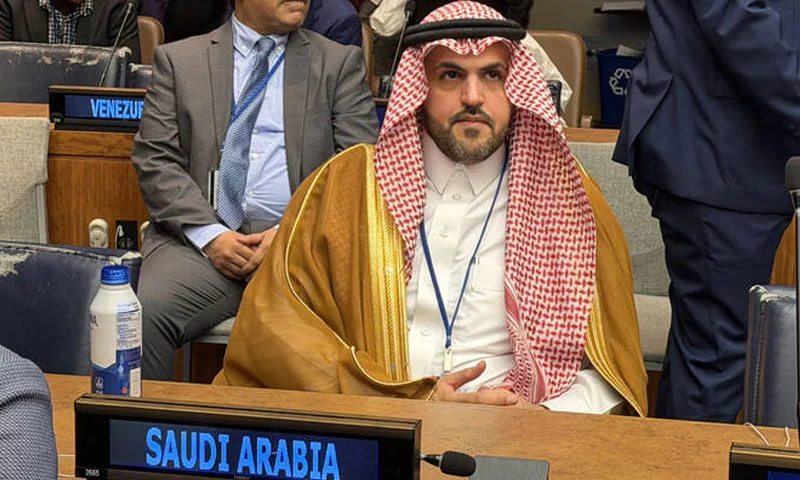
Saudi Arabia has told the United Nations that investing in human capital and localizing knowledge are the foundations of sustainable industrialization as the Kingdom highlighted the achievements of Vision 2030 during a high-level session on the UN Sustainable Development Goals. The remarks came during the High Level Political Forum on Sustainable Development at UN Headquarters in New York, where member states are reviewing progress toward the 2030 Agenda. Saudi Arabia used the forum to outline reforms aimed at strengthening innovation, infrastructure and industrial competitiveness under Sustainable Development Goal 9 (SDG 9). Speaking on behalf of the Kingdom, Saad bin Abdul Ghani Al Ghamdi, Deputy Minister for Planning and Development at the Ministry of Education, said sustainable industrial development begins with investing in people. “Pioneering and the sustainability of industrialization are based on investment in human capital and localizing knowledge as the basic engine for increasing productivity and competitiveness in order to face increasing international challenges,” Al Ghamdi said. He noted that Saudi Arabia has pursued major reforms through Vision 2030, the national transformation program launched in 2016 to diversify the economy and reduce dependence on oil. Vision 2030 drives innovation and digital transformation Al Ghamdi said Saudi universities are now ranked among the world’s leading institutions in artificial intelligence and that Saudi students continue to perform strongly in international competitions. He added that these investments have produced measurable results across several sectors. “This is our effort to invest in human capital, and this has led us to achieve many advances, particularly in electronic governance, in which we are ranked 10th worldwide,” he said. Saudi Arabia has steadily expanded digital government services under Vision 2030. According to the United Nations E Government Survey, the Kingdom has climbed significantly in global digital governance rankings in recent years through investments in technology, public services and digital infrastructure. Al Ghamdi also said the government has introduced several voluntary reporting mechanisms, including sustainability reports for the education sector, to strengthen transparency and prepare institutions for future economic and technological demands. The presentation took place during the forum’s session titled “SDG 9 and interlinkages with other SDGs: Industry, innovation and infrastructure.” UN highlights need for stronger global cooperation The High Level Political Forum is the United Nations’ main platform for monitoring progress on the 17 Sustainable Development Goals adopted in 2015. This year’s meeting runs from July 7 to July 15 under the Economic and Social Council. Delegates are conducting detailed reviews of SDG 6 on clean water and sanitation, SDG 7 on affordable and clean energy, SDG 9 on industry, innovation and infrastructure, SDG 11 on sustainable cities and communities, and SDG 17 on global partnerships. Thirty six member states, including Saudi Arabia, are also presenting Voluntary National Reviews that outline progress and remaining challenges. UN organizers describe SDG 9 as the “production engine” of the 2030 Agenda because it supports economic growth, poverty reduction, climate action and job creation through resilient infrastructure, industrial development and innovation. However, the UN warned that global progress remains uneven with fewer than four years left to meet the 2030 deadline. While investment in research, development and information technology continues to grow, many countries still face shortages in transport, energy and digital infrastructure. Limited financing for small and medium sized enterprises also remains a major obstacle to sustainable industrial growth. The UN has called for stronger international cooperation, increased investment, integrated policy planning and greater support for developing countries to accelerate progress toward achieving the Sustainable Development Goals by 2030.
Overseas Pakistanis Send Record $41.6 Billion Home in FY26
Overseas Pakistanis sent a record $41.6 billion in remittances during July to June FY26, according to State Bank of Pakistan data released on Thursday. The inflows rose 9% from $38.3 billion in the previous fiscal year. Remittances stood at $3.475 billion in June 2026. They fell 18% from May but rose 2% from June last year. Analysts said the annual increase came from stronger formal banking flows, exchange rate stability and higher overseas employment. Saad Hanif, Head of Research at Ismail Iqbal Securities, said reforms in exchange companies helped shift money away from hawala and hundi channels. “The corridor data reflects this breadth, with UAE up 12%, EU up 15% and others up 20% year-on-year, while incentive schemes provided additional support through the year,” he told Business Recorder. Formal channels support inflows Waqas Ghani, Head of Research at JS Global Capital, said higher overseas employment supported inflows during the year. He also pointed to continued migration toward formal banking channels and stable exchange rate dynamics. Sana Tawfik, Head of Research at Arif Habib Limited, gave a similar view. She said exchange rate stability and a narrow gap between interbank and open market rates encouraged legal transfers. She added that administrative action against illegal channels also helped. A rising number of Pakistani workers abroad also contributed to stronger inflows. Remittances remain vital for Pakistan’s external account. They support household income, foreign exchange reserves and domestic consumption. “The record inflows remain the anchor of Pakistan’s external account, fully absorbing a trade deficit that widened 21.6% year-on-year to $39.5 billion and keeping the current account in surplus,” Hanif said. He added that SBP reserves rose to $18.4 billion from $13 billion a year earlier, despite heavy debt repayments. He said this helped rupee stability and created room for eventual monetary easing. Saudi Arabia leads June inflows Saudi Arabia remained the largest source of remittances in June 2026. Overseas Pakistanis there sent $830 million. The figure was up 1% from June last year but down 19% from May. The UAE sent $792 million in June. That was 10% higher than last year but sharply lower than May. Remittances from the UK stood at $515 million. This was down 20% from May. Pakistanis in the US sent $297 million, showing a 15% monthly decline. EU countries sent $415 million in June. That was down 11% from May. SBP Governor Jameel Ahmad had earlier said remittances would likely cross $41.5 billion in FY26. He also projected inflows of $44 billion in FY27. The outlook now depends on Gulf labour markets, regional tensions and the impact of discontinued incentive schemes. SBP recently ended the telegraphic transfer reimbursement scheme and the Sohni Dharti Remittance Program.
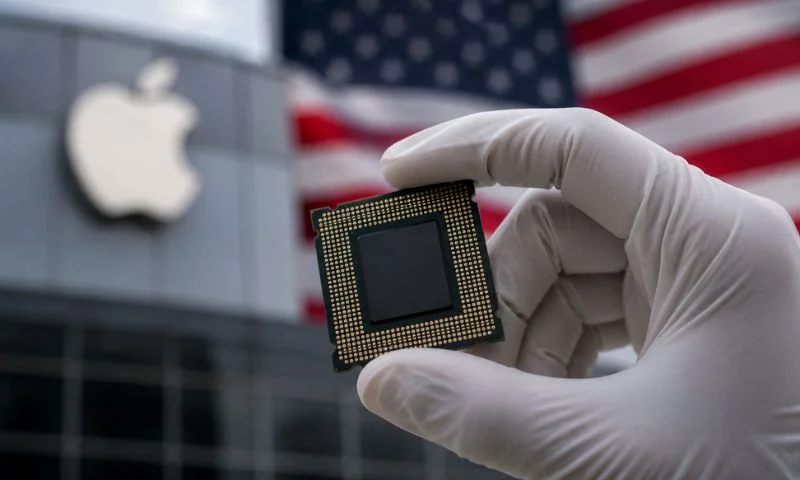
Apple Makes Massive $30 Billion Bet on US-Made Chips With Broadcom
Apple has announced a multiyear agreement worth more than $30 billion with semiconductor company Broadcom to design and manufacture advanced chips in the United States. The partnership marks Apple’s largest commitment under its American Manufacturing Program and will result in the production of more than 15 billion US made chips. The move comes as the technology giant expands domestic manufacturing while facing continued scrutiny over its dependence on overseas production. The agreement forms part of Apple’s broader $600 billion investment pledge in the US economy over four years. The company first announced the commitment during the Trump administration as it sought to strengthen its American supply chain and expand local manufacturing capabilities. Apple said Broadcom will produce custom silicon components and advanced wireless connectivity technologies that power several Apple products. The components include FBAR radio frequency filters, which help deliver cellular, WiFi and Bluetooth connectivity across devices such as the iPhone, iPad and Mac. Fort Collins Facility to Expand Under New Partnership As part of the agreement, Broadcom will invest $1.5 billion to expand and modernize its manufacturing facility in Fort Collins, Colorado. Apple said the investment will support hundreds of American jobs while helping establish a stronger domestic semiconductor supply chain. The agreement represents the biggest project under Apple’s American Manufacturing Program, which launched last year to increase production of critical components inside the United States. Apple said it has worked with businesses and government officials to build what it describes as an end to end silicon supply chain across the country. Apple Chief Executive Tim Cook said, “Apple and Broadcom have a long history together, and this new phase of our partnership further accelerates our commitment to American manufacturing and innovation. The cutting-edge components built in Fort Collins are essential to delivering the incredible performance and connectivity our customers expect, and we’re proud to deepen our investments in U.S.-based suppliers that share our commitment to excellence and innovation. We’re grateful to the president and his administration for supporting important projects like this one.” Broadcom President and CEO Hock Tan added, “Broadcom is proud to continue to work with Apple after decades of success together, and we share a strong commitment to American innovation. With Apple’s newest commitment, we’re pleased to expand our manufacturing footprint in Fort Collins, where we create groundbreaking technology that connects people around the world.” Apple Deepens US Investment Amid Supply Chain Shift Apple has relied on Broadcom for years to supply wireless connectivity components while depending on manufacturers such as TSMC to fabricate many of its custom processors. The latest agreement strengthens Apple’s strategy of sourcing more advanced components from US facilities without moving final device assembly away from Asia. The announcement also comes as Apple continues to face political pressure over its manufacturing footprint in China. The company has steadily increased investment in American semiconductor production while maintaining global supply chains for products such as the iPhone and MacBook. Analysts say the Broadcom partnership reinforces Apple’s long term commitment to expanding domestic chip production and improving supply chain resilience.

Aamir Khan’s Wedding Ring for Gauri Took 256 Hours to Create
Days after Aamir Khan and Gauri Spratt tied the knot in an intimate ceremony, details of the bride’s extraordinary wedding ring have captured widespread attention. The bespoke piece, designed by luxury jewellery brand Qween, features a rare natural ruby sourced from Madagascar that reportedly took nearly three months to find and more than 256 hours to craft. The couple exchanged vows in a registered marriage on July 6 at Aamir Khan’s Pali Hill residence in Bandra, Mumbai. Instead of hosting a lavish celebrity wedding, they chose a private ceremony attended by close family members and friends. Their children also played a special role, making the occasion deeply personal. The wedding ring has emerged as one of the ceremony’s biggest talking points. Unlike the large diamond rings commonly associated with celebrity weddings, Aamir selected a rare cabochon cut natural ruby, giving the jewellery a distinctive and timeless appearance. According to the jewellery brand, fewer than 0.1 percent of natural rubies match the quality of the Madagascar gemstone used in the design. Rare Madagascar Ruby Took Three Months to Source Qween designed the custom ring around a crown inspired gold setting decorated with 40 natural diamonds. The intricate piece required the combined efforts of 131 skilled artisans and more than 256 hours of craftsmanship before completion. The jewellery brand said the search for the rare ruby alone lasted almost three months because of its exceptional quality and rarity. This was not the first bespoke jewellery piece Aamir commissioned for Gauri. Earlier this year, she was seen wearing another custom designed ring featuring a rare Brazilian aquamarine surrounded by 40 natural diamonds. For the wedding ceremony, Gauri chose an understated bridal look created by Sabyasachi Mukherjee. She wore a muted lehenga decorated with delicate white floral embroidery instead of the traditional red bridal outfit. She completed the look with a sheer dupatta, layered polki jewellery featuring emerald accents, natural makeup and a side swept fishtail braid decorated with white flowers. Fashion experts praised the look for embracing elegance over extravagance. Private Ceremony Focused on Family The wedding remained intentionally low key despite Aamir Khan’s status as one of India’s biggest film stars. His son, Azad Rao Khan, and Gauri’s son, Quinn, served as ring bearers during the ceremony, adding another personal touch to the celebrations. The actor, who recently confirmed his relationship with Gauri before announcing their wedding, has repeatedly said the couple wanted a simple celebration centered on family rather than a star studded event. The unique ruby ring now stands as one of the defining symbols of that celebration. Instead of focusing on luxury alone, the couple chose craftsmanship, rarity and personal meaning, making the ring one of the most talked about celebrity wedding jewels of the year.

Bestway Signs Landmark Deal to Bring Geely Cars to Pakistan
Bestway Group has signed a strategic partnership with China’s Geely Auto Group to distribute and assemble Geely vehicles in Pakistan. The agreement marks one of the biggest new developments in Pakistan’s automotive sector. Under the partnership, Bestway Automotive (Private) Limited will become the sole authorised distributor of Geely vehicles in Pakistan. The companies signed the agreement at Geely’s headquarters in Hangzhou, China. Bestway will first import selected Geely models as Completely Built Units (CBUs). Customers will gain early access to the company’s latest vehicles. The partners will later begin local assembly at Bestway’s automotive plant in Karachi. The companies expect the partnership to increase localisation, strengthen Pakistan’s auto supply chain, create skilled jobs and support long term industry growth. Three Geely Models Set for Pakistan Bestway plans to introduce three Geely models during the initial phase. The Geely EX5 is a premium all electric SUV. It combines advanced EV technology, intelligent features and a comfortable cabin. The Geely EX2 will also arrive in Pakistan. It became China’s best selling passenger vehicle in 2025 and offers smart technology, high efficiency and everyday practicality. The third model is the Geely Starray EM-i. The plug in hybrid SUV holds the Guinness World Record for the lowest fuel consumption by a plug in hybrid SUV. Industry reports suggest the first imported models could reach Pakistani customers during the third quarter of 2026. Bestway will share launch dates and pricing later. Global Technology and Local Investment Geely ranks among China’s largest privately owned automotive companies. The company has earned global recognition for engineering, safety, innovation and research. Its portfolio includes Volvo, Lotus, Aston Martin, Smart, Zeekr, Lynk & Co, Proton, Polestar, LEVC, Livan Automotive, Farizon Auto, Radar Auto, Benelli, QJMotor and Keeway. Geely has also expanded beyond vehicle manufacturing. Through Geespace, it operates 64 low Earth orbit satellites. Together with Xingji Meizu smartphones and the Flyme Auto operating system, the company has created an integrated digital ecosystem for connected mobility. Bestway said more details about the product lineup, dealership network and launch schedule will follow soon. The diversified multinational group has operated in Pakistan for more than three decades. Its major investments include Bestway Cement Limited, United Bank Limited, UBL Insurers Limited, renewable energy, packaging, food processing and consultancy services. The company believes its experience and nationwide presence will help Geely establish a strong position in Pakistan’s growing automotive market.

Why PACRA Raised easypaisa’s Rating to AA- and What It Means
The Pakistan Credit Rating Agency Limited (PACRA) has upgraded easypaisa digital bank’s long term credit rating from A+ to AA-, marking another milestone for Pakistan’s first licensed Digital Retail Bank. The upgrade reflects the bank’s strong financial position, rapid business growth and expanding digital ecosystem. Announced on July 8, the rating action represents easypaisa’s second consecutive credit rating upgrade in two years, a rare achievement in Pakistan’s banking sector. The bank said the latest improvement recognizes the strength of its balance sheet, disciplined risk management and continued expansion following its transition into a fully licensed Digital Retail Bank after receiving a commercial DRB licence in January 2025. PACRA also acknowledged easypaisa’s growing transaction volumes, rising customer engagement and the continued popularity of its mobile application, which remains central to its digital banking strategy. Strategic backing from shareholders, including Telenor and Ant Group, also contributed to the improved rating by strengthening the bank’s operational resilience and long term growth prospects. Strong Financial Performance Drives Rating Upgrade easypaisa reported strong financial and operational growth throughout 2025. The digital bank processed more than 4.6 billion transactions worth PKR 16 trillion, highlighting the increasing adoption of digital financial services across Pakistan. Monthly active users climbed to more than 22 million, while branchless banking deposits rose sharply to PKR 122.8 billion, compared with PKR 72.4 billion a year earlier. The bank attributed the increase to higher customer engagement and stronger wallet adoption. Financial performance also improved significantly. easypaisa recorded a Profit After Tax of PKR 17.04 billion, representing a fivefold increase from the previous year. Growth in net markup income and fee based services supported the strong earnings. The bank’s equity increased to PKR 30.9 billion, while its Capital Adequacy Ratio reached 20.4 percent, providing a solid capital buffer for future expansion. Total assets also expanded to PKR 184.8 billion, up from PKR 108.4 billion in 2024. The investment portfolio grew to PKR 113.3 billion, supported by higher deposits and profit retention. The merchant network expanded to 300,000 businesses, further strengthening easypaisa’s presence in Pakistan’s digital payments ecosystem. Leadership Reaffirms Focus on Financial Inclusion Commenting on the achievement, Jahanzeb Khan, President and CEO of easypaisa digital bank, said, “This rating upgrade is a strong endorsement of easypaisa digital bank’s strategy, execution, and long-term vision of building a more inclusive and digitally empowered financial ecosystem while maintaining a strong balance sheet. As Pakistan’s first digital bank to commence commercial operations, we are focused on expanding access to formal financial services, deepening customer engagement through innovation, and delivering seamless digital experiences that empower individuals and businesses across the country. This recognition further strengthens our resolve to accelerate financial inclusion and contribute meaningfully to Pakistan’s digital transformation journey.” Chief Financial Officer Amin Sukhiani added, “The upgrade reflects the strength of our financial fundamentals, the resilience of our business model, and our ability to deliver sustainable growth at scale. Strong growth in deposits, profitability, capital adequacy, and customer adoption demonstrates the robustness of our digital banking model and reinforces the confidence of our stakeholders. We remain committed to maintaining prudent risk management, strong governance standards, and a solid balance sheet as we continue to support the bank’s next phase of growth.” easypaisa now serves more than 60 million registered users through its mobile application and nationwide agent network. The bank offers payments, lending, savings, insurance, merchant services and digital banking solutions. Its continued growth aligns with the State Bank of Pakistan’s vision of promoting financial inclusion through technology and innovation.

Where Did More Than 762,000 Pakistanis Go for Jobs in 2025?
Saudi Arabia remained the largest overseas employer of Pakistani workers in 2025, hiring 530,256 Pakistanis, nearly 70 percent of all workers who left the country for jobs abroad during the year, according to the latest data from Pakistan’s Bureau of Emigration and Overseas Employment (BEOE). The BEOE reported that 762,499 Pakistanis registered for overseas employment in 2025, continuing the recovery that began after the COVID-19 pandemic. Since 1971, the total number of registered overseas Pakistani workers has reached 15.13 million. Saudi Arabia has employed 7.87 million Pakistanis over the past five decades. That accounts for more than 52 percent of all registered overseas workers from Pakistan. The United Arab Emirates remained the second-largest destination with 52,664 workers in 2025. It was followed by Qatar with 68,376, Bahrain with 37,726, Oman with 9,375, and Kuwait with 6,590. The latest figures show Saudi Arabia, Qatar, Bahrain and Kuwait increased their hiring of Pakistani workers compared with 2024. Oman, however, recorded a significant decline from 81,587 workers in 2024 to 9,375 in 2025. Overseas employment recovers after pandemic slowdown Pakistan’s overseas employment dropped sharply during the COVID-19 pandemic. Worker registrations fell to 225,213 in 2020 before recovering to 288,280 in 2021. The labor market has strengthened steadily since then. Pakistan sent 832,339 workers abroad in 2022, followed by 862,625 in 2023, 727,381 in 2024, and 762,499 in 2025, reflecting sustained demand from Gulf countries. The BEOE data also highlights the composition of Pakistan’s overseas workforce. In 2024, 366,092 workers belonged to the unskilled category. Another 255,706 were skilled workers, while 56,562 were semi-skilled. Pakistan also sent 29,434 highly skilled professionals and 19,587 highly qualified workers abroad. Among occupations, laborers formed the largest group with 364,574 workers. Drivers followed with 185,209, while 14,938 masons, 10,895 electricians, 8,018 engineers, and 3,642 doctors also secured overseas jobs. Officials say demand for Pakistani manpower remains strong because Gulf economies continue investing heavily in construction, infrastructure, healthcare and services. Gulf countries remain Pakistan’s biggest source of remittances The Gulf region continues to dominate Pakistan’s overseas employment landscape and remains the country’s largest source of foreign exchange through workers’ remittances. According to the State Bank of Pakistan, the country received a record $38.3 billion in workers’ remittances during FY2024-25, compared with $30.25 billion in the previous fiscal year. Saudi Arabia contributed the largest share at $9.34 billion, while the United Arab Emirates sent $7.83 billion. Together, the two countries accounted for more than $17 billion, nearly half of Pakistan’s total remittance inflows. Although Pakistanis have migrated to more than 50 countries since 1971, non-Gulf destinations account for less than 5 percent of total overseas employment. Among those countries, Malaysia leads with 149,601 registered workers, followed by Iraq with 100,348, Libya with 81,818, the United Kingdom with 55,109, Italy with 32,873, Cyprus with 20,949, and South Korea with 20,642. The latest BEOE figures reaffirm the Gulf’s central role in Pakistan’s labor export strategy and underline the growing importance of overseas workers in supporting the country’s economy through employment opportunities and remittance inflows.
