

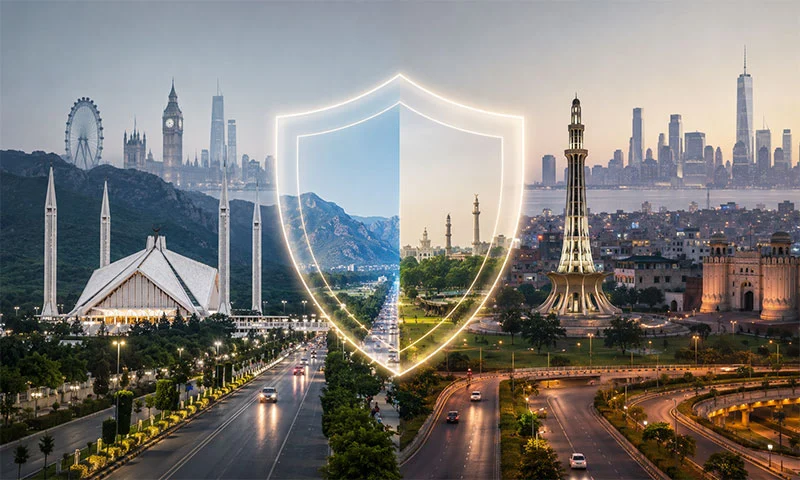
Islamabad and Lahore have emerged among the better-performing cities in Numbeo’s Crime Index 2026 Mid-Year report. The Pakistani cities recorded lower perceived crime scores than London, Paris, New York and Toronto. Islamabad posted a Crime Index score of 30.8, the lowest among Pakistan’s major cities covered by the survey. Lahore followed with 36.2. Rawalpindi scored 52.0, while Karachi recorded 57.6. Lower scores indicate less concern about crime and a stronger perception of public safety. Read More: World’s Most Beautiful Cities in 2026, Cape Town Tops Global List The results place both Islamabad and Lahore ahead of several major global centres. Paris recorded a Crime Index score of 57.9, followed by London at 55.3 and New York at 50.8. Toronto posted 43.7, which remained above Lahore and Islamabad. What the Numbeo Scores Show Numbeo classifies Crime Index scores between 20.01 and 40 as low. Scores from 40.01 to 60 fall into the moderate category. Under that scale, Islamabad and Lahore both remained in the low-crime perception range. Rawalpindi and Karachi fell within the moderate range. The Safety Index works as the inverse of the Crime Index. This gives Islamabad a Safety Index of about 69.2 and Lahore about 63.8. Numbeo states: “A city with a high Safety Index is considered very safe.” Read More: World’s Safest Cities Revealed: Abu Dhabi Leads, UAE Takes 5 of Top 6 The ranking covers more than 400 cities and offers a global comparison of how contributors view local security. However, it does not use police reports, court records or government crime databases. Therefore, the results should not be presented as proof of actual crime levels. Survey Measures Public Perception, Not Official Crime Numbeo builds the index from responses submitted by visitors to its website. It asks contributors about general crime levels and whether they feel safe walking alone during daylight and at night. The survey also measures concern about mugging, robbery, vehicle theft, physical attacks and harassment. It covers burglary, vandalism, violent crime, drug activity, corruption and bribery. Numbeo scales the responses from zero to 100 and applies filtering systems to remove suspicious submissions. Read More: Karachi Ranked Among World’s Least Liveable Cities Again The platform uses data collected during the previous five years for its continuously updated index. It also publishes historical snapshots twice each year. Numbeo says it requires a minimum number of contributors before including cities, although response totals can differ widely between locations. The mid-year results provide a positive perception-based signal for Islamabad and Lahore. They suggest that residents and visitors generally feel more secure there than respondents in several famous global cities. Still, differences in reporting habits, contributor profiles and local expectations can affect international comparisons. The index offers insight into public confidence, but official crime data remains necessary for a complete assessment of urban safety.

US imposes new tariffs on 60 trade partners, including Pakistan
The Trump administration imposed tariffs of 10% and 12.5% on goods from 60 trading partners on Friday. They began at 12:01 a.m. EDT as Trump’s temporary 150-day global tariff expired. In-transit goods remain exempt until July 28. The action covers 99.4% of US imports but excludes oil, gas, fertiliser and certain foods. It restores a near-global tariff floor after the Supreme Court struck down Trump’s 10% to 50% “reciprocal” duties in February. Read More: $37.5 Billion Spent on Iran War as Trump Seeks $90 Billion More Section 301 Provides New Tariff Route Washington used Section 301 of the Trade Act of 1974, which has survived earlier court challenges. “The United States has had a forced labor import ban for nearly a century, and rigorously enforces it. It’s well past time for our trading partners to do the same,” US Trade Representative Jamieson Greer said. “Today’s action will begin to correct what is both a human rights abuse and distortive trade practice to improve the welfare of workers everywhere.” Greer said trade-deal tariff caps would still apply. The 10% rate applies to Argentina, Bangladesh, Britain, Cambodia, Canada, Ecuador, El Salvador, Guatemala, Honduras, India, Indonesia, Jordan, Malaysia, Mexico, Pakistan, Sri Lanka, and Trinidad and Tobago. Read More: Truth Social Will Sell Traders Faster Access to Trump’s Posts For the EU, Taiwan, Japan, South Korea and Switzerland, the duties combine with existing rates to total 10% or 12.5%. Another 38 economies face 12.5%, including China. Officials aim to restore Trump’s second-term China tariff rate to 20%, agreed with President Xi Jinping in November 2025. China separately faces earlier 25% duties. Washington accuses China of Uyghur forced labour, which Beijing denies. Countries Protest as Cost Concerns Grow Norwegian Foreign Minister Espen Barth Eide said “there is no basis for this tariff against Norway because we already have clear rules that are intended to prevent trade in goods produced using forced labor.” Australia and Brazil called the tariffs unjustified. Canada faced new duties on $20 billion of goods earlier this week. “We will continue engaging constructively with the United States on this matter, as well as other outstanding issues, over the coming weeks to the mutual benefit of our citizens,” Canadian Trade Minister Dominic LeBlanc said. Read More: Pakistan Wants Samsung to Export Locally Made Phones to Africa Massachusetts Governor Maura Healey said they “will result in higher costs, negative impacts to businesses and weakened American competitiveness. Nobody can afford this.” “As expected, the forced labor tariffs largely replicate current tariff levels as negotiated in various reciprocal trade agreements, and replace the 10% tariffs under Section 122 that expire on Friday,” trade lawyer Tim Brightbill said. A senior official rejected that view. The official said stricter US enforcement disadvantages American firms. Bipartisan lawmakers want forced labour removed from global supply chains, “so we’re really responding to that call,” the official said. “Once the 301 duties are placed, they have a lot of flexibility to adjust them,” trade lawyer Ryan Majerus said. “It’s a sledgehammer. It’s also intended to keep the …10% baseline in place, and they think they’re well protected when this goes to court.” Exemptions also cover autos, steel, aluminium and copper already subject to Section 232 tariffs. USMCA-compliant goods remain exempt due to integrated North American supply chains.
