

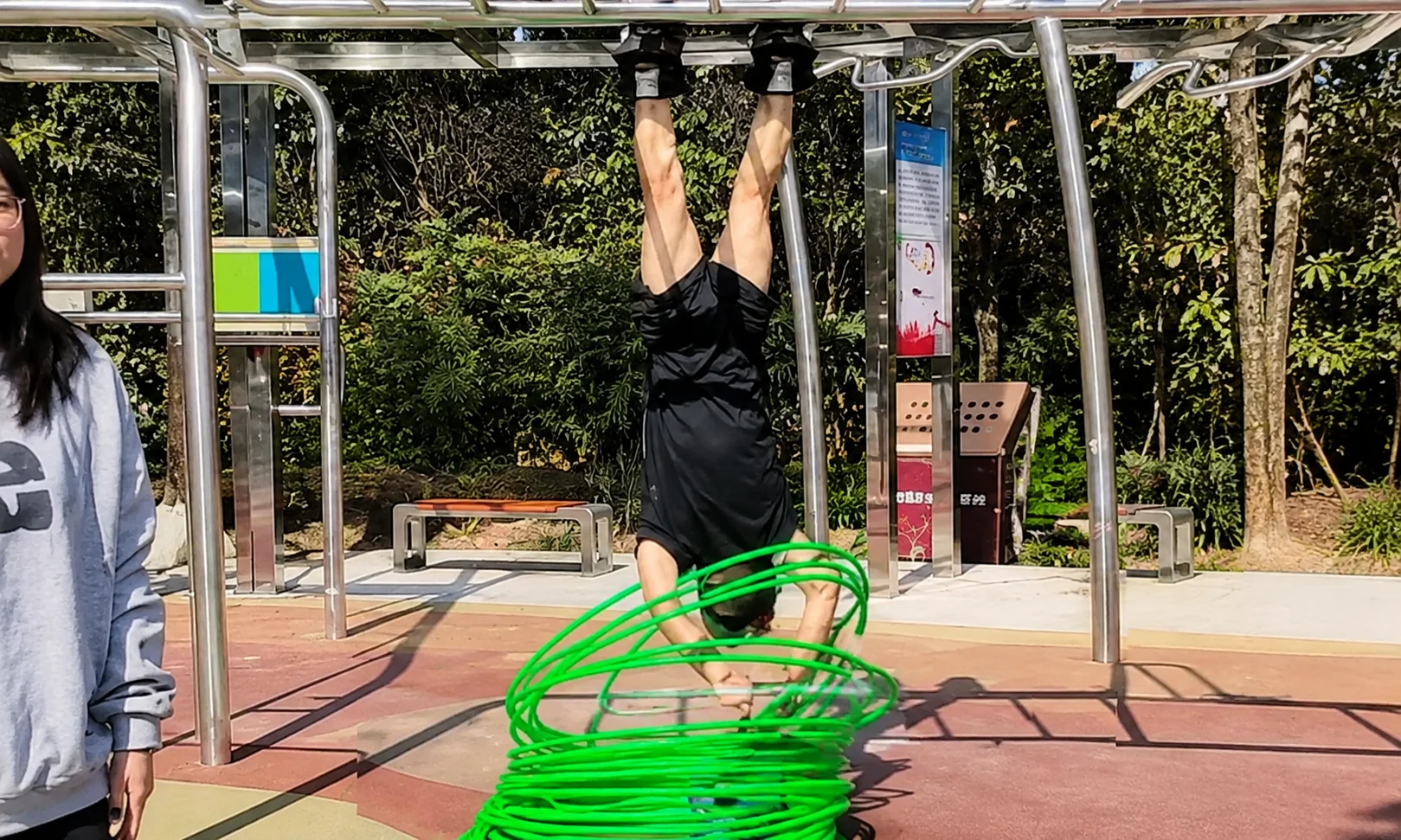
A Chinese man has broken a Guinness World Record by spinning 33 hula hoops while hanging upside down in Guilin, Guangxi. Yan Yanjia performed the unusual feat on playground equipment. Two friends helped pull the hoops over his head and position them around his hips. Guinness World Records confirmed that Yan now holds the title for the most hula hoops spun while suspended upside down. The record attempt took place on November 29, 2025. Guinness released details and footage of the feat this week. Its official record page says Yan maintained the movement for roughly 20 rotations. His total of 33 hoops beat the previous record by 10. Weight-loss exercise turns into record attempt Yan, who works as a farmer, started hula hooping in 2018. He initially took up the activity after a health warning encouraged him to lose weight. “In 2018, I was diagnosed with fatty liver due to obesity, and my doctor advised me to lose weight. At that time, I bought a 2-kilogram [4.4-pound] hula hoop for exercise, and in a month, I went from 80 kg [175 pounds] to 63 kg [132 pounds],” he told Guinness World Records. Read More: Man Pulls 21,000-Pound Bus With Neck to Break Guinness Record Yan also stressed that exercise was not the only factor behind the weight change. “Of course, the main factor in successful fat loss is gradual control of diet.” What began as a fitness activity gradually developed into an unusual skill. Guinness said Yan later watched a viral video featuring Hong Kong actor and singer Nicholas Tse hula hooping in a difficult position. Three to four years of upside-down practice The video encouraged Yan to test whether he could perform the exercise while hanging upside down. “I suddenly wondered if I could practise hanging and spinning hula hoops upside down, and it took me about three or four years to reach this level,” Yan said. For the record attempt, Yan climbed onto the playground structure and hung from it by his feet. His two friends then moved all 33 hoops into place. Read More: A Chicken That Beat the Odds: Guinness Crowns Texas Hen as World’s Oldest Chicken He successfully kept them spinning for the required period. Guinness now officially lists 33 as the record for the category. The footage drew wider attention after Guinness published it on August 11. UPI also reported the unusual achievement the same day. Yan already targets another world record Yan has no plans to stop after securing his first title. He is now considering another challenge involving hula hoops and pull-ups. “This exercise consumes many times more force than dozens of hula hoops upside down, requiring much greater core stability,” he explained. Guinness said Yan has already practised other hula-hooping moves and believes he can challenge additional records. His world record marks an extraordinary transformation of a hobby that began eight years ago as a fitness activity. Years of practice eventually turned the weighted hoop exercise into a Guinness-recognised achievement.

Pakistan Wins Major Basmati Rights Case Against India
Pakistan has secured a major win in the international dispute over the Basmati name after the Federal Court of Australia dismissed an Indian appeal. India’s Agricultural and Processed Food Products Export Development Authority, or APEDA, had challenged an earlier rejection of its Basmati word mark application. The court also ordered APEDA to pay the respondent’s costs, as agreed or taxed. Read More: The Surprising Reason Food Feels Tastier at Night “The decision vindicates Pakistan’s principled and consistently maintained position regarding Basmati as a geographical indication,” Pakistan’s Ministry of Commerce said on Wednesday. Australian Registrar Had Rejected Basmati Word Mark APEDA had sought to register Basmati as a certification trade mark for rice in Australia. A delegate of the Australian Registrar of Trade Marks rejected the application on December 22, 2022. The delegate concluded that Basmati could not distinguish APEDA-certified rice from rice legitimately marketed by other traders. The proceedings also recognised that Basmati rice is grown in Pakistan. Australian intellectual property analysis later noted that other traders could have an equally valid claim to use the term. APEDA subsequently took the matter to the Federal Court of Australia. By dismissing the appeal, the court left those findings intact, according to Pakistan’s Commerce Ministry. Read More: From Breakfast Cereals to Ready Meals: WHO Prepares Guidance on Ultra-Processed Foods “The outcome constitutes a significant victory for Pakistan’s position that Basmati originates from a historically recognised growing region spanning areas of Pakistan and India, and that no single national authority can claim an exclusive right over the word Basmati to the exclusion of producers and exporters having an equally legitimate right to its use,” the ministry said. Ruling Protects Pakistani Basmati Exporters The ministry said the outcome protects Pakistani Basmati growers, millers and exporters. It also preserves their right to market authentic Pakistani Basmati in Australia. The Australian development follows a similar ruling in New Zealand. In October 2025, the New Zealand High Court dismissed APEDA’s appeal over a Basmati certification mark. The court recognised a Basmati-growing region covering areas of both Pakistan and India. The issue carries significant commercial importance for Pakistan. Pakistan Bureau of Statistics data show Basmati exports worth Rs24.943 billion in June 2026 alone. Read More: 5 Supplements for Travel Sickness: What May Help The Commerce Ministry said it has consistently resisted attempts to secure exclusive national rights over the Basmati name. It has worked with national institutions and industry stakeholders to defend Pakistan’s interests abroad. The ministry said it would continue protecting Basmati based on its historical origin, established reputation and distinctive qualities. Federal Commerce Minister Jam Kamal Khan praised ministry officials and stakeholders for their coordinated efforts in the case. He called the outcome an important achievement for Pakistan’s agricultural heritage, commercial interests and export identity.

Pakistan Railways Ordered to Pay Rs50,000 to Delayed Passenger
A consumer court has ordered Pakistan Railways to pay Rs50,000 to a passenger after a delayed Khyber Mail journey from Ghotki to Karachi. Lawyer Ayaz Ali Chachar filed the claim under the Sindh Consumer Protection Act 2014. He sought Rs500,000 in damages for negligence, deficient service and mental agony. He also asked for a refund of his ticket price with mark-up. Read More: India’s Railway Theft Case. The Most Stolen Item Will Surprise You Four-and-a-Half-Hour Delay Disrupts Commitments Chachar told the court that he booked the Khyber Mail in January 2025 for travel from Ghotki to Karachi. The train reached Karachi more than four and a half hours late. He said the delay disrupted professional commitments planned around the expected arrival time. Pakistan Railways did not file its response within the stipulated period. Judicial Magistrate South Abdul Ahad Memon therefore proceeded ex parte and considered the passenger’s evidence. The court found that the unexplained delay caused more than ordinary inconvenience. It said Chachar suffered “inconvenience, harassment and mental distress” during the overnight journey. The judge said passengers who plan work or personal commitments around an arrival time can reasonably expect the service provider to follow its schedule. Court Finds Deficiency in Railway Service The judge said the hardship from a long delay extends beyond lost time. It can include disrupted sleep, anxiety over missed commitments and frustration when passengers receive no information or remedy. Read More: Meet the Volunteers Keeping a 100-Year-Old Swiss Railway Alive The court concluded that Pakistan Railways had provided deficient service. It noted that the railway neither completed the journey within the scheduled time nor offered any explanation on record. The court awarded Rs50,000 as general damages. However, it rejected Chachar’s request for a refund of the ticket amount and mark-up. The judge also advised Pakistan Railways to “improve their service in all aspects to ensure smooth, timely and quality services”. Consumer Law Gives Passengers a Legal Remedy The Sindh Consumer Protection Act aims to protect consumer rights and provide speedy redress for complaints. Its definition of a consumer includes a person who hires a service for payment. The law also recognises damage arising from deficiency in a service. Sindh’s judiciary says consumer protection courts operate at district level to protect consumer interests and resolve complaints. Read More: Pakistan Opens Historic British-Era Minister’s Railway Saloon to the Public The ruling treats an unexplained train delay as more than a routine inconvenience. The court linked the delay to foreseeable mental distress and disruption of a passenger’s plans. The decision does not mean every delayed passenger will automatically receive compensation. Claims still depend on the facts, evidence and applicable law. In Chachar’s case, the court found the prolonged and unexplained delay sufficient to justify general damages.abb

YouTube Doubles Monetisation Requirements for New Creators
YouTube will make it harder for new creators to qualify for advertising and YouTube Premium revenue sharing from February 1, 2027, after announcing a major overhaul of Partner Program entry thresholds. New applicants seeking the ad-revenue tier will need at least 1,000 subscribers plus either 8,000 qualified public watch hours in the previous 365 days or 20 million qualified Shorts views in 90 days. YouTube confirmed the change on August 10. Existing partners will not lose access simply because they fall below the new entry bar. Monetisation thresholds double for new creators The current requirement is 1,000 subscribers and either 4,000 qualified watch hours in 12 months or 10 million qualified Shorts views in 90 days. The February change doubles both audience thresholds while leaving the subscriber requirement unchanged. “This update won’t impact creators already in YPP,” YouTube said in its official announcement. Read More: Google Slashes YouTube Premium Price by 50% for Eligible Users YouTube defines qualified watch hours as viewing time from public long-form videos. Hours from private, unlisted or deleted videos do not count. Watch time generated by ad campaigns and Shorts also does not contribute toward the long-form threshold. Qualified Shorts views must come from public Shorts appearing in the Shorts Feed. YouTube says the platform now records more than 200 billion daily Shorts views. Users also watch over one billion hours of YouTube content on television screens each day. Shorts creators face separate revenue rule YouTube is also changing how Shorts revenue is distributed. From February 1, creators will need 10 million qualified Shorts views during the previous 90 days to receive ad and subscription revenue sharing from Shorts. Channels that drop below that level will remain inside YPP and can continue earning from eligible long-form content. Shorts revenue sharing will resume automatically if their 90-day total rises above 10 million again. Read More: End of Endless Scrolling? YouTube Adds Option to Remove Shorts YouTube plans additional incentives for creators below that threshold. The company cited potential bonuses linked to YouTube Shopping, brand deals and starting or growing trends, although it has not released full details. The lower entry thresholds for fan funding and selected Shopping features will remain unchanged. In eligible markets, creators can currently access that level with 500 subscribers, three public uploads in 90 days and either 3,000 watch hours or three million Shorts views. Premium Lite expansion adds another earning stream YouTube is also expanding Premium Lite to every country where YouTube Premium is offered. The company says creators will share revenue generated from those subscriptions based on member watch time and views. YouTube said the Premium Lite revenue pool will represent 60% of net subscription revenue, while the Premium pool will represent 30%. Creators receive a 55% revenue share for long-form videos and 45% for Shorts from the relevant distribution. The new YPP terms take effect on February 1, 2027. For aspiring creators, reaching advertising revenue eligibility will require far more viewing activity than under the current system.

Chinese EVs Claim to Outperform Porsche, Ferrari and BMW
Chinese carmakers are rapidly closing the performance gap with Porsche, Ferrari and BMW, raising a harder question for the global auto industry. Can technology and extreme performance create the same desire as decades of luxury heritage? The Yangwang U9 Xtreme offers perhaps the clearest example. BYD’s electric hypercar reached 496.22 km/h at Germany’s Papenburg test track in September 2025. It later completed the Nürburgring Nordschleife in 6:59.157, becoming the first production EV to break the seven-minute barrier. The U9 Xtreme uses four electric motors, a 1,200-volt platform and nearly 3,000 horsepower. Yet technical dominance has not automatically translated into luxury-market dominance. Performance records are only part of the battle DMARGE reported that Yangwang sold just 945 vehicles across its entire range during the first quarter of 2026. That contrasts sharply with the attention generated by the U9 Xtreme’s records. Xiaomi has demonstrated the same engineering potential. Its production SU7 Ultra recorded a 7:04.957 Nürburgring lap, setting a record for its category. The bigger challenge lies in brand value and emotional appeal. Read More: Ferrari’s First Electric Supercar Gets Futuristic Cabin and 1,000+ HP Industry commentator Mark Rainford told DMARGE that age plays an important role in Chinese buying habits. Older customers still tend to trust established foreign brands because they remember a much weaker domestic auto industry. “There’s a lot of horror stories of cars going downhill and the brakes failing,” Rainford said. Younger buyers, however, have grown up during China’s rapid technological rise. They show greater confidence in local manufacturers and place more value on software, screens and connected features. Chinese luxury brands target a new generation That shift is already hurting traditional manufacturers. Reuters reported that German brands have lost significant ground in China as local companies introduce premium vehicles with advanced technology at lower prices. BMW, Mercedes-Benz and Porsche have all faced weaker Chinese sales. Chinese manufacturers increasingly define luxury through technology and practicality. Large three-row SUVs offer entertainment screens, sophisticated cabin systems and integration with connected home devices. Rainford argues that established European brands still hold an advantage in consistency and refinement. “You can get in a Mercedes and you know you’re going to get what you’re going to get. But in a BYD, you’re never quite sure. Some examples will do it really well and some won’t.” China is now chasing emotion as well as numbers Chinese manufacturers are also exploring traditional performance-car ingredients. Great Wall Motor used the 2026 Beijing Auto Show to reveal its GF supercar project. The programme centres on a mid-engine architecture and an in-house 4.0-litre twin-turbo V8 with hybrid assistance. Former McLaren engineer Adam Thomson is involved in the development. The move suggests Chinese companies no longer see acceleration, software and specifications as enough. Read More: BMW Plans 8,000 Job Cuts by End of 2027 as Costs Rise At the same time, global competition continues to intensify. Chinese manufacturers are expanding overseas as domestic conditions become more difficult. Reuters reported that Chinese vehicle exports jumped 88.2% year on year in July 2026. The industry’s next battle may therefore have less to do with horsepower. Chinese manufacturers have already shown they can challenge Europe on measurable performance. The tougher task is building the heritage, consistency and emotional connection that make buyers choose a Ferrari, Porsche or BMW even when another car looks better on paper.

Ronaldo Marries Georgina Rodriguez After 10 Years Together
Football superstar Cristiano Ronaldo has married his long-term partner Georgina Rodriguez after nearly a decade together. The couple held a private civil ceremony in Cascais, Portugal, on Tuesday, Ronaldo’s management confirmed. Ronaldo and Rodriguez announced the marriage on Instagram by sharing a photograph of their wedding bands. The post attracted more than 16 million likes within hours, underlining the enormous global interest surrounding the couple. Read More: Ronaldo Breaks New Ground in World Cup History at 41 British broadcaster Piers Morgan also congratulated the newlyweds on X. He shared a photograph of the couple after they exchanged wedding rings. From a Madrid Gucci Store to Marriage Ronaldo, 41, and Rodriguez, 32, met in Madrid in 2016. Rodriguez was working at a Gucci store when their relationship began. They have remained together through Ronaldo’s moves between Spain, Italy, England and Saudi Arabia. View this post on Instagram A post shared by Cristiano Ronaldo (@cristiano) The couple have two daughters together, Alana, seven, and Bella, three. Their wider family includes Ronaldo’s other children, and reports said their five children attended the intimate ceremony. The wedding comes exactly one year after Rodriguez publicly announced their engagement. She shared a photograph of their hands and her engagement ring on Instagram. “Yes I do. In this and in all my lives,” Rodriguez wrote at the time. Their marriage also ends years of speculation about when one of football’s most famous couples would officially wed. Only days earlier, hundreds of fans had gathered at a wedding in Madeira after mistakenly believing Ronaldo was getting married there. Read More: Cristiano Ronaldo’s Partner Georgina Rodríguez Turns Heads With Multi-Million Lifestyle Ronaldo has won five Ballon d’Or awards during a career spanning Sporting Lisbon, Manchester United, Real Madrid, Juventus and Al Nassr. Reuters describes him as one of football’s most decorated players. Ronaldo Returns to Saudi Arabia After Wedding The wedding comes just before Ronaldo begins another season with Al Nassr. The Saudi club opens its 2026-27 league campaign against Al Fateh on August 15. Ronaldo will return to Saudi Arabia to work under new Al Nassr coach Ange Postecoglou. The Australian takes charge as the defending champions attempt to retain the Saudi Pro League title. Ronaldo scored 28 league goals during Al Nassr’s title-winning campaign last season. He also represented Portugal at his sixth World Cup this summer and scored three times before Spain eliminated Portugal in the last 16. Read More: 10 Games Without A Goal: Ronaldo Faces Growing Questions Those goals lifted Ronaldo to 976 senior career goals. He now sits 24 away from the extraordinary milestone of 1,000, giving his new season another major storyline. For now, however, attention remains on his personal milestone. After ten years together, Ronaldo and Rodriguez have officially turned one of football’s most closely followed relationships into marriage.

New FBR Rule Hits Digital Creators With 5% to 10% Tax
Pakistan’s Federal Board of Revenue (FBR) has introduced a 10% withholding tax on social media earnings received by digital content creators and influencers who do not appear on the Active Taxpayers List. The new rates took effect from July 1, 2026, under changes introduced through the Finance Act 2026. The FBR’s latest Withholding Income Tax Rate Card for Tax Year 2027 confirms two rates under Section 154B. Creators appearing on the ATL face a 5% deduction, while non-ATL creators face a 10% rate. Read More: FBR Targets Social Media Income as New Tax Rules Emerge in Pakistan The new provision is titled “Withholding tax on revenues received from social media platforms.” It covers income earned through platforms such as YouTube, Facebook, Instagram and TikTok, as well as similar digital services. Banks to Deduct Tax When Payments Arrive Under Section 154B, banking and non-banking financial institutions must deduct the tax when social media revenue reaches a creator’s account. The law also covers payments routed through online payment providers and other digital financial platforms. For example, an ATL-listed creator receiving Rs100,000 in qualifying social media revenue would face Rs5,000 in withholding tax. A creator outside the ATL would face Rs10,000 on the same amount. For resident taxpayers, the law treats the deduction as minimum tax. For a non-resident without a permanent establishment in Pakistan, it operates as final tax. The measure expands Pakistan’s tax framework into the fast-growing creator economy. It also creates a financial incentive for influencers, YouTubers and other online earners to remain on the ATL. Read More: NCCIA Takes Notice of Social Media Campaign Against easypaisa FBR says appearing on the ATL already gives taxpayers access to lower withholding rates across several types of transactions. The social media provision now extends that filer advantage to digital creator earnings. The official FBR rate card is updated up to June 30, 2026 under the Finance Act 2026 and applies to Tax Year 2027. This corrects reports suggesting the new card itself remains applicable only through June 30, 2026. Foreign Card Payments Also Get New Rates The Finance Act 2026 has separately changed withholding tax on amounts remitted abroad through credit, debit and prepaid cards. Under Section 236Y, taxpayers appearing on the ATL now face a 0.5% withholding rate on such transactions. The rate doubles to 1% for people outside the ATL. This provision is separate from the tax on creator earnings. Section 154B applies when creators receive social media revenue, while Section 236Y covers money sent abroad through payment cards. Read More: Pakistan EV Tax 2026: Which Electric Vehicles Will Be Taxed and Which Remain Exempt? The Finance Act 2026 came into force on July 1 unless a provision specified otherwise. The new social media withholding regime therefore applies to qualifying payments received from that date. The change means Pakistani creators now face a clear tax deduction at the banking stage. Those outside the ATL will effectively pay twice the withholding rate applied to listed taxpayers.
