


Canva will give departing employees at least six months’ salary, healthcare support and their company-issued MacBooks under a major restructuring. The changes affect 1,271 people, or 22% of its workforce. The Australian graphic design platform announced the overhaul on November 4. It marks the first restructuring in its 13-year history. Canva has not disclosed how many employees will lose their jobs. Some will change roles, while others will face relocation requests. “We have made the incredibly hard decision to make significant changes to how we’re organised, where some of our teams are based, and the roles and skills we need for the future. This means 1,271 people, or 22% of Canva, will be impacted,” CEO Melanie Perkins told employees. “For some people, this will mean changes to their roles or being asked to relocate to centralised hubs. Sadly, it will also mean saying goodbye to teammates and friends who have helped build Canva into what it is today,” she said. Canva outlines severance package Perkins apologised directly to affected employees. “I’m deeply sorry for the pain and disruption this will cause for everyone affected. While nothing can make this news easier, we will do everything we possibly can to support everyone affected,” she said. The company outlined financial, wellbeing and career assistance in its public announcement. “Everyone will receive at least six months of salary, inclusive of statutory entitlements, regardless of location,” Canva announced. It will remove the one-year vesting cliff for employees who joined within the past year. Canva also promised 12 months of continued healthcare coverage “in countries where we currently provide this.” Employees will receive “12 months of Canva Care (our EAP), with this coverage also extending to family members.” Departing staff can retain their work laptops. “Everyone leaving will be able to keep their Canva MacBook as we know not everyone has a personal laptop,” the company said. Career support and $10,000 grants The package includes one year of LinkedIn Premium. Employees will also receive individual career coaching and interview preparation. Canva’s talent acquisition team will help with CV reviews and interview practice. Departing employees can join an optional alumni talent directory. Canva will proactively share it with investors, partners and industry contacts. The company is also launching the Canva Collective Fund. It will offer US$10,000 grants to departing employees pursuing businesses or community projects. Employees have until December 14 to register their interest. Canva will take no equity or ownership in their ventures. The overhaul follows Canva’s first growth slowdown in a decade. It will combine Product, Growth and Platform into one organisation. The company also plans to simplify management layers and consolidate overlapping responsibilities. Sydney will become the primary base for more product teams. From January, most hybrid employees will attend offices two to three days weekly, depending on their area.

Democrats Win Congress: What It Means for Trump’s Final Two Years
Democrats won control of the Senate and House in Tuesday’s US midterm elections, delivering a major setback to President Donald Trump. Their victories reached Republican strongholds including Texas, South Carolina and Iowa. Voter frustration centred on living costs, economic management and Trump’s February decision to launch war against Iran, which pushed petrol prices higher. The outcome sets up divided government from January. Democrats will gain powers to investigate the administration, challenge legislation and block presidential nominees, including potential Supreme Court appointments. Democrats overturn Republican strongholds In Kansas, megachurch pastor Adam Hamilton became the first Democrat to win a Senate seat since the Great Depression. Ohio Democrat Sherrod Brown captured the seat Vice President JD Vance held two years earlier. Texas state Representative James Talarico defeated Republican Attorney General Ken Paxton despite heavy outside spending. Both states backed Trump by double-digit margins in 2024. In South Carolina, paediatrician Annie Andrews defeated Senator Darline Graham. Graham had taken office after her brother, Senator Lindsey Graham, died. Trump won the state by nearly 18 points in 2024. Trump backed Paxton and Graham over more established alternatives. Paxton’s controversies included his 2023 impeachment and securities fraud charges. Graham faced criticism over her admitted inexperience. Early reporting counted six Republican Senate seats flipping Democratic. That secured control even without Democratic victories in competitive Michigan and Minnesota. Democrats also retained seats in Georgia and New Hampshire. Initial House gains included at least eight Republican seats, spanning Kentucky, New Jersey and North Carolina. Democrat Gina Hinojosa defeated three-term Texas Governor Greg Abbott. Democrats also captured governorships in Iowa and Ohio. Trump responds as voters demand checks Trump held more than two dozen late campaign rallies, supporting Paxton, Graham and Ohio’s Jon Husted. He repeatedly urged supporters to “pretend I’m on the ballot”. As Republican losses mounted, he wrote: “I wasn’t on the Ballot and if I was, we would have won IN A LANDSLIDE! Thank you for your attention to this matter.” A White House official described the mood around Trump as “defiant”. The official said he would resist the “radical left” regardless of the outcome. Georgia Senator Jon Ossoff, the projected winner, told supporters: “In sweeping and decisive victories, the American people have rebuked the depravity, corruption and incompetence of the man named President Donald J. Trump,” In Florida, Republican Senator Ashley Moody defeated Democrat Angie Nixon. Her roughly three-point lead contrasted with Trump’s 13-point statewide victory in 2024, according to Reuters and USA Today tallies. Democrats retained three redrawn Florida House districts that backed Trump by at least nine points. SSRS exit polls for a media consortium, including the Associated Press, highlighted widespread discontent. Half of voters viewed the election as an opportunity to rebuke Trump. Three-quarters described themselves as “angry” or “dissatisfied” with the country’s direction. Another 70% wanted Congress to impose stronger checks and balances on the president.

Pakistan Tests First Indigenous Fa’az Air-to-Air Missile
Pakistan successfully tested its first indigenously developed air-to-air missile, Fa’az, on Tuesday, November 3, according to Inter-Services Public Relations (ISPR). The flight test marked a new step in the country’s domestic aerospace and defence development. ISPR described the launch as “marking another significant milestone in the advancement of national aerospace and defence capabilities”. The missile features a state-of-the-art terminal guidance system. It can engage enemy aerial targets at longer ranges, the military’s media wing said. Footage released on November 3 showed a JF-17 fighter jet launching the missile during the test. Fa’az to strengthen Pakistan Air Force capabilities “Fa’az will significantly enhance [the] operational flexibility of [the] Pakistan Air Force, further strengthening the country’s overall defence posture. The successful flight test underscores the technical maturity, innovation and self-reliance achieved by Pakistan’s defence industry,” ISPR said. Senior military officers witnessed the launch alongside scientists and engineers involved in developing the system. The announcement highlighted their contribution to the successful flight test. President Asif Ali Zardari and Prime Minister Shehbaz Sharif congratulated the scientists and engineers. Chief of Defence Forces and Chief of the Army Staff Field Marshal Asim Munir also extended congratulations. The service chiefs joined them in recognising the achievement. Interior Minister Mohsin Naqvi separately congratulated the nation and praised the development team. “Our scientists and engineers have once again achieved a remarkable feat that makes the nation proud,” he said. “The successful test of the indigenously developed Fa’az missile marks a significant advancement in the field of defence. “We are all proud of Pakistan’s distinguished scientists and engineers.” Test follows Fatah missile launches The Fa’az flight test follows two successful surface-to-surface missile tests in October. Those launches involved extended-range versions of the Fatah-2 ballistic missile and Fatah-IV ground-launched cruise missile. The Pakistan Army tested the Fatah-2 Extended Range (ER) hypersonic ballistic missile on October 13. ISPR said the system features advanced navigation and state-of-the-art avionics. “It is capable of engaging targets with high precision and defeating [the] enemy’s missile defence systems due to its unique trajectory and manoeuvrability features,” it said. The military said the extended range would increase the Army’s reach against deep targets. The Commander Army Rocket Force Command attended that launch with senior officers, scientists and engineers. He praised the development team’s dedication and technical expertise. A week earlier, Pakistan tested the indigenously developed extended version of the Fatah-IV ground-launched cruise missile. “Equipped with advanced avionics and state-of-the-art navigational aids, the weapon system is capable of engaging targets at extended ranges with high precision and lethality,” ISPR said. The military added that the test “also validated additional technical parameters of various sub-systems incorporated for improved accuracy and enhanced survivability”. Together, the announcements cover developments in both airborne and ground-launched missile systems.
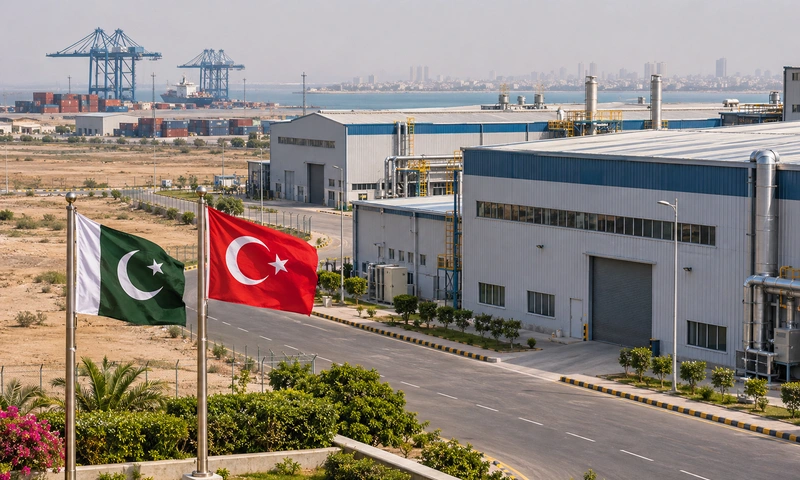
Pakistan Earmarks 1,000 Acres in Karachi for Turkish Businesses
Pakistan has earmarked 1,000 acres at Karachi Industrial Park for Turkish enterprises, Commerce Minister Jam Kamal Khan said on Wednesday. The government aims to attract foreign investment and deepen industrial cooperation with Türkiye through the allocation. Khan discussed the opportunity with Türkiye’s Trade Minister Prof Ömer Bolat during bilateral talks in Istanbul. They met on the sidelines of the 42nd Session of the Standing Committee for Economic and Commercial Cooperation (COMCEC). He invited Turkish businesses to establish industrial units and expand their manufacturing and investment footprint in Pakistan. Both ministers reviewed economic and commercial issues and reaffirmed their commitment to stronger bilateral trade relations. Pakistan seeks greater rice and mango exports Agricultural exports featured prominently in the discussions, particularly Pakistani basmati rice and mangoes. Khan thanked Türkiye for supporting Pakistan’s legitimate claims concerning basmati rice. He stressed the need for continued cooperation to protect and promote Pakistan’s premium agricultural products in international markets. Bolat highlighted the importance of effective marketing and branding for Pakistani basmati rice in Türkiye. He said these efforts could strengthen its market presence and improve consumer recognition. Read More: Pakistan, Turkiye Agree Rapid Military Deployment to Saudi Arabia Khan also sought Turkish support for better market access and increased imports of Pakistani mangoes. Bolat assured him of full support, recognising opportunities to expand agricultural trade between the countries. The Turkish minister agreed to send an official delegation to Pakistan to review existing bilateral trade mechanisms. The delegation will explore practical measures to improve trade relations. Both sides stressed sustained institutional engagement, stronger business cooperation and closer coordination to turn economic opportunities into concrete trade and investment outcomes. The investment invitation follows earlier efforts to attract Turkish manufacturers. In July, Prime Minister Shehbaz Sharif announced a 1,000-acre allocation for Turkish investors in a Karachi special economic zone. Pakistan and Türkiye also maintain a Trade in Goods Agreement, which took effect on May 1, 2023. Their broader economic cooperation agenda includes a $5 billion bilateral trade target. Reliable data central to OIC trade cooperation Separately, Khan met Zehra Zümrüt Selçuk, director general of the Statistical, Economic and Social Research and Training Centre for Islamic Countries (SESRIC). Selçuk outlined the institution’s ongoing activities, research initiatives and reports on trade among Organisation of Islamic Cooperation (OIC) member countries. She highlighted its statistical information and analytical work supporting economic cooperation across Islamic countries. Read More: Turkiye to Begin Offshore Drilling in Pakistan for Oil and Gas Khan praised SESRIC’s work and stressed the importance of accurate, reliable and clean data in economic research and policy analysis. Credible statistics and evidence-based assessments help identify emerging trade trends, understand market dynamics and evaluate trade potential, he said. He added that better data and comprehensive analysis could reveal untapped opportunities and help countries address trade barriers. These tools could also support more effective strategies for expanding intra-OIC trade. Khan called for stronger research cooperation and reliable trade statistics to guide informed decisions and promote greater economic integration among OIC members.