

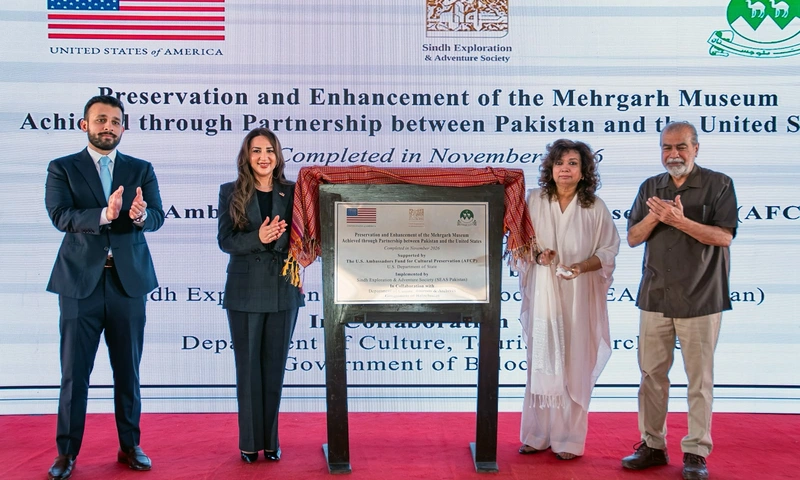
US and Balochistan officials marked the completion of the Mehrgarh Museum preservation project on Saturday, ahead of the Quetta museum’s official reopening later this month. US Chargé d’Affaires Natalie Baker joined Balochistan Parliamentary Secretary Nawabzada Mir Muhammad Zarain Khan Magsi and Sindh Exploration and Adventure Society (SEAS) leadership for the ceremony. The initiative marks the first project in Balochistan under the US Ambassadors Fund for Cultural Preservation (AFCP). Its completion extends the programme’s footprint to all four Pakistani provinces. SEAS and the Balochistan Culture Department implemented the project together. They preserved ancient Neolithic and archaeological artefacts from the Mehrgarh civilisation and upgraded museum curation to international standards. The work also expanded community outreach and trained local heritage professionals in long-term collection care. These measures aim to help museum staff protect the collections beyond the project’s completion. Preservation work prepares museum for visitors Baker linked the initiative to wider cooperation between Pakistan and the United States. She said American museum and preservation expertise could deliver lasting results while building trust between the peoples of both countries. “Today, we are thrilled that, through American excellence in museums and heritage preservation, the Mehrgarh Museum of Balochistan will showcase the 8,000-year-old Mehrgarh civilization and many others.” CDA Baker stated. “Projects like this one show what American expertise delivers: lasting, tangible results that preserve history, create jobs, and strengthen local communities. Together, the United States and Pakistan are making real progress in protecting this remarkable legacy.” During the ceremony, Baker, Magsi and project leads Dr. Asma Ibrahim and Dr. Kaleemullah Lashari unveiled a commemorative plaque. It will stand at the museum entrance in Quetta ahead of the reopening. The project follows a US grant announcement of more than $320,000 in January 2024. Then-US ambassador Donald Blome and then-caretaker Balochistan chief minister Ali Mardan Khan Domki launched the initiative. At that stage, US-supported cultural preservation funding across Pakistan exceeded $8 million for 33 projects. Earlier initiatives included work on Frere Hall, Varun Dev Temple and historic tombs at Makli. Mehrgarh’s archaeological importance Mehrgarh lies on Balochistan’s Kachi plain, near the mouth of the Bolan Pass and approximately 30 kilometres from Sibi. The archaeological site covers around 250 hectares. Its remains help researchers understand early food production, settlement patterns and the development of specialised crafts before the Indus civilisation’s urban centres emerged. Excavations have revealed mudbrick structures, storage compartments and burial grounds. The French Archaeological Mission conducted excavations between 1974 and 1986 and resumed work in 1996. Pakistan added Mehrgarh to its UNESCO World Heritage Tentative List in January 2004. That status identifies it for possible future nomination to the World Heritage List. The museum project brings preservation of this archaeological legacy together with improved displays and local professional training as Quetta prepares to welcome visitors again.
“It Was All of Us”: Khawaja Claims Entire Australia Team Knew About Sandpapergate
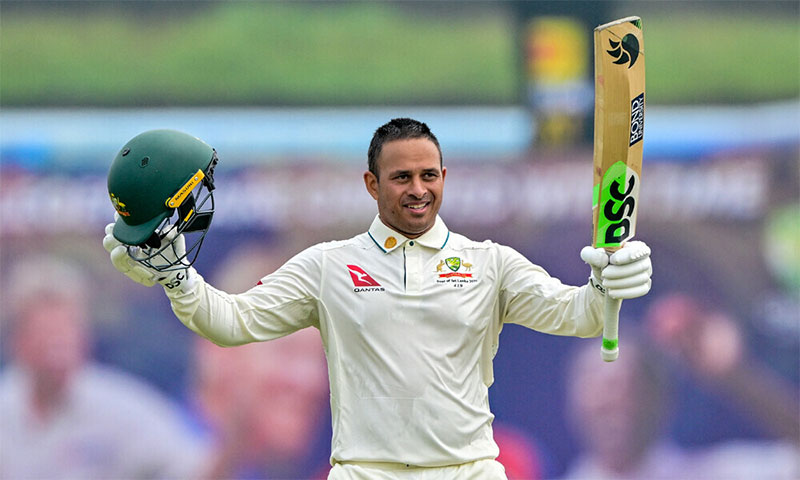
Usman Khawaja claimed on Saturday that Australia’s entire touring team knew about the 2018 Cape Town ball-tampering plot. He also alleged that players used sandpaper during the preceding Test in Port Elizabeth, now Gqeberha. His account challenges Cricket Australia’s finding that only Steve Smith, David Warner and Cameron Bancroft had prior knowledge. “It was all of us. Not the batters, not the bowlers, not the staff. All of us,” Khawaja told the Sydney Morning Herald. The former opener retired this year after 88 Tests. Meanwhile, his autobiography, Sabr, arrives next week with a chapter on the scandal. After the Cape Town Test, Khawaja said he urged the team to accept collective responsibility instead of blaming three players. “In an ideal world, I don’t want to do this,” Khawaja said. “I don’t want to be the one who comes out and talks about the truth. The issue is that I genuinely thought after eight years the truth would have been out by now. “Maybe I thought Davey (Warner) would have exposed it, or someone else would have talked about it more. I just didn’t think it was going to come down to this.” According to Khawaja’s account, players discussed roughening the ball during the second Test. Once they identified sandpaper as effective, Smith allegedly walked away, saying he wanted no involvement. Bancroft then allegedly volunteered to use it during South Africa’s first innings, when the ball swung significantly. Following the Cape Town scandal, Cricket Australia sent the trio home. Smith lost the captaincy and received a one-year ban. Warner also received a 12-month suspension and lost his leadership roles, while Bancroft received nine months. Subsequently, Pat Cummins, Mitchell Starc, Josh Hazlewood and Nathan Lyon publicly denied prior knowledge in 2021. Lehmann disputes widespread knowledge However, former coach Darren Lehmann challenged Khawaja’s account. He resigned after the series. “I don’t think everybody would have known,” he told ABC. “I can’t speak for them (the players) at all. I only know what I know, and I know that ball-tampering was a big part of the game of cricket. “Now it’s obsolete, but that doesn’t make it right either and we paid a heavy price for that.” Lehmann also said the allegations revived “bad memories”. “For the families and the people involved, I feel for them right now because it’s taking them back to a really bad place,” he said. “It’s been eight years. You get to a place where you move on, and I’ve moved on with my life.” Nevertheless, Cricket Australia said it remained open to evidence. “There has been a great deal of speculation in the eight years since the 2018 Cape Town Test, including extensive media coverage throughout last month’s series in South Africa,” it said. “During this time there has been the ongoing opportunity to present any relevant information, and this remains the case. “All relevant information presented to CA to date has been properly considered and we remain comfortable with the findings of our integrity process.”

From Startup Lawyer to Endeavor Pakistan Chief: Meet Mubariz Siddiqui
Endeavor Pakistan has appointed Mubariz Siddiqui as managing director, effective November 1, 2026, to lead its support for entrepreneurs. In this role, he will head the local team and report to the Endeavor Pakistan Board and Endeavor Global. His responsibilities include identifying founders with strong growth potential and supporting business development across Pakistan’s economic sectors. Siddiqui brings experience in law, venture capital and startup regulation. Since beginning his legal career in 2008, he has advised businesses on financing, corporate structures and regulation. Meanwhile, his involvement with Pakistan’s startup community dates back to 2015. As founder of Carbon Law, Siddiqui advised founders, investors and technology companies. Previously, he served as general counsel at Sarmayacar, a venture capital fund focused on Pakistan. His career also includes senior legal positions on corporate and infrastructure projects, alongside work with regulators on reforms for early-stage companies. To take up the appointment, Siddiqui has paused his legal practice. “Pakistan will produce companies that matter far beyond its borders. Our job is to find the founders behind them early, in every sector, and put the world’s best network behind them. Mubariz shares this ambition, and we are excited to back him on this mission,” said Mudassir Sheikha, co-founder and CEO of Careem and founding board chair of Endeavor Pakistan. Alongside software, the organisation will focus on retail, agriculture, healthcare, logistics, services exports and consumer brands. Selected entrepreneurs join a network spanning more than 45 markets. Through that network, they gain access to mentors, peers, talent and investors. Endeavor Pakistan launched in 2022 as the global organisation’s 40th office. Since then, its community has included entrepreneurs behind Bazaar, Abhi, SadaPay, LAAM, PostEx, PriceOye, QistBazaar and KamelPay. “I’ve seen what happens when a founder meets the right people at the right time, and what happens when they don’t. Endeavor Pakistan exists to make that moment happen more often, then ask those founders to do the same for the next ones. That is how an ecosystem compounds. Mubariz knows this work from the inside, and I’m glad he’s the one leading it,” said Aaqib Gadit, founding board member of Endeavor Pakistan. Endeavor calls this approach its “Multiplier Effect”. As entrepreneurs grow, they mentor, train and invest in other founders. In turn, those connections help extend support to the next generation. The organisation’s Pakistan launch announcement focused on businesses beyond the initial startup phase with potential for rapid expansion. “Entrepreneurship is the most credible path to social mobility in Pakistan. Our priority is to make it a viable career for far more Pakistanis. Endeavor has helped build entrepreneurial ecosystems in markets around the world, and Endeavor Pakistan will bring that network and those lessons here. I want to hear from founders, mentors and institutions who want to build it with us,” Siddiqui said.

Use of Cheques to End: All AAA Payments via Raast From November 16
The government will discontinue cheque payments under the Asaan Assignment Accounts (AAA) system from November 15. All payments through these accounts nationwide will move exclusively to Raast from November 16, officials told a meeting on Friday. Drawing and disbursing officers have already completed training for the transition. Prime Minister Shehbaz Sharif chaired the meeting in Islamabad on November 6 to review progress towards a cashless economy. Officials said federal and provincial departments were advancing payment digitisation. Most institutions expect to complete the process by December 2026. Shehbaz directed authorities to prepare a clear roadmap for establishing a fully digital payments system across Pakistan. He asked for specific targets and deadlines and instructed ministries and government institutions to implement the cashless economy plan. He also ordered officials to resolve technical difficulties and consumer complaints without delay. Wider access to technology and reliable internet connectivity, he said, would underpin the transition. The prime minister described digital payments as a government priority and commended the finance ministry and other institutions for their work. Officials reported that the Benazir Income Support Programme now makes all payments through digital wallets. They also briefed the meeting on efforts to develop a payment mechanism for areas without internet access. Work on that mechanism remains under way, alongside infrastructure development to improve connectivity nationwide. Raast QR payments and utility bills The meeting reviewed efforts to encourage digital transactions between consumers and merchants through Raast QR codes. Shehbaz directed that the initiative continue with government backing, saying it supported the cashless economy plan. He also ordered an effective media campaign encouraging electricity and gas consumers to scan the QR codes printed on their bills. The campaign would promote digital payments for routine household expenses as the government expands adoption across public institutions and businesses. Raast is Pakistan’s national instant payment system. It enables transfers between individuals, businesses and government entities in real time. Its infrastructure connects participating financial institutions, allowing customers and merchants to transact across different providers. SBP’s guidance lists mobile applications, internet banking, USSD and branches among the available channels, depending on the participating bank. Customers can send money using a registered Raast ID or an IBAN. A Raast ID links a mobile number to an account, simplifying the details recipients share to receive funds. Participants included Finance Minister Muhammad Aurangzeb, IT Minister Shaza Fatima and Information Minister Attaullah Tarar. Maritime Affairs Minister Junaid Anwar Chaudhry, Petroleum Minister Ali Pervaiz Malik and Power Minister Awais Leghari also attended. Adviser on Political Affairs Rana Sanaullah, Minister of State for Finance Bilal Kayani and SBP Governor Jameel Ahmad joined the meeting. Provincial chief secretaries and senior government officials also participated in the review of payment digitisation and the nationwide Raast transition.
