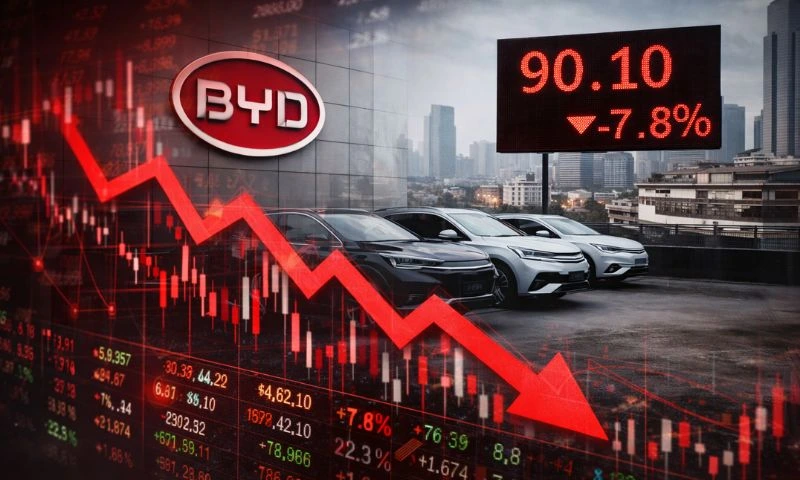
Shares of Chinese electric vehicle maker BYD Co. Ltd. slumped sharply this week after the company reported a significant drop in vehicle sales, raising concerns among investors about its growth trajectory and competitive edge in the global electric vehicle (EV) market.
On February 2, BYD’s Hong Kong-listed stock fell 7.8% to HK$90.10, its lowest level in over a year. Shares on the Shenzhen exchange also slipped, down as much as 4.3%, following the January sales data that showed a 30.1% year-on-year decline in vehicle deliveries.
January marked the fifth consecutive month of falling sales for BYD, with total deliveries of 210,051 vehicles, compared with more than 300,000 units in the same period last year. The downturn represents the weakest January performance since 2020, when the COVID-19 pandemic severely disrupted production and demand.
Industry data show the slump affected nearly all segments. Plug-in hybrid electric vehicle (PHEV) sales — which account for more than half of BYD’s total sales — fell 28.5%, extending a decline that began in 2025 after a 7.9% drop the prior year. Battery electric vehicle sales also lagged, reflecting weaker domestic demand and a stagnating Chinese EV market.
Production figures mirrored the sales slump. BYD’s January output fell 29.1%, with PHEVs down nearly 25% and pure battery EVs sliding 35.7%. However, commercial vehicle output, particularly buses, showed growth, rising more than 50% as BYD diversified beyond passenger EVs.
The slump in sales comes as China’s domestic EV market weakens amid the scaling back of government subsidies, which previously boosted demand for electric vehicles. Analysts say reduced incentives have shifted consumer behaviour and intensified competition among domestic rivals such as Geely, Leapmotor, XPeng and Li Auto.
Despite the domestic challenges, BYD has seen stronger performance overseas, with foreign sales up 43.3% in January, accounting for nearly half of total deliveries. The company has targeted 1.3 million overseas shipments in 2026, a nearly 24% increase from last year, even though this falls short of earlier projections of up to 1.6 million units.
This global focus helped BYD become the world’s largest EV seller in 2025, overtaking U.S. rival Tesla in annual vehicle deliveries thanks to robust export growth last year. However, the recent sales slump underscores that foreign markets alone may not fully offset pressures at home.
As Chinese EV stocks broadly reacted to the weak data, other manufacturers also saw share price declines. Analysts warn that the EV industry’s early-year performance could shape investor sentiment and competitive dynamics in 2026.
For BYD, the challenge now lies in balancing long-term global expansion with the need to revive domestic demand and reinvigorate its product lineup as subsidies wane and competition intensifies.