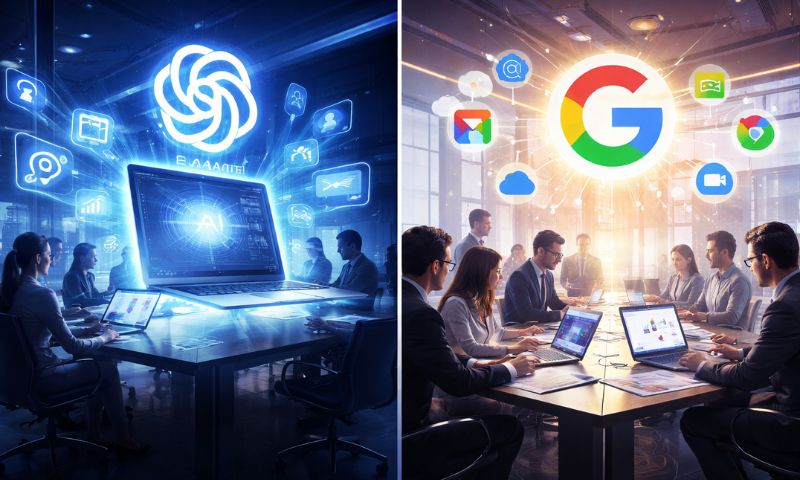
CIOs aren’t split on whether AI matters. They’re split on where to standardize: OpenAI’s “bring ChatGPT to work” approach, or Google’s “put Gemini inside what you already use.”
OpenAI’s enterprise push leans on a simple advantage: many employees already know ChatGPT. OpenAI says it now has more than 1 million business customers and 7 million “ChatGPT for Work” seats, with ChatGPT Enterprise seats growing quickly year over year. For CIOs, that familiarity can shrink pilots and speed adoption. Teams don’t need weeks of training to get value.
Security is the next selling point. OpenAI states it doesn’t train on customer data by default for ChatGPT Enterprise/Business/Edu and the API, and it highlights encryption and SOC 2 commitments for Enterprise. That messaging resonates with regulated industries that need clear boundaries around prompts, files, and outputs.
Google’s Gemini business story is different. It’s less about a new destination and more about a new layer across Gmail, Docs, Sheets, Meet, and Google Cloud. Google’s Workspace materials emphasize that customer data isn’t used to train Gemini models or for ads, and admins can apply governance controls like DLP. In many enterprises, that “already in the suite” integration is the real killer feature. If your workforce lives in Workspace, Gemini becomes a low-friction rollout.
Then there’s the platform buyer. Google Cloud positions Vertex AI as the build-and-govern layer, with Gemini models available for enterprise development, agents, and tooling. That appeals to CIOs who want custom workflows, stronger centralized policy, and one vendor for cloud + AI.
So who’s “winning” corporate adoption? The data points suggest OpenAI is capturing a big share of day-to-day spend. One recent Ramp analysis reported OpenAI leading enterprise AI provider share in its dataset, with spending hitting a record high in late 2025. But Google has a different kind of leverage: distribution through its app ecosystem and cloud footprint. For some CIOs, that’s safer than adding another major vendor.
Why the split? OpenAI often wins when companies want fast productivity gains and a best-in-class chat experience. Google wins when companies want AI embedded in existing workflows, with familiar enterprise controls. In 2026, the “winner” may be whichever platform proves it can scale from clever demos to audited, repeatable business processes.