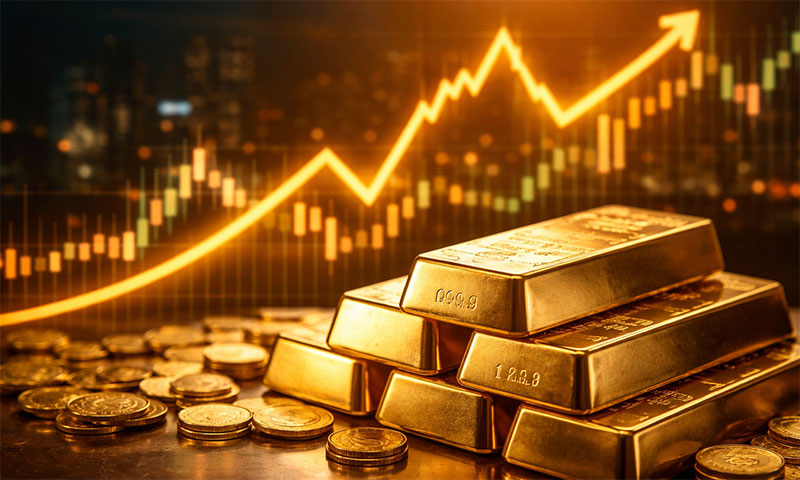
Gold prices have entered 2026 at record levels, reinforcing the metal’s role as a global safe haven amid persistent geopolitical uncertainty, shifting monetary policy expectations, and strong institutional demand. Market analysts and major financial institutions broadly agree that gold still has room to rise this year, though they caution that volatility is likely to remain a defining feature of the market.
Spot gold climbed above $4,600 per ounce in January, extending a powerful rally from 2025. The surge has pushed several leading banks to revise their forecasts, with some now projecting that gold could approach — or even breach — the $5,000 per ounce mark before the end of 2026.
Where gold prices could head
Among the most optimistic forecasts, J.P. Morgan expects gold prices to average around $5,055 per ounce by the fourth quarter of 2026, citing sustained investor demand and supportive macroeconomic conditions. HSBC has also stated that gold could reach $5,000 per ounce in the first half of 2026, though it warns that price swings may be sharp and frequent, with a wide trading range likely throughout the year.
Meanwhile, Morgan Stanley projects gold prices to rise toward $4,800 per ounce by late 2026, supported by easing global monetary conditions and continued buying from central banks. While forecast levels vary, the overall consensus suggests that prices are likely to remain elevated through most of the year, with further upside possible if current trends persist.
Key drivers behind the rally
Analysts point to several interconnected factors driving gold’s strength:
First, geopolitical and political uncertainty continues to boost safe-haven demand. Ongoing conflicts, fragile regional stability, and election-related risks in major economies have encouraged investors to seek protection in gold.
Second, interest rate expectations remain a crucial driver. Anticipation that major central banks — particularly the U.S. Federal Reserve — may cut interest rates later in the year has lowered the opportunity cost of holding non-yielding assets like gold, making the metal more attractive.
Third, central bank demand has provided a strong structural support. Many central banks, especially in emerging markets, have continued to add gold to their reserves as part of long-term diversification strategies, reinforcing demand even at high price levels.
Finally, investment flows, including inflows into gold-backed exchange-traded funds (ETFs), have added momentum to the rally. Institutional investors have increasingly treated gold as a strategic hedge rather than a short-term trade.
How long can the rally last?
Based on current forecasts, analysts believe gold could continue to show strength through most of 2026, with key price milestones potentially reached in the first or second half of the year. However, few expect a straight upward move.
Several institutions caution that price corrections are possible, particularly if geopolitical tensions ease, inflation proves more persistent than expected, or central banks delay or scale back rate cuts. A stronger U.S. dollar could also weigh on prices by making gold more expensive for non-U.S. buyers.
Despite these risks, gold’s overall outlook for 2026 remains constructive. With prices already at historic highs and multiple global banks projecting further gains, gold is likely to retain its appeal as a hedge against uncertainty and financial market stress.
While the pace of gains may slow and volatility may increase, analysts broadly agree that gold is expected to remain well supported throughout 2026, with the possibility of new record levels if global economic and political risks intensify.