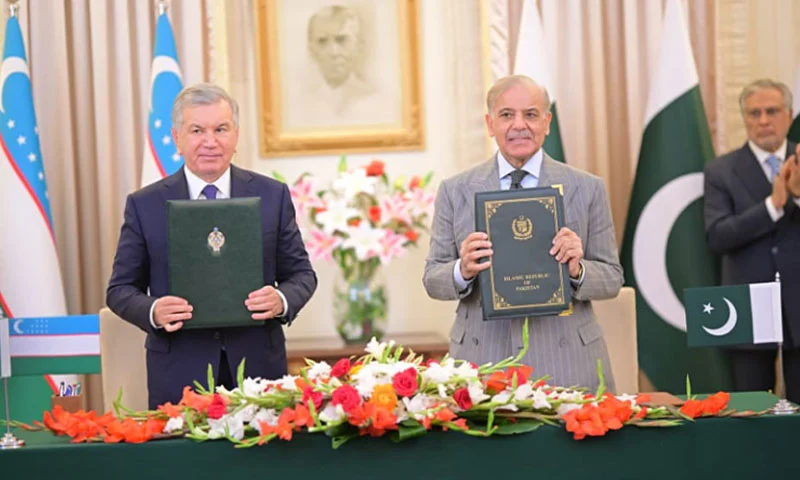
Pakistan and Uzbekistan have once again reaffirmed their commitment to deepening economic and strategic ties, with both sides setting an ambitious $2 billion bilateral trade target by 2029. The pledge came in a joint declaration issued after Uzbek President Shavkat Mirziyoyev’s state visit to Pakistan from February 5–6, underscoring a growing partnership spanning trade, connectivity, culture and security.
During comprehensive talks in Islamabad, Pakistani Prime Minister Shehbaz Sharif and President Mirziyoyev reviewed the current state of relations and expressed satisfaction over a positive trajectory of cooperation that has strengthened over the last three decades since formal diplomatic ties began.
Read More: Ishaq Dar Calls for Policy Continuity to Restore Investor Confidence in Pakistan
The leaders specifically highlighted their shared resolve to expand trade and industrial cooperation, noting existing agreements and institutional mechanisms that provide a roadmap toward achieving the $2 billion goal. Under the joint declaration, both countries pledged to pursue closer economic relations and targeted cooperation across sectors including textiles, agriculture, manufacturing, pharmaceuticals, mining and information technology.
پاکستان اور ازبکستان کے تعلقات صدیوں پرانی شاہراہِ ریشم سے جڑے ہیں۔
مغل ورثہ اور سمرقند و بخارا کے علمی مراکز نے پاکستان کی تاریخ و تہذیب پر گہرے اثرات ڈالے ہیں۔
مفاہمتی یادداشتوں کے تبادلے کی تقریب میں وزیراعظم شہباز شریف کا خطاب pic.twitter.com/cf3JJ0XXZ3— Samina Kauser Swl (@Skpmln) February 6, 2026
Economists and trade experts see this renewed push as a step toward unlocking Pakistan’s potential in Central Asian markets and reducing its traditional dependence on a narrow export base. Pakistan’s trade with Uzbekistan has historically been modest, but officials believe that stronger alignment, expanded market access and improved logistics can accelerate growth.
Read More: Pakistan–Bangladesh Direct Flights Resume After 14 Years With Dhaka–Karachi Route
Connectivity remains central to this vision. Both leaders reaffirmed support for regional infrastructure initiatives such as the Uzbekistan–Afghanistan–Pakistan Railway Project, a planned 573-kilometer rail corridor aimed at linking Tashkent and Peshawar via Kabul. The railway is expected to cut transit times and dramatically lower freight costs, offering a major boost to trade flows between South Asia and Central Asia.
In addition, the countries celebrated progress on their Preferential Trade Agreement (PTA) — first signed years ago and currently under expansion to cover more products, services and market segments. Negotiators are reportedly working on raising the number of tariff-reduced products to broaden trade opportunities.
Read More: Top Europe Destinations Pakistanis Can Visit Without a Schengen Visa in 2026
The joint declaration also covered broader diplomatic cooperation, including security collaboration, multilateral engagement at the United Nations and cultural initiatives aimed at strengthening people-to-people ties. Both leaders agreed that enhanced aviation links and tourism cooperation would further cement relations.
Experts say that boosting Pakistan-Uzbekistan trade to $2 billion will require sustained political will, streamlined customs procedures and expanded private-sector engagement. However, the latest high-level interactions signal strong intent on both sides to transform shared economic vision into practical outcomes.