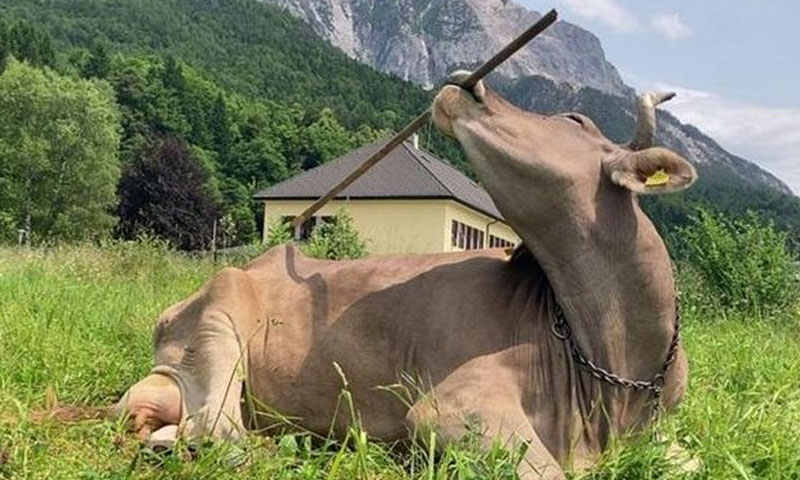
Cows may be far more intelligent than they are usually given credit for. New research published in Current Biology has documented what scientists describe as the first recorded case of tool use by a cow, challenging long-standing assumptions about bovine cognition.
The study centres on Veronika, a Swiss brown cow living in a mountain village in the Austrian countryside. Researchers from the University of Veterinary Medicine Vienna observed Veronika over several years and found that she repeatedly used objects such as sticks, rakes, and brooms to scratch parts of her body—behaviour that meets scientific criteria for intentional and consistent tool use. The findings were also reported by the BBC.
According to the researchers, Veronika did not simply rub against objects at random. Instead, she demonstrated purposeful selection and control, choosing different parts of the same tool depending on her physical needs. When scratching tougher areas such as her back, she used the bristle end of a broom. For more sensitive areas, including her underbelly, she switched to the smoother handle, indicating an ability to adjust behaviour based on bodily sensation.
Scientists noted that this type of multi-purpose tool use is rare in the animal kingdom and had never before been formally documented in cattle. This is despite more than 10,000 years of close coexistence between humans and cows, during which such behaviour had gone unnoticed. Comparable examples of tool use are more commonly associated with animals such as chimpanzees, which use sticks to extract insects and stones to crack open nuts.
The research team said Veronika’s actions suggest a level of physical self-awareness, problem-solving ability, and behavioural flexibility that challenges the traditional view of cows as cognitively simple farm animals. They argued that cattle may possess latent cognitive capacities that only emerge under certain environmental conditions.
Veronika’s owner, organic farmer Witgar Wiegele, welcomed the findings and said he hoped they would encourage people to rethink how animals are perceived and treated. He described biodiversity as “the key to survive on this planet,” adding that animals often reveal unexpected abilities when given space and opportunity.
The authors of the study concluded that cattle cognition may be far more complex than previously assumed. They suggested that other cows might also be capable of similar tool-using behaviour if raised in environments that allow exploration, learning, and individual expression.