
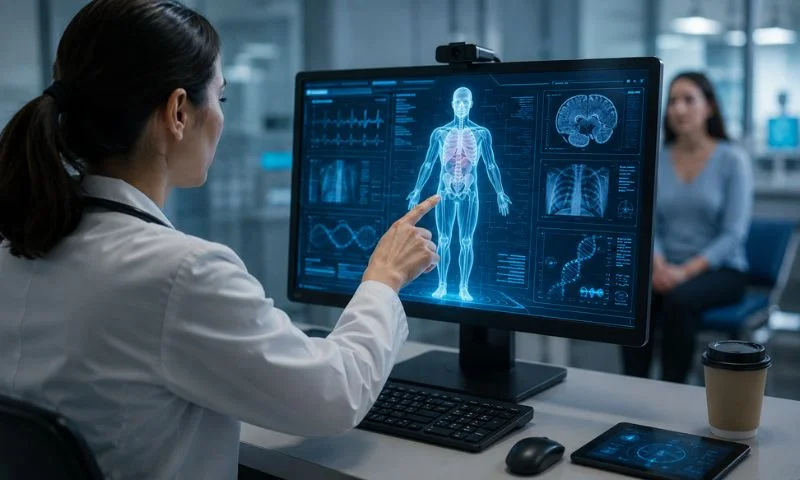
Millions of people now use artificial intelligence chatbots to seek health information online. In response, Microsoft and Mayo Clinic have launched a major partnership to develop an AI model trained specifically on healthcare data, medical research and clinical expertise. The project aims to address concerns about the reliability of health advice generated by mainstream AI systems. Most popular chatbots rely on broad internet content, which can sometimes produce inaccurate or unsafe responses. Microsoft unveiled the initiative during its Build developer conference. The project marks one of the industry’s most ambitious attempts to create a healthcare-focused AI system for both patients and medical professionals. “We needed to have the right data and the right people in the right place to be able to do this, and we firmly believe that will result in better healthcare outcomes for people who use the model,” Mayo Clinic CEO Gianrico Farrugia told CNN ahead of the announcement. Built on Medical Expertise and Clinical Data The new model differs from general-purpose AI chatbots. It will use Mayo Clinic’s extensive medical records, research findings and clinical expertise to generate responses. Mayo Clinic will own the model. Microsoft will provide AI technology and cloud computing support. The organizations plan to deploy the system first within Mayo Clinic’s healthcare network. Clinicians will test the technology and help improve its performance before a wider rollout. The partnership could eventually support AI tools across Mayo Clinic hospitals. The organizations may also license the technology to other healthcare providers. They also plan to create an AI healthcare assistant for patients. Users could access it through Mayo Clinic’s online portal. According to Microsoft AI CEO Mustafa Suleyman, the technology could help patients understand diagnoses, explore treatment options and learn more about preventive care. However, Suleyman warned that public deployment will take time. “It will take many years” to train and refine the model to a level where people can trust it for high-stakes health decisions, he said. The announcement comes as technology companies compete aggressively in the growing AI healthcare market. Studies published in journals such as Nature Medicine show that advanced AI systems perform well on some medical benchmarks. However, researchers continue to warn about inaccuracies, hallucinations and bias. Competition Intensifies in AI Healthcare Race Microsoft and Mayo Clinic’s move follows similar healthcare efforts by major technology firms. Google recently expanded its AI health tools. OpenAI and Anthropic have also added health-related features to their platforms. Mayo Clinic believes its clinical experience could provide a competitive advantage. The institution has already developed AI systems that help detect heart disease and assist with pancreatic cancer diagnosis. The healthcare provider said it anonymized patient data before using it for AI training. The two organizations declined to reveal the project’s financial details. Suleyman said both sides were making “very material, long-term commitments to one another.” Farrugia acknowledged concerns about artificial intelligence. However, he said healthcare systems around the world need innovative solutions to meet growing demand. “Globally, but even United States, there’s still so much need for better healthcare that we should embrace AI,” he said, “because it helps us get better results.” As interest in AI-powered health advice grows, Microsoft and Mayo Clinic hope their model can deliver more reliable and medically grounded guidance for patients and healthcare professionals.

Teen Invents AI Device That Could Treat Crossed Eyes Without Surgery
A 14-year-old student has created a teen AI crossed eyes device that could change how doctors treat strabismus, commonly known as crossed eyes. Notably, the invention has already drawn attention from medical experts and technology communities. The young innovator designed a wearable system that uses artificial intelligence to improve eye alignment. In particular, the device gives real-time feedback and helps train the eyes to work together. As a result, it offers a possible alternative to surgery and long-term patch therapy. Strabismus affects millions of people worldwide, especially children. If left untreated, it can lead to serious vision problems. AI innovation targeting strabismus treatment The device tracks eye movement and detects misalignment. Then, it sends visual signals that guide the eyes into correct positioning. Over time, this training helps improve coordination between the eyes and the brain. “I wanted to find a way to help people correct their vision without going through invasive procedures,” the teenager said. Meanwhile, experts say AI is playing a growing role in eye care. Doctors already use it to detect diseases such as glaucoma and diabetic retinopathy. Now, innovators are also using it to support treatment. The teen AI crossed eyes device highlights how technology can make treatment simpler and more accessible. In addition, it reflects a shift toward smarter healthcare solutions. Growing interest from medical community Researchers and doctors have shown strong interest in the invention. For instance, many believe wearable AI tools could support early treatment and improve outcomes. Studies show that strabismus affects around 4 percent of the global population. In many cases, the condition reduces depth perception and can lead to lazy eye if not treated early. Therefore, experts stress that early treatment remains critical. At the same time, they note that the device needs clinical testing before doctors can use it widely. The invention shows how young minds can solve real-world problems. More importantly, it highlights the growing role of innovation in healthcare. Looking ahead, the teen AI crossed eyes device could become part of future vision therapy tools and help reduce reliance on invasive treatments.

Doctors Are Secretly Turning to AI Chatbots, But Should Patients Worry?
Millions of Americans are using artificial intelligence chatbots for health questions, and doctors are increasingly doing the same, as the technology moves deeper into clinics, hospitals and medical training. According to CNN, specialized medical AI chatbots have become a regular reference tool for physicians and trainees, helping them review research, draft notes, write insurance letters and build lists of possible diagnoses. One medical chatbot company CEO recently claimed that more than 100 million Americans were treated last year by a doctor who used its platform. But doctors interviewed by CNN drew a clear distinction between medical AI platforms and general-purpose chatbots such as ChatGPT. OpenAI’s own usage policies say its services should not be used for “tailored advice” requiring a license, including medical advice, without appropriate involvement by a licensed professional. “ChatGPT is like your crazy uncle,” said Dr. Ida Sim, a University of California, San Francisco professor who studies health data and technology. She told CNN that medical chatbots are more likely to ground answers in peer-reviewed research and clinical guidelines. How doctors are using AI One of the biggest uses is keeping up with medical research. Millions of papers are published each year, making it difficult for doctors to stay current. Dr. Jared Dashevsky, a resident physician at the Icahn School of Medicine at Mount Sinai, told CNN: “You’d need like 18 hours a day to stay up to date.” Doctors are also using AI to summarize long hospital stays, draft clinical notes, prepare letters for insurance companies and support prior authorization requests. Dashevsky said AI-generated insurance letters have become a “game-changer,” helping physicians respond faster to patient needs. Another growing use is diagnosis support. Medical students and doctors use AI chatbots to generate possible explanations for a patient’s symptoms, lab results or imaging findings. Evan Patel, a fourth-year medical student at Rush University Medical College, told CNN that chatbots help trainees understand “what possibilities it could be.” Read More: Same Question, Different Answer: AI Chatbots Raise Medical Concerns The risks patients should know The rise of AI in medicine has also raised concerns about patient data. CNN reported that some doctors are using unauthorized “shadow AI” tools, including platforms that advertise HIPAA compliance features. Iliana Peters, a health care lawyer and former HHS HIPAA enforcement official, warned that “‘HIPAA compliance’ is not an accurate term to use by any company.” Dr. Carolyn Kaufman, a Stanford Medicine resident, said patient information may be entering unauthorized systems. “Data is money,” she said. Public use is also expanding rapidly. A KFF poll found that about one-third of US adults used AI chatbots for health information in the past year, while Gallup and West Health found that 59% of AI health users research questions before doctor visits and about 14 million adults skipped a provider visit after using AI. Researchers are warning that general chatbots can still produce inaccurate or unsafe responses. Two recent studies cited by The Washington Post found major reliability gaps, including potentially dangerous wrong answers and failures in early diagnostic reasoning. Experts say AI may reduce paperwork and improve access to medical knowledge, but it is not ready to replace human judgment. As Dr. Jonathan H. Chen of Stanford Medicine told CNN: “People treat AI like it’s magic.”
