
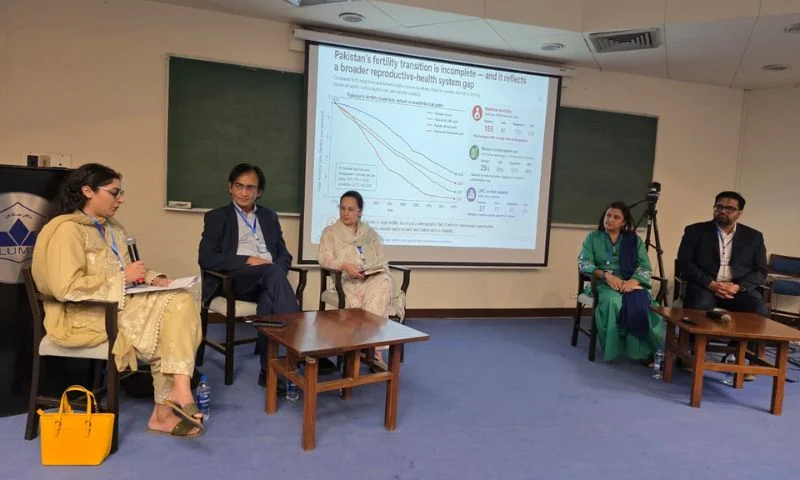
Experts at a gender and economy conference in Lahore warned that artificial intelligence could either unlock major economic opportunities for women or deepen existing inequalities if Pakistan fails to expand digital education and skills training. The discussion took place during a panel on “Health & Gender” moderated by Warda Riaz at LUMS. Panelists included Fyeza Jehan, Usman Ali, Adnan Khan and M. Farhan Majid. Speakers stressed that women’s economic empowerment depends heavily on education, access to information and bargaining power within society. One panelist said affordable learning opportunities and digital skills programmes could help women overcome structural barriers that continue to limit workforce participation and entrepreneurship. “There is a risk that communities with lower skills will be unable to benefit from new technologies,” the panel noted during the discussion. The experts warned that countries failing to invest in digital capacity-building may fall further behind in productivity and global competitiveness. AI Could Transform Women-Led Businesses The panel highlighted how digital tools and AI systems are rapidly reshaping business operations around the world. Referring to survey findings conducted with the Asher Blair Foundation, speakers said women entrepreneurs from nearly 80 countries showed strong interest in adopting generative AI tools. According to the findings, many women business owners wanted to use AI for accounting, payroll management and routine administrative work. Experts said AI could help women-led enterprises reduce time-consuming manual tasks while improving efficiency and productivity. The panel also referenced estimates suggesting Pakistan’s women-focused digital economy could represent a market worth nearly $500 million. That estimate is linked to Pakistan’s female population of around 73 million, highlighting the scale of untapped economic potential. Pakistan has one of the lowest female labor force participation rates in South Asia. The World Bank estimates female participation remains below 25 percent, despite rising smartphone and internet usage. Digital access for women also remains uneven, particularly in rural areas where internet access, digital literacy and educational opportunities remain limited. Digital Divide Could Hurt Long-Term Growth Experts warned that Pakistan’s weak education indicators and low literacy rates could limit the country’s ability to benefit from AI-driven economic transformation. They argued that unequal access to technology may create broader macroeconomic problems in the future. According to the discussion, economies with lower digital adoption could face slower productivity growth and greater dependence on imports. Meanwhile, digitally advanced economies may continue scaling faster through automation and AI integration. The panelists urged policymakers, educational institutions and private companies to invest urgently in women’s digital education and technology-focused training. They said inclusive access to AI skills would play a critical role in ensuring equitable economic growth across Pakistan. Analysts worldwide have increasingly warned that AI may widen social and economic inequality if governments fail to invest in education and workforce adaptation. For Pakistan, experts said the challenge now lies in ensuring women are not excluded from the next phase of technological and economic change.
AI and Jobs: Blessing or Burden? What experts are warning about
Debate over artificial intelligence and job losses has intensified as business leaders and global institutions issue increasingly blunt assessments of how fast work is changing. Jensen Huang, whose company’s chips power much of the AI boom has repeatedly argued that AI will affect every job, and that workers risk being displaced by other workers who adopt AI faster. In a widely reported remark, Huang said: “Every job will be affected, and immediately. It is unquestionable.” He added: “You’re not going to lose your job to an AI, but you’re going to lose your job to someone who uses AI.” What’s the core fear and what do major institutions say? The concern is not only “job loss,” but job transformation at scale: AI systems automate portions of work (tasks), potentially reducing hiring in some areas while boosting productivity and creating demand elsewhere. The International Monetary Fund has framed the shift as both opportunity and disruption. In a recent policy speech, Kristalina Georgieva said: “On average, 40 percent of jobs globally will be impacted by AI either upgraded, or eliminated or transformed. For advanced economies, 60 percent of jobs will be affected.” In earlier remarks reported widely, Georgieva also warned that: “Your job may disappear altogether — not good — or artificial intelligence may enhance your job…” highlighting that outcomes may vary widely by occupation and country readiness. Meanwhile, the World Economic Forum estimates significant churn in the near term. Its Future of Jobs Report 2023 projected 83 million jobs lost and 69 million created over the following five years (net -14 million), describing broad labor-market “churn” as firms adopt AI and other technologies. Which jobs are most exposed? Across major studies and employer surveys, the most frequently flagged vulnerable areas include: Clerical, administrative, and routine office tasks (data entry, basic processing, scheduling) Some entry-level “white-collar” roles where work is text-heavy and standardized (basic research, templated writing, simple analysis) The WEF’s reporting and explainers repeatedly point to administrative and clerical roles among the fastest-declining categories, while highlighting strong growth in AI-adjacent roles like data and cybersecurity. A more pessimistic warning has come from Anthropic CEO Dario Amodei, who has argued AI could produce severe labor-market disruption and even a low-wage or unemployed “underclass” if policy and industry fail to respond. At the same time, several analyses caution against assuming an immediate “jobpocalypse,” noting that evidence so far is mixed and job effects often show up as task reshuffling rather than instant mass unemployment. So… will AI be a blessing or a burden? What credible sources converge on is this: AI will raise productivity for some workers and firmsThe IMF describes potential growth gains, but emphasizes uneven distribution and the need for preparedness and safety nets. AI will disrupt hiring and entry pathways in some fieldsSome leaders and research warn that entry-level roles are especially sensitive because AI can handle “first draft” work and routine analysis at scale. Outcomes depend heavily on skills, adoption, and policyWEF reporting emphasizes reskilling/upskilling as the central pressure point for companies and workers. In other words: the “blessing vs burden” question is not answered by a single forecast. It depends on how fast workers adapt, how companies redesign roles, and whether governments and employers invest in skills transitions. How workers can use AI to stay employable—based on what experts are actually saying Huang’s most practical point is competition: workers may be displaced by other workers using AI more effectively. The IMF’s guidance stresses preparedness, retraining, and safety nets. From that, a verifiable “best practice” direction emerges: 1) Use AI for “first drafts,” then add human judgment Huang has described using chatbots to produce first drafts and then refining them. This aligns with the most common enterprise pattern today: AI accelerates drafting, summarizing, outlining, and reformatting — while humans verify, contextualize, and decide. 2) Turn AI into a daily “skills multiplier” The IMF notes job postings increasingly demand new skills and that AI shifts skill demand. In practice, workers who win are often those who can: Write precise instructions (prompting) Verify and fact-check outputs Apply domain knowledge (law, finance, medicine, operations) on top of AI speed 3) Build a small, repeatable workflow for your job Instead of “learning AI” as a vague goal, adopt workflows such as: Meeting → summary → action items → follow-up email Dataset/brief → key insights → slide outline Customer messages → response drafts → QA + tone control Those are the types of task-bundles WEF and major employers discuss when they talk about AI changing jobs via tasks, not titles. Tools that are commonly used in AI-enabled work today Below is a practical, work-oriented tool map (not a prediction). Selection depends on role, data sensitivity, and company policy. Writing, research, and summaries OpenAI ChatGPT Gemini (Google) Claude (Anthropic) Office productivity Microsoft Copilot (Word/Excel/PowerPoint workflows) Google Workspace AI features (Docs/Sheets/Slides workflows) Coding and technical productivity GitHub Copilot Cursor / Codeium (AI coding assistants) Design and creative production Canva AI tools (quick design iteration) Adobe Firefly (creative generation in Adobe ecosystem) Automation (non-technical) Zapier / Make (connect apps, automate repetitive steps) Important safety note for real work: experts and institutions repeatedly warn that AI outputs must be checked—especially for legal, medical, finance, and public communications. (This is consistent with the IMF/WEF framing that AI transforms tasks and raises new skill demands.) What to watch next: the risks experts highlight Based on credible reporting and institutional warnings, the key risks discussed publicly include: Inequality widening if high-skill workers gain more while others lose bargaining power Entry-level pipeline disruption, making it harder for young workers to get “starter” experience Reskilling gaps, where workers need training but don’t receive it at scale
