
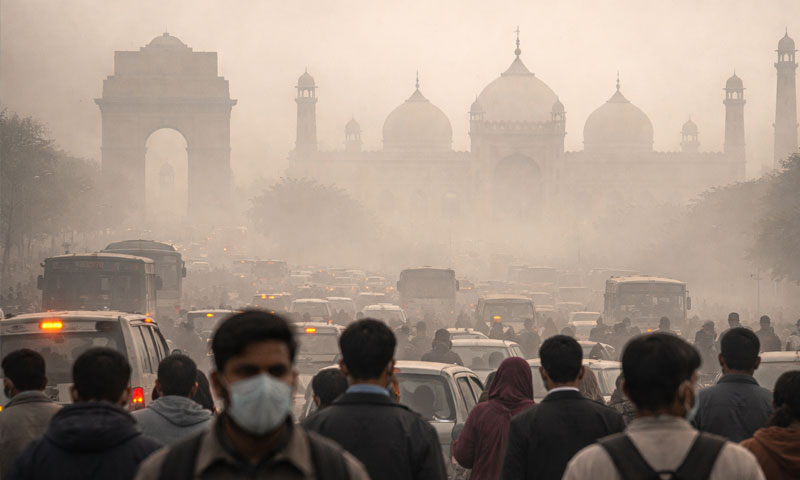
Dhaka has topped the global list of the world’s most polluted cities, recording a “very unhealthy” Air Quality Index (AQI) of 299, just shy of the hazardous threshold, according to the latest industry air-quality data. Close behind, Delhi ranked second with an AQI of 264, while Lahore placed third at 228, underscoring the severe air pollution crisis gripping South Asia’s largest urban centres. Kolkata followed with an AQI of 225, also in the “very unhealthy” category. Other cities appearing near the top of the global pollution rankings include Bishkek (213), Sarajevo (201), Kraków (195), Medan (194), Warsaw (180), and Kabul (175). Most of these cities fall within the unhealthy (red) or very unhealthy (purple) AQI zones. Why pollution levels are surging Experts attribute these alarming readings to a combination of vehicular emissions, industrial pollution, brick kilns, biomass burning, construction dust, and unfavourable seasonal weather patterns. During winter, calm winds and temperature inversions trap pollutants close to the ground, preventing their dispersion and worsening smog conditions. According to global monitoring data, only around 17% of cities worldwide meet the annual PM2.5 air-quality guidelines set by the World Health Organization. In South Asia and parts of Africa, average PM2.5 levels are at least ten times higher than the WHO’s recommended annual limit of 5 micrograms per cubic metre. South Asia’s winter smog crisis Delhi, home to roughly 32 million people, continues to exemplify the region’s winter smog emergency. While air quality fluctuates during the day, winter months routinely push PM2.5-based AQI readings beyond 300, often crossing 400 during severe cold spells. Lahore has repeatedly ranked among the world’s most polluted cities this winter, with thick smog disrupting daily life, closing schools, and increasing hospital admissions. Dhaka, meanwhile, has seen persistent high pollution levels driven by traffic congestion, industrial emissions, and brick kilns operating around the capital. Serious health consequences Health researchers warn that prolonged exposure to AQI levels above 300 can cause severe respiratory and cardiovascular damage. Some studies equate a full day of breathing such air to smoking multiple cigarettes, while heavy outdoor exposure during peak smog episodes has been likened to inhaling the equivalent of dozens of cigarettes per day. These conditions significantly raise the risk of asthma, chronic lung disease, heart attacks, and premature death, particularly among children, the elderly, and those with pre-existing health conditions. How air quality is monitored Global rankings are compiled using real-time and ground-level data from tens of thousands of monitoring stations operated by companies such as IQAir. The system allows hourly tracking of pollution spikes and issues public health alerts when AQI levels reach dangerous thresholds. The bigger picture While modest improvements have been reported in a handful of cities, the majority of urban populations worldwide continue to breathe air that poses serious short- and long-term health risks. The latest rankings highlight the urgent need for stricter emission controls, cleaner energy transitions, and coordinated regional action, particularly in densely populated regions like South Asia.

“Never Experienced This Before”: World No. 3 Anders Antonsen Quits India Open Over Delhi’s Air
Denmark’s men’s singles world number three Anders Antonsen has withdrawn from the ongoing India Open, citing what he described as “extreme” air pollution in the Indian capital — a decision that will cost him a $5,000 fine under Badminton World Federation (BWF) regulations. Antonsen announced his withdrawal in a detailed statement on Instagram, where he explained that continuing to compete in the prevailing conditions posed serious health risks. “Many is curious to why I have pulled out of the India Open for the third consecutive year. Due to the extreme pollution in Delhi at the moment I don’t thinks it’s a place to host a badminton tournament. Crossing my fingers that it will be better in the Summer when the World Championships will take place in Delhi. As a result BWF once again has fined me 5000 USD,” Antonsen wrote on his Instagram story. Accepts Fine but Prioritises Health Under BWF tournament rules, players who withdraw after the draw has been made are subject to financial penalties. Antonsen confirmed he would accept a $5,000 fine, stating that the cost was secondary to protecting his long-term well-being. The Danish shuttler, a former World Championship silver medallist and one of the tournament’s top seeds, was widely seen as a strong title contender before his exit. Antonsen also referenced fellow Danish player Mia Blichfeldt, saying she had also been affected by the poor air quality in Delhi. “Mia has also been struggling with the conditions,” he noted, highlighting that the issue was not limited to one athlete but was impacting players more broadly. Renewed Focus on Delhi’s Air Quality The withdrawal has once again drawn international attention to Delhi’s persistent air pollution problem. The city frequently ranks among the world’s most polluted, with hazardous levels of particulate matter caused by traffic emissions, industrial pollution, construction dust, and seasonal factors. Medical experts warn that high pollution levels can severely affect lung function — a critical concern for elite badminton players, whose sport demands intense cardiovascular exertion and rapid recovery. Wider Debate on Athlete Safety Antonsen’s decision has reignited debate over whether international sporting events should proceed in cities facing severe environmental conditions. In recent years, athletes across multiple sports have raised concerns about competing in polluted environments, arguing that air quality should be treated as a core safety issue rather than a secondary concern. As the India Open continues, the withdrawal of one of its biggest stars stands as a stark reminder that environmental conditions can directly influence participation, performance, and the credibility of global sporting events.
