
Airline safety watchdog AirlineRatings.com has released its Top 25 Safest Full-Service Airlines and Top 25 Safest Low-Cost Airlines for 2026, selecting the rankings from a pool of 320 global carriers it continuously monitors. Announcing the latest list, AirlineRatings.com chief executive Sharon Petersen said travellers should be cautious about interpreting airline safety rankings too rigidly, noting that the difference between the world’s safest airlines has become extremely small. She explained that the gap separating the top performers is narrower than ever before. Less than four points separate airlines ranked first through 14 in the full-service category, while the top six are divided by just 1.3 points. According to Petersen, this level of parity means traditional league-table rankings can sometimes distort reality. She said grouping airlines into performance tiers may now offer a clearer picture of safety standards, stressing that every airline in the Top 25 represents the highest level of global aviation safety. Claims that one airline is significantly safer—or more dangerous—than another, she added, are both misleading and sensationalist. How the rankings were determined Petersen said the core assessment framework remains largely unchanged from previous years. The methodology evaluates incident rates relative to total flights, fleet age, history of serious incidents, pilot training standards, and compliance with international safety audits. However, one major adjustment was made for 2026: greater weight has been given to turbulence management. Turbulence remains the leading cause of in-flight injuries worldwide, prompting AirlineRatings.com to place added emphasis on whether airlines participate in the IATA Turbulence Aware programme or similar systems, as well as the results of independent onboard safety audits. She also highlighted transparency as a critical factor, saying airlines that openly share safety data and operational practices score more strongly in the assessment. Top 25 Safest Full-Service Airlines for 2026 EtihadCathay PacificQantasQatar AirwaysEmiratesAir New ZealandSingapore AirlinesEVA AirVirgin AustraliaKorean AirSTARLUXTurkish AirlinesVirgin AtlanticANAAlaska AirlinesTAP Air PortugalSASBritish AirwaysVietnam AirlinesIberiaLufthansaAir CanadaDelta Air LinesAmerican AirlinesFiji Airways Key changes in the full-service rankings Petersen noted that 2026 marks the first time a Gulf carrier has secured the top position, with Etihad taking the number-one spot. She said Etihad’s rise was driven by a combination of factors, including a young fleet, advancements in cockpit safety—particularly around turbulence mitigation—a crash-free operational history, and the lowest incident rate per flight among all ranked airlines. The carrier also participated in an independent onboard safety audit and demonstrated strong cabin-level turbulence management. Two airlines—STARLUX and Fiji Airways—appear on the list for the first time. Petersen said STARLUX’s inclusion is particularly notable given its relative youth, adding that its safety culture, transparency, and reputation among established global airlines set it apart. Singapore Airlines also returned to the list after being excluded in 2025 following a serious turbulence-related incident. After on-site visits to the airline’s safety and training facilities and extensive discussions with its operations team, AirlineRatings.com said it was satisfied with the carrier’s corrective actions and reinstated it for 2026. Top 25 Safest Low-Cost Airlines for 2026 HK ExpressJetstar AirwaysScootflydubai (now classified as full-service for future rankings)EasyJet GroupSouthwestairBalticVietJet AirWizz Air GroupAirAsia GroupTUI UKVuelingNorwegianJetBlueFlyNASCebu PacificJet2Ryanair (Ireland and UK)Spring Airlines ChinaTransavia GroupEurowings GroupVolarisWestJet GroupGOLSKY Airline Chile Notable developments in the low-cost category Discussing the low-cost rankings, Petersen highlighted several significant shifts. Spring Airlines China became the first Chinese airline ever to appear in an AirlineRatings.com safety ranking, while airBaltic made a substantial jump into the top 10. HK Express retained the top position for a second time, a result Petersen attributed to its modern fleet, exceptionally low incident rate, and an almost flawless onboard safety audit. She added that Hong Kong’s strict incident-reporting requirements make the airline’s safety record particularly meaningful. What the rankings really show Petersen emphasized that every airline on the 2026 list recorded some form of incident in the past two years, ranging from tail strikes to engine shutdowns and onboard fires. However, she noted that incident rates per flight remain remarkably low—between 0.002 and 0.09—underscoring the overall strength of modern aviation safety. She concluded that in today’s aviation environment, where serious accidents are increasingly rare, safety is no longer defined by isolated events but by consistency, safety culture, adaptability, and effective risk management across millions of flights.
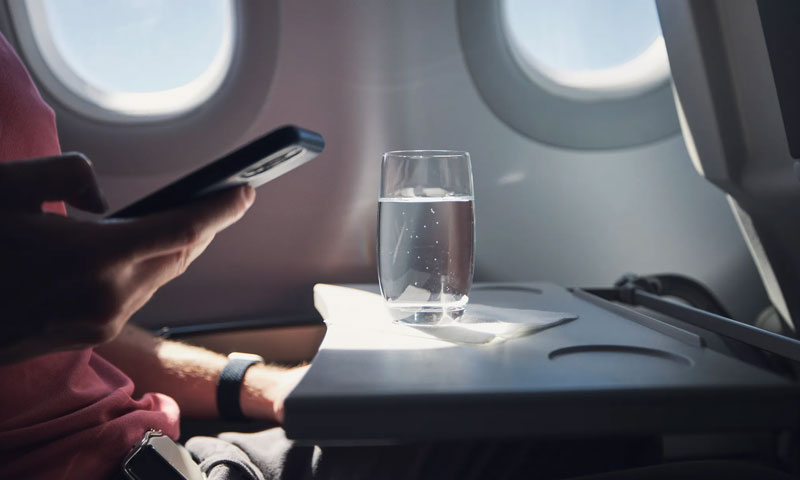
Think Twice Before Drinking Water on Flights, New Study Warns
Airline passengers may want to rethink what they drink on board. A new study has warned that water served on many flights could be potentially unhealthy, prompting researchers to advise travelers to stick to bottled water and avoid coffee or tea prepared using aircraft water systems. The findings come from the Center for Food as Medicine & Longevity, which analyzed more than 35,000 water samples collected from 10 major and 11 regional airlines over a three-year period. Based on the results, the nonprofit also recommends avoiding washing hands with airplane tap water and instead using hand sanitizer with at least 60% alcohol. While water quality may not rank high among passengers’ safety concerns, the organization described it as an important public health issue. Drinking contaminated aircraft water, it warned, can lead to gastrointestinal illness and potential exposure to harmful pathogens. What the study found The analysis showed that 2.7% of samples tested positive for total coliform bacteria, an indicator that disease-causing organisms may be present in the water system. More alarmingly, E. coli was detected 32 times across the 21 airlines reviewed. “Testing for coliform bacteria is critical because its presence suggests that pathogens could enter the drinking water supply,” the group said. In the United States, onboard water systems are regulated under the Environmental Protection Agency’s Aircraft Drinking Water Rule (ADWR), introduced in 2011. The rule requires airlines to regularly test water, flush and disinfect tanks multiple times a year, and monitor for contamination. However, the study noted that enforcement is inconsistent and penalties for violations are rarely imposed. Airlines respond Several airlines pushed back against the findings. American Airlines said it is reviewing the study but stressed that its potable water program complies fully with EPA rules and has passed recent audits without violations. JetBlue Airways said it follows EPA, FDA, and FAA standards and primarily serves bottled drinking water onboard.Spirit Airlines said it maintains a comprehensive testing and maintenance program and has improved procedures in recent years. Industry group Airlines for America said passenger and crew safety remains the sector’s top priority, adding that U.S. airlines follow federal guidelines to ensure onboard water safety. Major airlines ranked: best to worst The study scored airlines on a five-point scale, with points deducted for violations such as detecting contaminants in water samples. Delta Air Lines — 5.00 (Grade A) Frontier Airlines — 4.80 (Grade A) Alaska Airlines — 3.85 (Grade B) Allegiant Air — 3.65 (Grade B) Southwest Airlines — 3.30 (Grade C) Hawaiian Airlines — 3.15 (Grade C) United Airlines — 2.70 (Grade C) Spirit Airlines — 2.05 (Grade D) JetBlue Airways — 1.80 (Grade D) American Airlines — 1.75 (Grade D) Regional airlines ranked: best to worst GoJet Airlines — 3.85 (Grade B) Piedmont Airlines — 3.05 (Grade C) Sun Country Airlines — 3.00 (Grade C) Endeavor Air — 2.95 (Grade C) SkyWest Airlines — 2.40 (Grade D) Envoy Air — 2.30 (Grade D) PSA Airlines — 2.25 (Grade D) Air Wisconsin — 2.15 (Grade D) Republic Airways — 2.05 (Grade D) CommuteAir — 1.60 (Grade D) Mesa Airlines — 1.35 (Grade F) What passengers should do Until oversight improves, researchers advise travelers to avoid aircraft tap water entirely—including coffee and tea—and rely on sealed bottled beverages. For hygiene, alcohol-based hand sanitizer is considered safer than washing hands with onboard water. The study concludes that while many airlines meet basic regulatory requirements, stronger enforcement and greater transparency are needed to ensure that something as simple as a glass of water at 35,000 feet does not pose a health risk.
